Why You Must Demand a Written Estimate: 7 Powerful Rules to Stop Chimney Scams and Protect Your Home
Demanding a written estimate is the single most important action you can take to protect your home and wallet from chimney repair scams. When you notice a water leak around your fireplace or see crumbling bricks on your roof, you want the problem solved quickly. However, allowing a contractor to begin work based on a vague verbal promise is an invitation for financial disaster. Without a formal written estimate, you have zero legal protection against surprise upcharges, shoddy materials, or unfinished construction.
Many fraudulent handymen use verbal quotes as a deliberate bait-and-switch tactic. They promise a low cleaning fee over the phone, but once they dismantle your fireplace, they claim to discover “emergency” hazards that cost thousands of dollars to fix. A professional written estimate removes these deceptive tricks. It forces the contractor to document every material specification, labor charge, and warranty promise before you spend a single dollar.
According to consumer fraud reports published by the Better Business Bureau (BBB), home improvement scams and billing disputes rank among the top consumer complaints in the United States every year. Demanding an itemized proposal is the most effective way to separate honest craftsmen from opportunistic scammers.
This comprehensive guide reveals 7 powerful rules to evaluate your next written estimate like an expert. You will learn how to spot red flags, compare contractor proposals, and use Verified Chimney Pros to hire vetted professionals who operate with complete financial transparency.
Why Asking for a Written Estimate Is Your Strongest Shield Against Contractor Scams
When you ask for a written estimate, you immediately establish a professional boundary between yourself and the contractor. Honest chimney sweep and masonry companies are eager to provide written proposals because they take pride in their technical accuracy. They want you to understand the exact scope of the project so you feel confident in their recommendations.
A formal written estimate also serves as a crucial educational tool. Homeowners rarely understand the mechanical complexities of chimney liners, mortar crowns, or step flashing. When a contractor provides an itemized proposal, they explain how each repair component protects your home from chimney fires and moisture decay.
Furthermore, demanding a written estimate creates a permanent paper trail. If a dispute ever arises regarding the quality of a stainless steel liner or the color of replacement bricks, your signed document is the ultimate proof of what was agreed upon.
The Verbal Pricing Trap: How Unverified Handymen Exploit the Lack of a Written Estimate
The biggest problem in the home improvement industry is the verbal pricing trap. Unverified handymen and call-center dispatchers love to quote ballpark figures over the phone without inspecting your chimney. When you rely on a verbal promise instead of a written estimate, you give the contractor complete control over your final bill.
Shady operators use verbal quotes to execute classic bait-and-switch scams. They lure you in with a $49 chimney sweeping special. Once inside your living room, they claim your chimney liner is “shattered” or “about to collapse,” demanding $2,500 in immediate cash. Because you never received a written estimate, you cannot prove that the initial quote covered the full service.
Another major problem is material substitution. Without a written estimate specifying the exact grade of materials, unverified handymen often install cheap, non-code components. They may drop an undersized aluminum pipe down a wood-burning flue instead of a UL-listed stainless steel liner, creating a severe house fire hazard.
To protect your family from financial fraud and fire dangers, you must refuse to do business verbally. A detailed written estimate is the only way to hold contractors accountable for their pricing and craftsmanship.
Related reading: 7 Warning Signs You’re About to Hire a Chimney Scam
Why an Itemized Written Estimate Protects Your Home Equity and Legal Rights
Insisting on an itemized written estimate matters because your fireplace is an active combustion system burning inside your home. Proper chimney maintenance requires adherence to strict building codes and fire safety standards. An itemized proposal proves that the contractor understands those technical regulations.
According to consumer protection guidelines from the Federal Trade Commission (FTC), signed written contracts and estimates are the most effective way for consumers to defend their legal rights against fraudulent billing practices. A written estimate prevents contractors from adding unexpected surprise fees after the work is finished.
Fire safety compliance elevates this importance even further. The National Fire Protection Association (NFPA) mandates strict structural standards under NFPA 211 codes. When your written estimate details the installation of listed liners and proper mortar formulations, you ensure your home complies with national fire codes.
Finally, an itemized written estimate preserves your property equity. When you sell your home, buyers’ inspectors will scrutinize your chimney. Documented proposals and paid invoices from a Verified Chimney Pro prove that your repairs were completed professionally, preventing closing delays.
Related reading: Why Homeowners Choose a Verified Contractor Over Unverified Handymen
7 Powerful Rules to Evaluate Your Next Written Estimate Like an Expert
Follow these 7 powerful rules to evaluate contractor proposals, identify red flags, and ensure your next written estimate protects your home completely.
Rule 1: Never Authorize Work Without a Comprehensive Written Estimate Upfront
The golden rule of home improvement is simple: never allow a technician to touch your chimney without providing a comprehensive written estimate first. Whether you need a basic sweeping or a complete chimney rebuild, every job demands written documentation.
Unverified handymen often say, “Let us start tearing out the old brick, and we will figure out the price later.” This is a guaranteed setup for an overpriced bill. An honest contractor inspects the structure first and documents the full cost before starting.
When you demand a written estimate upfront, you eliminate ambiguity. You establish clear expectations for both pricing and project completion before any work begins on your property.
Rule 2: Demand Itemized Material Specifications on Every Written Estimate
A vague proposal that says “Repair chimney liner – $2,000” is not a professional written estimate. You must demand itemized material specifications that list the exact brand, grade, and dimensions of the materials being installed.
For liner replacements, the written estimate should specify whether the liner is 316-grade or 321-grade stainless steel, its exact diameter, and whether it includes UL-listed ceramic insulation. For masonry, it should specify the mortar type and waterproofing sealant.
Itemized specifications prevent contractors from secretly substituting cheap, substandard components. Knowing the exact materials on your written estimate allows you to compare quotes from multiple contractors fairly.
Related reading: What Is a Chimney Liner and Do You Need One?
Rule 3: Check for Documented Labor Charges and Clean-Up Responsibilities
A professional written estimate must separate material costs from labor charges. It should also explicitly define who is responsible for job site clean-up and debris disposal after the construction is finished.
Masonry repairs generate hundreds of pounds of old brick, mortar dust, and clay tile fragments. Shady contractors often leave this hazardous rubble in your yard, claiming that hauling away debris costs an extra fee.
When clean-up responsibilities are documented on your written estimate, you ensure your living room hearth, landscaping, and patio are left immaculate without paying surprise disposal upcharges.
Rule 4: Verify That General Liability Insurance Is Explicitly Stated on the Written Estimate
Never assume a contractor is insured simply because they drive a work van. A legitimate written estimate should explicitly state that the company carries active commercial general liability and workers’ compensation insurance.
If a technician falls off your roof or drops a heavy brick onto your neighbor’s car, an uninsured contractor leaves you legally and financially liable. Confirmed insurance protection creates a legal shield around your home.
You can request that the contractor attach an active Certificate of Insurance (COI) directly to your written estimate. This simple verification step separates professional contracting firms from high-risk handymen.
Rule 5: Look for Clear Project Timelines and Payment Milestone Schedules
An ethical written estimate must outline a realistic project timeline and define a clear payment milestone schedule. Never sign a proposal that demands 100% of the payment upfront in cash before work starts.
For standard chimney sweepings and minor repairs, payment is typically due upon project completion. For larger masonry restorations, a standard payment schedule requires a small deposit for materials, with the remaining balance due after completion.
Documenting payment milestones on your written estimate ensures you only pay for completed, inspected work. This rule protects you from contractors who take upfront deposits and abandon the job site.
Related reading: Chimney Maintenance Cost: 7 Devastating Ways Neglect Destroys Your Wallet
Rule 6: Demand Written Warranty Terms Before Signing Your Written Estimate
Verbal warranty promises are worthless if a repair fails three months later. Rule six requires that all workmanship guarantees and manufacturer warranties be explicitly written into your written estimate.
A reputable chimney contractor should provide at least a one-year workmanship warranty on masonry repairs, while stainless steel liners should carry transferable lifetime manufacturer warranties.
Having documented warranty terms on your written estimate gives you long-term financial security. If a mortar crown cracks or a cap blows off during a winter storm, your written document guarantees the contractor will fix it free of charge.
Related reading: What Is Tuckpointing? 7 Critical Warning Signs Mortar Is Failing
Rule 7: Walk Away Immediately If a Contractor Refuses to Provide a Written Estimate
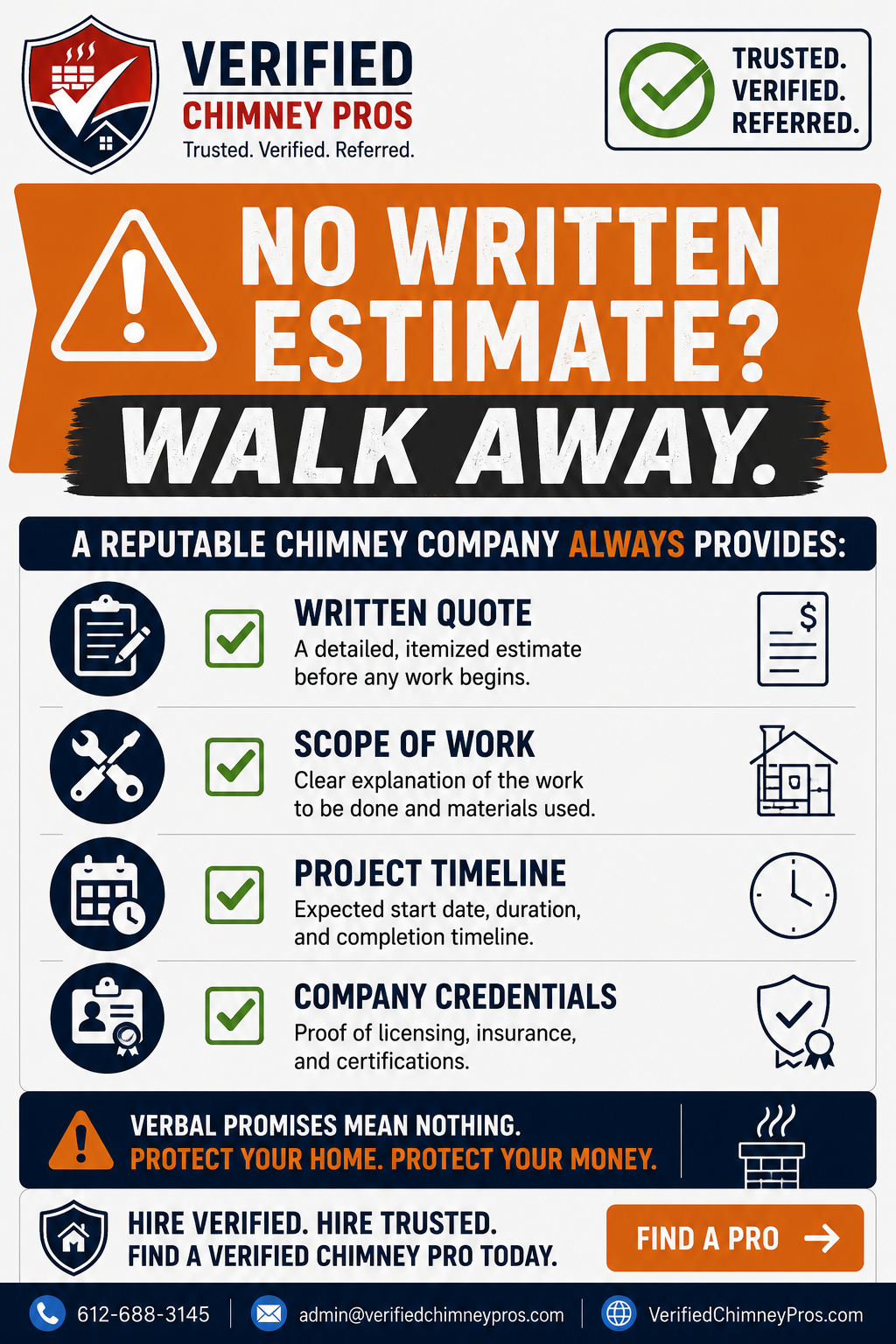
The most important rule in this guide is knowing when to walk away. If a contractor hesitates, makes excuses, or outright refuses to give you a written estimate, close your door immediately.
Scam artists rely on confusion and intimidation. They may claim that writing out an estimate takes too much time or that their verbal word should be good enough. This behavior is a massive red flag.
Walking away from a contractor who refuses to provide a written estimate is the smartest decision you can make. Always hold out for a verified professional who respects transparent business practices.
The Verified Chimney Pros Solution: Transparent Written Estimate Standards You Can Trust
Evaluating proposals and sifting through confusing technical quotes takes hours of stressful research. Verified Chimney Pros simplifies your hiring process by ensuring that every contractor in our directory operates with complete financial transparency.
We built our vetting shield to eliminate verbal pricing scams. Every professional in our nationwide network must pass rigorous third-party screening before earning our official verified trust badge.
Our screening team confirms active general liability and workers’ compensation insurance. We validate technical industry certifications, perform criminal background checks, and continuously monitor real customer reviews for ethical estimating practices.
When you hire a Verified Chimney Pro, you are guaranteed to receive a professional, itemized written estimate before any work begins. Our contractors explain their proposals clearly, show you camera proof of damage, and never use surprise upcharges.
7 Financial and Safety Rewards of Demanding a Professional Written Estimate
Insisting on an itemized written estimate from a Verified Chimney Pro delivers compounding benefits that protect your entire property:
1. Absolute price certainty. Itemized proposals lock in your project costs upfront, eliminating surprise upcharges and bait-and-switch billing schemes.
2. Verified material quality. Documented specifications guarantee the installation of UL-listed stainless steel liners and proper mortar formulations.
3. Total legal protection. Signed estimates act as legally binding contracts that safeguard your consumer rights if disputes arise.
4. Guaranteed clean-up accountability. Clear labor terms ensure your hearth, landscaping, and patio are left spotless without extra disposal fees.
5. Confirmed insurance shielding. Documented liability coverage protects your personal bank account from rooftop accident lawsuits.
6. Transferable resale value. Written warranty terms and paid invoices prove to home buyers that your fireplace was maintained professionally.
7. Ultimate peace of mind. You can light your fireplace on freezing winter nights knowing your repairs were completed to national fire codes.
Every homeowner who demands a written estimate reports the same result: stress-free communication, fair pricing, and total confidence in their fireplace safety.
FAQ
1. Why is a written estimate important when hiring a chimney contractor?
A written estimate locks in your project price, documents material specifications, outlines labor responsibilities, and provides legal protection against bait-and-switch scams and surprise upcharges.
2. What should be included on a professional chimney written estimate?
A professional written estimate should include itemized material brands, labor costs, project timelines, clean-up responsibilities, proof of insurance, and explicit warranty terms.
3. Should I ever accept a verbal quote for chimney repairs?
No. Never accept a verbal quote. Verbal promises offer zero legal protection and are commonly used by unverified handymen to execute expensive bait-and-switch scams.
4. How much should a standard chimney inspection written estimate cost?
A standard visual inspection and sweeping estimate typically costs between $150 and $300, while a Level 2 video camera scan estimate ranges between $200 and $400.
5. What is the difference between an estimate and a contract?
An estimate outlines expected costs and project scope. Once both you and the contractor sign an itemized written estimate, it becomes a legally binding contract.
6. Can a contractor charge more than the signed written estimate?
A contractor cannot charge more than the signed written estimate unless hidden structural damage is discovered and you sign a formal written change order approving the additional cost.
7. Why do unverified contractors refuse to give a written estimate?
Unverified contractors refuse to give a written estimate so they can inflate prices mid-job, install cheap non-code materials, and avoid legal accountability for shoddy work.
8. Should I pay for a chimney repair upfront in cash?
Never pay 100% upfront in cash. A reputable contractor’s written estimate will outline a fair payment schedule, usually requiring payment upon satisfactory job completion.
9. How do I know if the materials on my written estimate are safe?
Look for UL-listed specifications on your written estimate, such as 316-grade stainless steel for liners, which confirms compliance with national fire safety codes.
10. Can I use a written estimate to compare multiple chimney contractors?
Yes! Obtaining an itemized written estimate from three different Verified Chimney Pros allows you to compare labor rates, material quality, and warranty terms fairly.
11. What should I do if a contractor asks for cash without an estimate?
Close your door and walk away immediately. Operating without a written estimate and demanding cash is the number one red flag of a home improvement scammer.
12. Does a written estimate protect my home’s resale value?
Yes. Storing your signed written estimate and paid invoice proves to future buyers and real estate appraisers that your chimney was repaired professionally by a licensed firm.
13. Should my written estimate state who pulls the building permit?
Yes. For major masonry or structural rebuilds, your written estimate should explicitly state that the contractor is responsible for pulling all required municipal building permits.
14. How long is a typical chimney contractor’s written estimate valid?
Most professional chimney contractors state on their written estimate that the quoted pricing is valid for 30 days, protecting you against sudden material price spikes.
15. Where can I find a verified pro who provides a written estimate?
Visit Verified Chimney Pros to browse our nationwide directory of pre-screened, insured, and certified specialists who guarantee transparent estimating standards.
Stop Gambling With Verbal Quotes: Demand a Written Estimate Today
Your home is your most valuable asset, and your fireplace should bring warmth and comfort to your family—not financial anxiety. When chimney repairs arise, you cannot afford to gamble your hard-earned money on vague verbal promises from unverified handymen.
Demanding an itemized written estimate is your strongest shield against home improvement scams. By insisting on documented material specifications, clear labor charges, proof of insurance, and written warranties, you take total control of your hiring process.
You now have the 7 powerful rules to evaluate contractor proposals like an expert. Never authorize work without written paperwork, and never hesitate to walk away from contractors who refuse to operate transparently.
Stop guessing who to trust. Visit Verified Chimney Pros to connect with a pre-screened, certified professional near you who guarantees an honest, itemized written estimate on every single job.
Ready to Hire With Complete Financial Transparency?
Connect with a pre-screened, background-checked chimney professional in your area today.
📞 612-688-3145 | 📧 admin@verifiedchimneypros.com