DIY Chimney Cleaning: 7 Dangerous Reasons Every Homeowner Should Hire a Verified Professional Instead
DIY chimney cleaning seems like a straightforward way to save money on annual home maintenance — until you understand the serious risks, hidden dangers, and costly mistakes that homeowners make when they attempt chimney sweeping without professional training, specialized equipment, or safety certifications. Every year, thousands of homeowners across the United States climb onto their roofs with hardware store brushes, internet tutorials, and good intentions — and every year, emergency rooms, fire departments, and insurance adjusters document the preventable consequences.
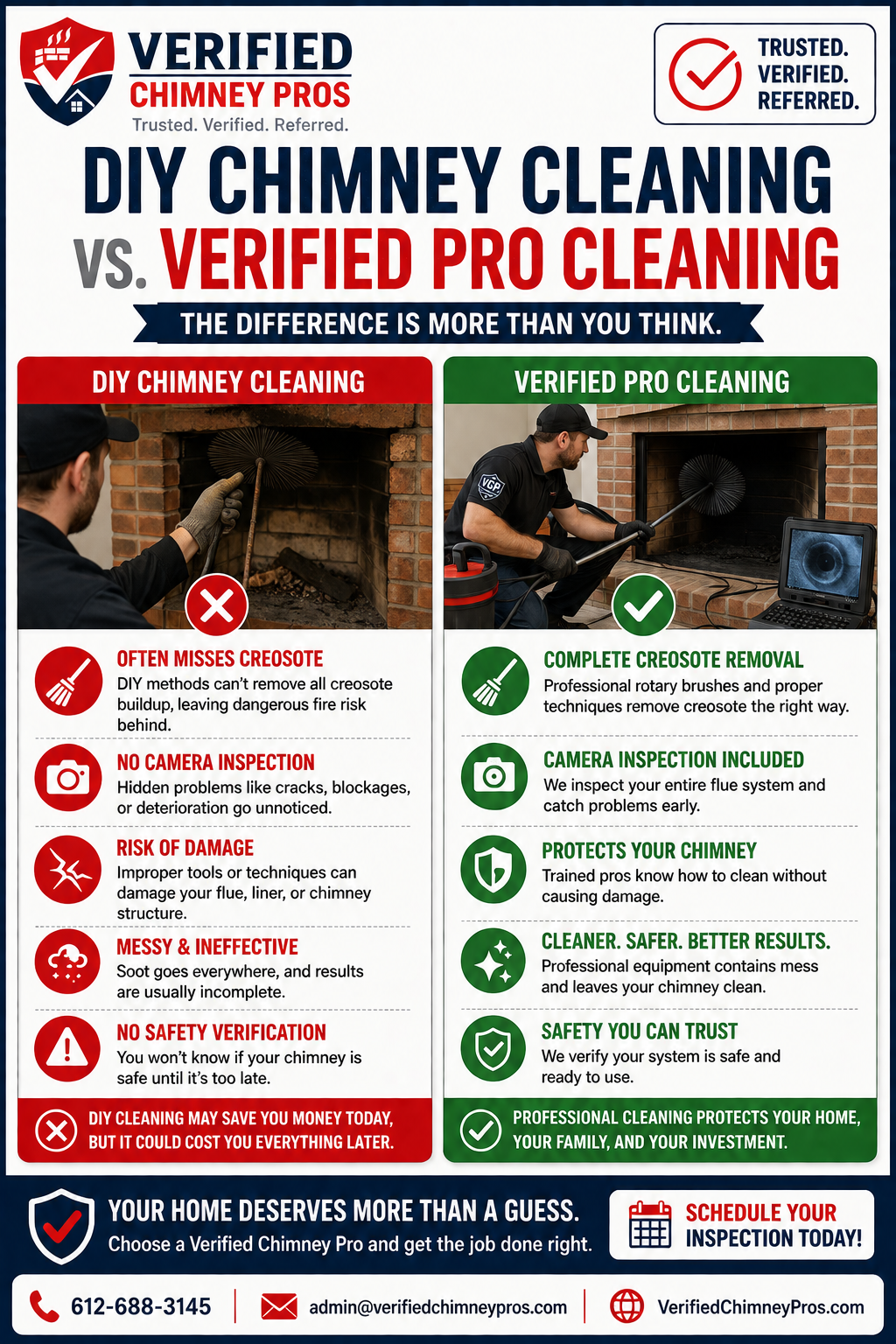
According to the National Fire Protection Association (NFPA), failure to clean chimneys is a leading contributing factor in residential structure fires caused by heating equipment. The Chimney Safety Institute of America (CSIA) reports that creosote — a highly flammable byproduct of wood combustion that accumulates inside chimney flues — ignites at temperatures as low as 451°F, creating explosive chimney fires that can destroy homes within minutes. Professional chimney sweeps are trained to identify, measure, and remove creosote safely. Homeowners attempting DIY chimney cleaning typically cannot detect creosote buildup accurately, brush it away completely, or recognize the warning signs of advanced Stage 3 glazed creosote that requires chemical treatment rather than mechanical brushing.
This guide explains exactly why DIY chimney cleaning is dangerous, what specialized tools and certifications professional chimney sweeps use to protect your home, and how Verified Chimney Pros connects homeowners with background-checked, insured, CSIA-certified chimney professionals who perform thorough, safe, code-compliant chimney cleaning that actually protects your family from fire hazards and carbon monoxide poisoning.
If you value your safety, your home’s structural integrity, and your family’s lives — keep reading. The risks of DIY chimney cleaning are far more serious than most homeowners realize.
Why Homeowners Are Tempted by DIY Chimney Cleaning — And Why It Always Backfires
Homeowners consider DIY chimney cleaning for understandable reasons: professional chimney sweeping services cost between $150 and $350 depending on location, chimney height, and creosote severity. Internet tutorials make chimney cleaning look simple — buy a brush kit, climb the roof, scrub the flue, vacuum the firebox, and you’re done. The appeal of saving $200 to $300 annually is compelling, especially for homeowners managing tight household budgets.
But DIY chimney cleaning tutorials omit critical information that professionals learn through certification training and years of field experience. They do not explain how to identify the three stages of creosote buildup, how to measure flue liner deterioration, how to inspect chimney crowns for water damage, or how to detect carbon monoxide leaks caused by blockages you cannot see from the firebox. They do not warn you that brushing Stage 3 glazed creosote incorrectly can dislodge chunks that block the flue entirely — creating immediate carbon monoxide hazards inside your home.
According to the U.S. Consumer Product Safety Commission (CPSC), an average of 430 deaths occur annually from accidental carbon monoxide poisoning — and residential heating equipment with improperly maintained chimneys is a leading source. Homeowners attempting DIY chimney cleaning without carbon monoxide detectors, inspection cameras, or flue blockage training create life-threatening hazards they never intended and cannot detect until symptoms appear.
The money you save on DIY chimney cleaning evaporates the moment you pay for emergency roof repairs, chimney fire restoration, or medical bills from carbon monoxide exposure. Professional chimney cleaning is not an expense — it is life-saving insurance.
Why DIY Chimney Cleaning Creates More Dangers Than It Prevents
Homeowners Cannot Detect Creosote Buildup Stages Without Professional Training
Creosote accumulation occurs in three progressive stages — and each stage requires different removal techniques, tools, and safety protocols. Stage 1 creosote appears as flaky, sooty deposits that brush away easily with standard chimney brushes. Stage 2 creosote forms shiny, tar-like flakes that require wire brushes and more aggressive scrubbing. Stage 3 creosote — the most dangerous form — hardens into a glossy, glaze-like coating that resists mechanical brushing entirely and requires chemical treatments or professional removal to eliminate safely.
Homeowners attempting DIY chimney cleaning cannot visually distinguish between Stage 2 and Stage 3 creosote without inspection cameras, flue lighting, and diagnostic training. They scrub what they can see from the firebox, assume the flue is clean, and resume using their fireplace — while Stage 3 creosote remains intact above the smoke shelf, waiting to ignite during the next high-temperature fire.
Professional chimney sweeps certified by the Chimney Safety Institute of America (CSIA) are trained to identify creosote stages visually and tactilely, measure buildup thickness with specialized gauges, and determine whether mechanical brushing is sufficient or whether chemical treatment is required. That diagnostic expertise is what separates effective chimney cleaning from dangerous DIY chimney cleaning that creates false confidence.
DIY Chimney Cleaning Causes Structural Damage Homeowners Never Intended
Chimney flues are lined with fragile clay tiles, stainless steel liners, or cast-in-place cement liners — and all three materials can be damaged permanently by aggressive brushing techniques that homeowners use when they encounter stubborn creosote buildup. Cracked flue tiles allow combustion gases to escape into the walls surrounding your chimney, creating hidden fire hazards and carbon monoxide leaks that you cannot detect without specialized inspection equipment.
Homeowners attempting DIY chimney cleaning frequently use oversized brushes, steel wire brushes on clay tile liners, or excessive force to remove creosote — cracking tiles, dislodging mortar joints, and creating flue gaps that professionals must repair at costs far exceeding the $200 you saved by avoiding professional service.
Professional chimney sweeps use calibrated brushes sized specifically for your flue dimensions, apply controlled pressure to avoid tile damage, and inspect liners with cameras before and after cleaning to confirm structural integrity. That precision protects your chimney’s long-term function and safety — something DIY chimney cleaning never achieves.
7 Dangerous Reasons You Should Never Attempt DIY Chimney Cleaning Yourself
These seven reasons explain exactly why DIY chimney cleaning is one of the most dangerous home maintenance tasks homeowners attempt — and why verified professionals exist specifically to protect you from these risks.
Dangerous Reason #1: You Cannot See What You’re Cleaning Without Professional Inspection Cameras
The most critical portion of chimney cleaning occurs inside the flue — the vertical shaft you cannot see from the firebox or the roof without specialized equipment. Homeowners attempting DIY chimney cleaning insert brushes blindly, scrub what they assume is the entire flue length, and declare the job complete without ever confirming that creosote was actually removed from the upper flue sections where fires most frequently ignite.
Professional chimney sweeps use inspection cameras with LED lighting to visually confirm creosote removal from every flue section, identify blockages caused by animal nests or debris, and document before-and-after flue conditions. That visual verification ensures the job was done completely — something DIY chimney cleaning never provides.
Dangerous Reason #2: You Don’t Have the Specialized Brushes, Rods, and Vacuums Professionals Use
DIY chimney cleaning kits sold at hardware stores include basic poly brushes and flexible rods — tools designed for light sooty deposits, not the tar-like Stage 2 creosote or glazed Stage 3 creosote that professional-grade wire brushes, rotary cleaning systems, and industrial HEPA vacuums are built to remove. Homeowners scrub with inadequate tools, assume the chimney is clean because visible soot disappeared from the firebox, and never realize that dangerous creosote remains intact higher in the flue.
Professional chimney sweeps carry calibrated brush kits for every flue size, rotary drill-powered cleaning tools for stubborn creosote, and industrial vacuums with HEPA filtration to capture carcinogenic soot particles safely. These tools cost thousands of dollars and require training to operate safely — investments homeowners attempting DIY chimney cleaning never make.
Dangerous Reason #3: DIY Chimney Cleaning Misses Carbon Monoxide Hazards You Cannot Detect
Blockages inside chimney flues — caused by animal nests, collapsed flue tiles, or dislodged creosote chunks — prevent combustion gases from venting properly, forcing carbon monoxide back into your home through the firebox. Carbon monoxide is colorless, odorless, and lethal — and homeowners attempting DIY chimney cleaning cannot detect blockages without draft testing equipment, smoke testing, or flue inspection cameras.
Professional chimney sweeps perform draft tests before and after cleaning to confirm that your chimney is venting properly. They use smoke pellets to identify draft reversal, inspect flues with cameras to locate blockages, and install carbon monoxide detectors near fireplaces when venting concerns exist. That safety verification prevents the silent, deadly hazard that DIY chimney cleaning creates when blockages go undetected.
Dangerous Reason #4: You Risk Serious Injury or Death From Roof Falls and Ladder Accidents
DIY chimney cleaning requires homeowners to climb steep roofs, lean over chimney openings, and maneuver heavy brush rods while maintaining balance on sloped surfaces. According to the Centers for Disease Control and Prevention (CDC), falls from roofs and ladders cause more than 500,000 injuries annually in the United States — and chimney-related falls are a significant contributor.
Professional chimney sweeps use commercial-grade roof safety harnesses, ladder stabilizers, and fall protection systems that meet Occupational Safety and Health Administration (OSHA) standards. They are trained in ladder safety, roof walking techniques, and emergency response protocols. Homeowners attempting DIY chimney cleaning rarely use any safety equipment beyond standard extension ladders — creating preventable fall risks that result in catastrophic injuries.
Dangerous Reason #5: DIY Chimney Cleaning Voids Your Homeowner’s Insurance Coverage
Many homeowner insurance policies require annual professional chimney inspections and cleaning as a condition of coverage for fire damage claims related to heating equipment. Homeowners who attempt DIY chimney cleaning instead of hiring CSIA-certified professionals may unknowingly void their insurance coverage — meaning a chimney fire caused by missed creosote buildup results in denied claims and total out-of-pocket restoration costs.
Professional chimney sweeps provide written documentation of cleaning services, inspection findings, and code compliance — evidence that insurance adjusters require when evaluating fire damage claims. Homeowners who perform DIY chimney cleaning have no verifiable documentation that cleaning occurred, no certification that the work met industry standards, and no protection when insurance companies deny claims based on maintenance neglect.
Dangerous Reason #6: You Cannot Identify Chimney Code Violations That Create Fire Hazards
Professional chimney sweeps are trained to identify code violations that homeowners cannot recognize: inadequate clearances between chimneys and combustible materials, missing chimney caps, deteriorated chimney crowns, damaged flashing, and improperly sized flue liners. These violations create fire hazards and carbon monoxide risks that DIY chimney cleaning never addresses because homeowners do not know what to inspect.
A chimney that appears clean after DIY chimney cleaning may still have a cracked crown allowing water infiltration, a missing damper allowing heat loss, or a liner gap allowing combustion gases to escape into wall cavities. Professional chimney sweeps inspect every component during cleaning — identifying hazards before they cause fires, structural damage, or carbon monoxide poisoning.
Dangerous Reason #7: DIY Chimney Cleaning Creates Environmental Hazards Inside Your Home
Chimney soot and creosote contain carcinogenic compounds — polycyclic aromatic hydrocarbons (PAHs) — that professional chimney sweeps contain and remove using industrial HEPA vacuums, protective sheeting, and negative air pressure systems. Homeowners attempting DIY chimney cleaning typically use household shop vacuums without HEPA filtration, allowing microscopic carcinogenic particles to circulate through HVAC systems and settle throughout the home.
Children, elderly family members, and individuals with respiratory conditions are particularly vulnerable to soot exposure. Professional chimney sweeps protect your indoor air quality by containing hazardous particles at the source — something DIY chimney cleaning never achieves because homeowners lack the equipment and training to do so.
What Professional Chimney Sweeps Use That Homeowners Attempting DIY Chimney Cleaning Don't Have
Professional chimney sweeps carry specialized equipment and certifications that homeowners attempting DIY chimney cleaning never possess:
| Professional Tool / Certification | Why Homeowners Don’t Have It | What It Protects Against |
|---|---|---|
| CSIA Certification | Requires 40+ hours of training, written exams, and field experience | Missed creosote stages, improper cleaning techniques, code violations |
| Inspection Cameras with LED Lighting | Cost $800–$3,000+ per unit | Invisible blockages, undetected creosote, structural damage |
| Calibrated Brush Kits for Every Flue Size | Require professional sizing and calibration | Flue tile damage, incomplete cleaning, liner cracks |
| Industrial HEPA Vacuums | Cost $500–$2,000+ per unit | Carcinogenic soot exposure, indoor air contamination |
| Rotary Cleaning Systems | Require specialized training and power tools | Stage 3 glazed creosote that resists manual brushing |
| Draft Testing Equipment | Requires technical training to interpret results | Carbon monoxide hazards, blocked flues, venting failures |
| Roof Safety Harnesses and Fall Protection | Meet OSHA commercial safety standards | Preventable falls, roof injuries, ladder accidents |
| Professional Liability Insurance | Costs $1,500–$5,000+ annually | Financial liability for accidental damage during service |
Homeowners attempting DIY chimney cleaning have none of these tools, none of this training, and none of this insurance protection — making every aspect of the job more dangerous, less effective, and more likely to cause costly damage.
How Verified Chimney Pros Ensures Your Chimney Cleaning Is Done Right Every Time
Verified Chimney Pros solves the most common problem homeowners face when hiring chimney professionals: distinguishing legitimate, certified, insured chimney sweeps from unverified contractors who lack training, insurance, or professional accountability. Every chimney professional listed on the platform has been reviewed for:
- Active state licensing where required by local jurisdiction
- Current general liability insurance with minimum coverage verified annually
- CSIA or National Fireplace Institute (NFI) certifications confirming professional training and competency
- Background checks to ensure no criminal history related to fraud, theft, or property damage
- Reputation reviews from real homeowners who have used their services
This verification process ensures that the chimney sweep you hire through Verified Chimney Pros arrives with the tools, training, and insurance protection that DIY chimney cleaning never provides. You receive written documentation of cleaning services, inspection findings, and code compliance — verifiable proof that your chimney was cleaned safely and thoroughly by a certified professional.
Homeowners who hire verified professionals avoid the seven dangerous risks of DIY chimney cleaning while gaining peace of mind that their chimney is actually safe to use. That protection is worth far more than the $200 you might save attempting the job yourself.
Powerful Benefits of Hiring a Verified Professional Instead of Attempting DIY Chimney Cleaning
Here is exactly what changes in your home safety and peace of mind when you hire a verified professional instead of attempting DIY chimney cleaning:
✅ Benefit #1: Your Chimney Is Actually Clean — Not Just Visibly Clean From the Firebox
Professional chimney sweeps use inspection cameras, calibrated brushes, and rotary cleaning systems to remove creosote from every flue section — not just the portions visible from the firebox. You receive before-and-after camera footage documenting complete creosote removal, structural integrity, and code compliance.
✅ Benefit #2: Hidden Hazards Are Identified Before They Cause Fires or Carbon Monoxide Poisoning
Professional chimney sweeps inspect chimney crowns, flashing, dampers, liners, and clearances during cleaning — identifying code violations, structural damage, and blockages that DIY chimney cleaning never detects. You receive a written report of findings with repair recommendations prioritized by safety urgency.
✅ Benefit #3: Your Homeowner’s Insurance Coverage Remains Valid
Professional chimney sweeps provide written documentation of cleaning services and inspection findings — verifiable proof that you maintained your chimney according to insurance policy requirements. Your fire damage coverage remains valid because you hired certified professionals instead of attempting DIY chimney cleaning.
✅ Benefit #4: Your Family Is Protected From Carcinogenic Soot Exposure
Professional chimney sweeps use industrial HEPA vacuums, protective sheeting, and negative air pressure systems to contain carcinogenic soot particles at the source — preventing indoor air contamination that DIY chimney cleaning creates when household vacuums circulate hazardous particles through HVAC systems.
✅ Benefit #5: You Avoid Preventable Roof Falls, Ladder Injuries, and Emergency Room Visits
Professional chimney sweeps use OSHA-compliant roof safety harnesses, commercial ladder stabilizers, and fall protection systems — eliminating the preventable fall risks that send thousands of homeowners attempting DIY chimney cleaning to emergency rooms every year.
Powerful Benefits of Hiring a Verified Professional Instead of Attempting DIY Chimney Cleaning
Use this checklist to evaluate whether you truly have the tools, training, and safety equipment required to attempt DIY chimney cleaning safely — or whether hiring a verified professional is the only responsible choice:
| ✅ Required Tool / Certification | Do You Actually Have It? | What Happens If You Don’t? |
|---|---|---|
| CSIA Certification or Equivalent Training | ☐ Yes ☐ No | You cannot identify creosote stages, structural damage, or code violations |
| Inspection Camera with LED Lighting | ☐ Yes ☐ No | You cannot verify that creosote was removed from upper flue sections |
| Calibrated Brush Kit for Your Specific Flue Size | ☐ Yes ☐ No | You risk cracking flue tiles or leaving dangerous creosote intact |
| Industrial HEPA Vacuum | ☐ Yes ☐ No | Carcinogenic soot circulates through your home’s HVAC system |
| Rotary Cleaning System for Stage 3 Creosote | ☐ Yes ☐ No | Glazed creosote remains intact and ignites during next high-temp fire |
| Draft Testing Equipment | ☐ Yes ☐ No | Carbon monoxide blockages go undetected and poison your family |
| OSHA-Compliant Roof Safety Harness | ☐ Yes ☐ No | You risk preventable falls, serious injuries, and emergency room visits |
| Professional Liability Insurance | ☐ Yes ☐ No | You pay out-of-pocket for any damage caused during cleaning |
| Written Documentation for Insurance Claims | ☐ Yes ☐ No | Your homeowner’s insurance denies fire damage claims |
If you checked “No” to any item on this checklist, you do not have the tools, training, or safety equipment required to perform DIY chimney cleaning safely. Hire a verified professional.
FAQ
1: Is DIY chimney cleaning safe if I follow online tutorials carefully?
No. Online tutorials for DIY chimney cleaning cannot teach you to identify the three stages of creosote buildup, measure flue liner deterioration, detect carbon monoxide blockages, or operate inspection cameras safely. Professional chimney sweeps receive 40+ hours of certification training covering hazards that tutorials never mention. Following tutorials carefully does not eliminate the risks — it just makes you confident while performing dangerous work incorrectly.
2: Can I save money by doing DIY chimney cleaning myself instead of hiring professionals?
Short-term, yes — you save $150–$350 per cleaning. Long-term, no — because DIY chimney cleaning causes costly problems professionals prevent: cracked flue tiles requiring $2,000–$7,000 liner replacements, chimney fires causing $10,000–$50,000+ restoration costs, voided insurance claims, and carbon monoxide poisoning requiring emergency medical treatment. The money you save evaporates the moment you pay for repairs professionals would have prevented.
3: What tools do I need to perform DIY chimney cleaning safely?
To perform DIY chimney cleaning safely, you need: CSIA certification or equivalent training, inspection cameras with LED lighting ($800–$3,000), calibrated brush kits for your specific flue size ($200–$500), industrial HEPA vacuums ($500–$2,000), rotary cleaning systems for Stage 3 creosote ($300–$1,200), draft testing equipment ($150–$600), OSHA-compliant roof safety harnesses ($200–$800), and professional liability insurance ($1,500–$5,000 annually). Total investment: $4,000–$13,000+ before you clean your first chimney. Hiring verified professionals costs $150–$350 per cleaning.
4: How do I know if my chimney has dangerous creosote buildup?
You cannot know without professional inspection. Creosote accumulates inside flues where homeowners cannot see without cameras. Stage 1 creosote looks like black soot. Stage 2 creosote forms shiny tar-like flakes. Stage 3 creosote hardens into glossy glaze that resists brushing. Homeowners attempting DIY chimney cleaning cannot visually distinguish stages without training — meaning you assume your chimney is clean while dangerous Stage 3 creosote remains intact above the smoke shelf.
5: Can DIY chimney cleaning cause chimney fires?
Yes — absolutely. DIY chimney cleaning causes chimney fires in two ways: (1) incomplete creosote removal leaves flammable deposits intact, and (2) aggressive brushing dislodges creosote chunks that block flues, creating backdraft conditions that ignite remaining creosote. Professional chimney sweeps remove creosote completely using calibrated tools and verify draft function with testing equipment. Homeowners attempting DIY chimney cleaning do neither — creating fire hazards they never intended.
6: Will my homeowner’s insurance cover damage if I perform DIY chimney cleaning?
Possibly not. Many homeowner insurance policies require annual professional chimney inspections and cleaning as a condition of coverage for fire damage claims. Homeowners who perform DIY chimney cleaning instead of hiring CSIA-certified professionals may void coverage — meaning fire damage caused by missed creosote results in denied claims and total out-of-pocket restoration costs. Professional chimney sweeps provide written documentation that insurance adjusters require. Homeowners performing DIY chimney cleaning have no verifiable proof that cleaning met industry standards.
7: How often should I clean my chimney if I use it regularly?
The National Fire Protection Association (NFPA) recommends annual chimney inspections and cleaning for all wood-burning fireplaces and stoves — regardless of how frequently you use them. Homeowners who burn wood daily may require cleaning twice per year if creosote accumulation is heavy. Gas fireplaces require annual inspections to check for blockages, carbon monoxide leaks, and venting issues. DIY chimney cleaning cannot replace professional annual inspections because homeowners lack the tools and training to perform comprehensive safety evaluations.
8: What happens if I damage my chimney while attempting DIY chimney cleaning?
You pay for repairs out-of-pocket — because homeowner’s insurance typically excludes coverage for damage caused by improper maintenance or DIY work. Cracked flue tiles cost $2,000–$7,000 to replace with stainless steel liners. Damaged chimney crowns cost $300–$1,200 to rebuild. Structural damage requiring partial chimney rebuilds costs $3,000–$15,000+. Professional chimney sweeps carry liability insurance covering accidental damage during service. Homeowners attempting DIY chimney cleaning have no insurance protection.
9: Can I use a shop vacuum to clean chimney soot instead of professional HEPA vacuums?
No. Chimney soot contains carcinogenic polycyclic aromatic hydrocarbons (PAHs) that pass through standard shop vacuum filters and circulate through your home’s HVAC system. Professional chimney sweeps use industrial HEPA vacuums with 99.97% filtration efficiency to capture microscopic carcinogenic particles safely. Homeowners attempting DIY chimney cleaning with household shop vacuums contaminate indoor air quality — creating long-term health risks for children, elderly family members, and individuals with respiratory conditions.
10: Are chimney cleaning logs an effective alternative to professional chimney sweeping?
No. Chimney cleaning logs reduce Stage 1 creosote accumulation slightly but cannot remove Stage 2 tar-like deposits or Stage 3 glazed creosote. They do not clean chimney caps, inspect flue liners, test draft function, or identify code violations. The Chimney Safety Institute of America (CSIA) states that chimney cleaning logs are not substitutes for professional chimney sweeping. Homeowners who rely on cleaning logs instead of professional service create the same fire hazards as those attempting DIY chimney cleaning — false confidence in incomplete maintenance.
11: How do professional chimney sweeps remove Stage 3 glazed creosote?
Professional chimney sweeps remove Stage 3 glazed creosote using rotary cleaning systems with carbide-tipped chains, chemical creosote removers that break down glazed deposits, or in severe cases, complete flue liner replacements. Homeowners attempting DIY chimney cleaning cannot identify Stage 3 creosote visually without cameras, cannot remove it mechanically with standard brushes, and risk dislodging chunks that block flues entirely. Professional removal requires specialized tools and training that DIY chimney cleaning never provides.
12: What safety equipment do professional chimney sweeps use that homeowners don’t have?
Professional chimney sweeps use OSHA-compliant roof safety harnesses, commercial ladder stabilizers with standoff arms, fall arrest systems rated for 5,000-pound loads, respiratory protection rated for carcinogenic particulates, and liability insurance covering accidental damage. Homeowners attempting DIY chimney cleaning typically use basic extension ladders without stabilizers, no fall protection, no respiratory protection, and no liability insurance — creating preventable fall risks, soot exposure, and financial liability.
13: Can I inspect my chimney myself before deciding whether to hire professionals?
You can visually inspect what is visible from the firebox and roof — but you cannot inspect flue interiors, liner condition, or draft function without inspection cameras, lighting equipment, and draft testing tools. Homeowners who inspect chimneys themselves frequently miss critical hazards: cracked flue tiles hidden above the smoke shelf, animal nests blocking upper flue sections, and carbon monoxide leaks caused by mortar deterioration. Professional chimney sweeps perform Level 1, Level 2, or Level 3 inspections (per NFPA 211 standards) using specialized equipment that homeowners attempting DIY chimney cleaning never possess.
14: What certifications should I look for when hiring professional chimney sweeps?
Look for CSIA (Chimney Safety Institute of America) Certified Chimney Sweep (CCS) designation — the most widely recognized and respected chimney sweep certification in the United States. CSIA-certified sweeps complete comprehensive training covering creosote identification, structural inspection, code compliance, and safety protocols. Additional certifications include NFI (National Fireplace Institute) credentials and NCSG (National Chimney Sweep Guild) membership. All verified professionals on Verified Chimney Pros hold active certifications, current insurance, and verified backgrounds.
15: How do I find a verified chimney professional instead of attempting DIY chimney cleaning?
Visit Verified Chimney Pros and search by your ZIP code or city. Every professional listed has been reviewed for active state licensing, current general liability insurance, CSIA or NFI certifications, and background checks. You receive verified credentials, real homeowner reviews, and written documentation of cleaning services — everything DIY chimney cleaning never provides. For questions, contact the platform at 📞 612-688-3145 or 📧 admin@verifiedchimneypros.com.
Stop Risking Your Safety With DIY Chimney Cleaning — Hire a Verified Professional Today
You have read the evidence. You understand the seven dangerous reasons why DIY chimney cleaning is one of the most hazardous home maintenance tasks homeowners attempt. You know that professional chimney sweeps use specialized tools, training, and certifications that eliminate the risks homeowners face when they climb roofs with hardware store brushes and internet tutorials.
The question is no longer whether DIY chimney cleaning is safe — it is demonstrably dangerous. The question is whether you value your family’s safety, your home’s structural integrity, and your financial protection enough to hire verified professionals who will protect you from risks you cannot see, cannot detect, and cannot prevent without their expertise.
Verified Chimney Pros connects you with background-checked, insured, CSIA-certified chimney sweeps who perform thorough, safe, code-compliant chimney cleaning that actually protects your home from fire hazards and carbon monoxide poisoning. You receive written documentation of cleaning services, inspection findings, and code compliance — verifiable proof that your chimney was cleaned safely and thoroughly by certified professionals.
Stop risking your safety with DIY chimney cleaning. Hire a verified professional who will do the job right.
👉 Find a Verified Chimney Pro Near You and schedule professional chimney cleaning today.
📞 Questions? Call us at 612-688-3145
📧 Email: admin@verifiedchimneypros.com
Your family deserves protection. Your home deserves safety. Your chimney deserves professional care. Stop attempting DIY chimney cleaning — and start protecting what matters most.