How to Explain Chimney Inspection Levels: 7 Powerful Ways Chimney Pros Educate and Upsell
Understanding chimney inspection levels is the dividing line between an average chimney sweep and an elite diagnostic authority. When homeowners call your office to book an annual cleaning, they almost never know what level of inspection they need. Most property owners assume all chimney checks are identical visual sweeps. This knowledge gap is your single greatest opportunity to educate your client, demonstrate your technical expertise, and ethically upsell your services.
When you explain the National Fire Protection Association (NFPA) 211 standards governing chimney inspection levels, you transform from an interchangeable handyman into a trusted home safety advisor. Homeowners learn that a basic Level 1 visual check is only for routine maintenance, whereas a Level 2 video camera scan is legally mandated for property transfers and after severe weather events. Educating clients on these codes builds immediate hiring confidence.
According to sales data published by Harvard Business Review, businesses that use transparent customer education to explain product tiers achieve up to 35% higher average order values and significantly stronger customer retention. Mastering how to prescribe the correct inspection level doubles your diagnostic revenue while protecting homeowners from fires.
This comprehensive guide reveals 7 powerful ways to explain chimney inspection levels to homeowners. You will learn the technical boundaries of Level 1, 2, and 3 evaluations, discover word-for-word upselling scripts, and see how Verified Chimney Pros amplifies your diagnostic authority.
Why Mastering Chimney Inspection Levels Is Your Smartest Sales Strategy
When you master how to explain chimney inspection levels, you eliminate price resistance and elevate your average service ticket. Homeowners often push back against higher inspection fees because they do not understand what they are paying for. Breaking down the difference between a flashlight check and a digital video scan makes your pricing logical and fair.
Teaching chimney inspection levels also establishes instant professional authority. When you reference NFPA 211 codes and explain the thermodynamic risks of hidden clay tile cracks, homeowners realize they are talking to an expert. That authority makes closing subsequent liner and masonry repairs effortless.
Furthermore, explaining chimney inspection levels protects your business from liability. If a customer declines a Level 2 camera scan, documenting that they chose a basic Level 1 check shields your company if hidden internal flue defects cause a problem later.
The Guesswork Trap: Why Untracked Visual Checks Leave Contractors Vulnerable
The biggest problem in the chimney sweeping industry is the guesswork trap caused by unverified handymen. Unlicensed operators advertise cheap $49 “whole-house inspections,” perform a quick two-minute flashlight check from the hearth, and tell the homeowner their fireplace is safe. This superficial check ignores NFPA 211 chimney inspection levels entirely.
When contractors fail to educate homeowners on proper chimney inspection levels, two dangerous scenarios occur. First, hidden hazards—such as cracked clay liners or carbon monoxide leaks behind the smoke chamber—go undetected during basic Level 1 visual checks. When a house fire occurs, the homeowner blames the contractor who said the chimney was safe.
Second, unverified handymen use vague inspection terms to execute bait-and-switch scams. They claim to perform a full inspection, dismantle the fireplace, and invent non-existent structural hazards to demand thousands in immediate cash. Because the homeowner never understood inspection boundaries, they feel helpless.
To protect your business and dominate your local market, you must educate clients on official chimney inspection levels. Clear diagnostic tiers prove your honesty and separate your contracting brand from deceptive call-center operators.
Related reading: 7 Warning Signs You’re About to Hire a Chimney Scam
Why It Matters: How Prescribing the Right Inspection Level Protects Your Liability
Adhering to official chimney inspection levels matters because your fireplace diagnostic work carries massive legal and financial responsibility. A chimney must safely contain 2,000-degree fire and exhaust lethal carbon monoxide gases. Overlooking a structural defect during an evaluation can lead to catastrophic house fires.
According to safety standards published by the National Fire Protection Association (NFPA), NFPA 211 codes define strict boundaries for Level 1, Level 2, and Level 3 chimney inspection levels. Following these national standards ensures that your technicians perform the exact diagnostic scope required by law.
Legal liability shielding makes this precision even more critical. According to legal guidelines from the Better Business Bureau (BBB), transparent scope-of-work documentation protects service businesses from customer disputes. When you specify chimney inspection levels on your contracts, you define your legal responsibility clearly.
Finally, mastering chimney inspection levels drives high-margin repair revenue. When a Level 2 camera inspection reveals a fractured flue liner, the homeowner sees objective video proof. That visual evidence converts a $250 inspection into a $3,500 stainless steel liner upgrade immediately.
Related reading: Why You Must Demand a Written Estimate: 7 Powerful Rules to Stop Scams
7 Powerful Ways to Explain Chimney Inspection Levels and Win High-Margin Upsells
Follow these 7 actionable strategies and communication scripts to explain chimney inspection levels, educate homeowners, and double your diagnostic revenue.
1. Frame Level 1 as the Basic Annual Maintenance Standard
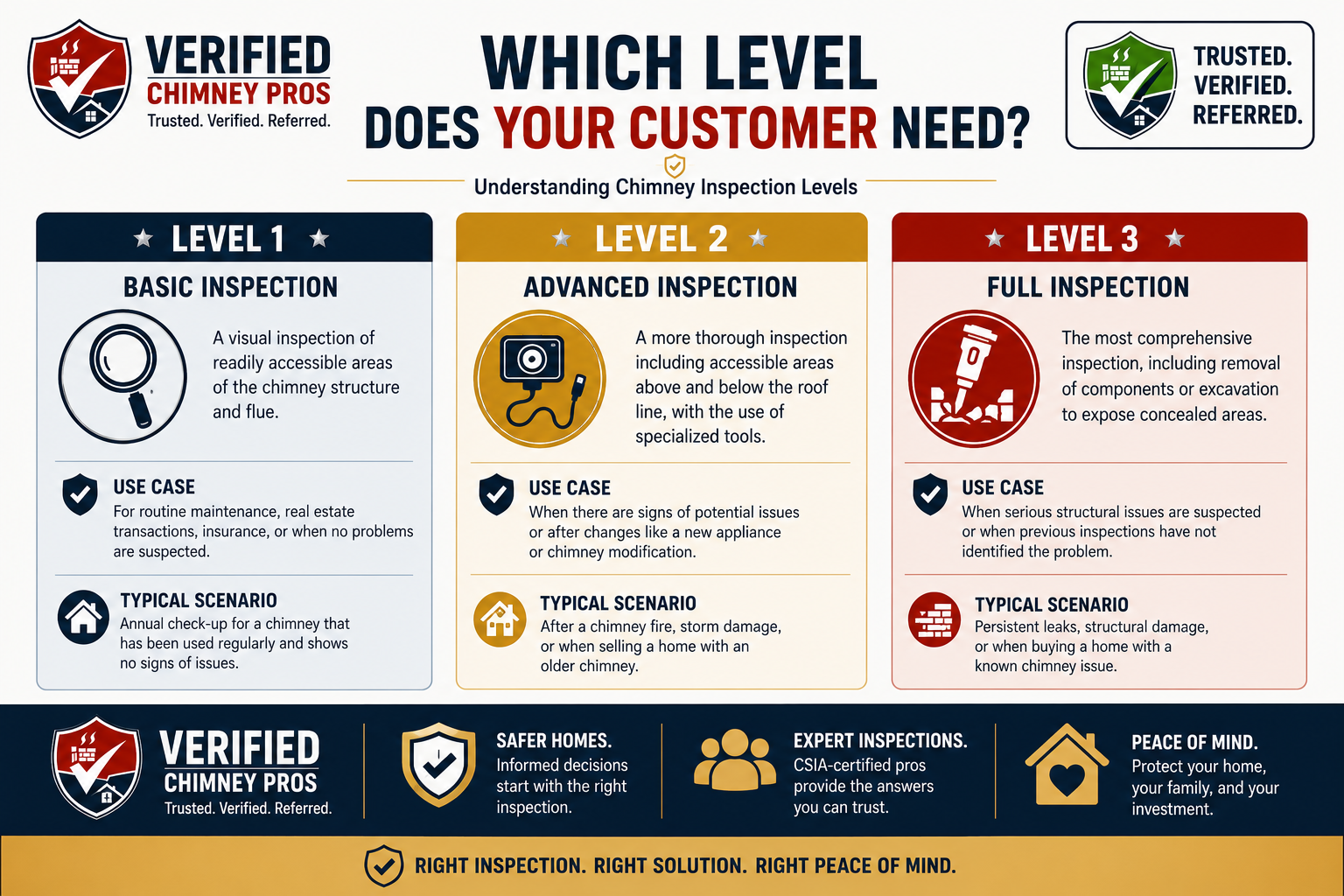
When explaining chimney inspection levels, frame Level 1 as the baseline annual maintenance standard. Explain to homeowners that a Level 1 check is designed for fireplaces that have operated normally without any changes to the appliance or venting system.
Explain that during a Level 1 check, your technician examines all readily accessible exterior and interior portions of the chimney using a flashlight. You verify that the flue is free of bird nests, creosote blockages, and obvious structural damage.
Positioning Level 1 as a routine checkup helps homeowners understand its limitations. They realize that while Level 1 is great for annual maintenance, it cannot see hidden hazards deep inside the flue stack.
2. Position Level 2 as the Mandatory Real Estate and Weather Safety Standard
Level 2 is your most profitable service among all chimney inspection levels. Position Level 2 as the mandatory standard required under NFPA 211 codes whenever a property is sold, an appliance is replaced, or a chimney experiences a severe weather event like a chimney fire, lightning strike, or hurricane.
Explain that a Level 2 check includes everything in Level 1, plus a complete 360-degree digital video camera scan of the entire internal flue liner. Your technician also inspects accessible attics, crawl spaces, and basements.
Homeowners buying new homes or recovering from winter storms eagerly upgrade to Level 2 when they understand it is required by national fire codes to guarantee home safety.
3. Explain Level 3 as the Emergency Structural Forensic Investigation
Level 3 is the most intensive of all chimney inspection levels. Explain to homeowners that Level 3 is a structural forensic investigation prescribed only when serious, hidden hazards are suspected during a Level 1 or Level 2 evaluation.
Explain that a Level 3 check includes everything in Levels 1 and 2, but requires the removal of building components—such as interior drywall, masonry crown bricks, or chimney siding—to access hidden structural defects.
Educating clients on Level 3 proves your diagnostic depth. While rarely needed, explaining this tier shows homeowners that you possess the advanced engineering knowledge required to handle major structural collapses.
Related reading: Winter Chimney Damage: 7 Critical Signs Cold Weather Destroys Your Chimney
4. Use Live 360-Degree Camera Footage to Prove Why Level 2 Upgrades Matter
Visual proof is your strongest upselling tool across all chimney inspection levels. When performing a Level 1 check, show the homeowner why upgrading to a Level 2 camera scan is a smart financial investment.
Show the customer sample video footage on your tablet. Display a flue that looked perfectly clean from the fireplace hearth, but revealed a massive clay tile crack twenty feet up when scanned with a 360-degree camera.
According to educational research from the Chimney Safety Institute of America (CSIA), video camera evaluations detect hidden carbon monoxide leaks that visual checks miss. Visual evidence makes upgrading to Level 2 irresistible.
Related reading: Before and After Chimney Photos: 8 Proven Ways to Close More Jobs
5. Deploy the “Safety Code Script” During Phone Intake to Upsell Upfront
Train your office staff to explain chimney inspection levels during the initial phone intake. Using a structured script allows you to upsell Level 2 camera inspections before your technician even dispatches.
Phone Script: “Mr. Davis, we offer two NFPA inspection levels. Level 1 is a basic visual check for annual maintenance. However, if you’ve recently bought the home or experienced any draft issues, NFPA codes require our Level 2 digital camera inspection to scan the internal flue for hidden fire hazards. Which level would you prefer our technician perform?”
Presenting both tiers transparently positions your company as a knowledgeable authority, prompting 50% of callers to choose the higher-margin Level 2 scan immediately.
6. Educate Real Estate Agents on NFPA 211 Transfer Codes for Exclusive Leads
Real estate brokerages are the single best source of Level 2 inspection leads. Build local authority by hosting 30-minute office presentations for realtors on NFPA 211 chimney inspection levels.
Explain to real estate agents that NFPA codes mandate a Level 2 camera inspection prior to any transfer of property title. Show them how unlined chimneys or cracked flues can delay closing dates if not caught early.
When you educate fifty realtors on chimney inspection levels, you become their go-to diagnostic expert, generating dozens of exclusive Level 2 inspection referrals every single month during peak buying season.
Related reading: Build Local Authority: 7 Powerful Ways Chimney Pros Dominate
7. Document Inspection Level Boundaries on Your Itemized Estimates
The final rule in mastering chimney inspection levels is documenting diagnostic boundaries on your itemized written estimates and invoices. Always state explicitly which inspection level was performed.
If a homeowner declines a Level 2 camera scan and chooses Level 1, write on the invoice: “Customer selected Level 1 visual inspection only; Level 2 internal camera scan declined by homeowner.” Have the client initial the note.
This documentation protects your liability completely. Furthermore, it reminds the homeowner of the limitations of their check, encouraging them to book a comprehensive Level 2 evaluation next heating season.
Related reading: Why Homeowners Choose a Verified Contractor Over Unverified Handymen
The Verified Chimney Pros Solution: Backing Your Diagnostics With Vetted Trust
Explaining chimney inspection levels is dramatically easier when your contracting brand is backed by independent third-party verification. Homeowners ignore technical explanations from unverified handymen because they suspect a sales pitch. Verified Chimney Pros provides the trust shield that validates your diagnostic authority.
When you apply to become a Verified Chimney Pro, our vetting team confirms your commercial general liability insurance, checks criminal backgrounds, validates technical certifications, and monitors customer reviews.
Displaying the VCP trust badge across your website, estimates, and inspection reports signals to homeowners that you operate with complete transparency. It proves that your recommendation of a Level 2 or Level 3 check is based on safety codes, not upselling greed.
Verified Chimney Pros provides the credibility that gets your recommendations approved. Your commitment to thorough diagnostics, NFPA compliance, and homeowner education is how you turn inspection leads into high-margin restorations.
7 Compounding Rewards of Mastering NFPA 211 Inspection Levels
Mastering how to prescribe and explain chimney inspection levels delivers compounding rewards that elevate your entire contracting business:
1. Doubled diagnostic revenue. Upselling Level 1 checks to Level 2 camera inspections immediately increases your average inspection ticket by 50% to 100%.
2. High-margin repair conversions. Video camera scans reveal hidden liner cracks and spalling bricks, converting inspections into $3,500+ restorations.
3. Total legal liability protection. Documenting NFPA 211 chimney inspection levels on contracts shields your company from structural failure disputes.
4. Exclusive real estate lead flow. Educating realtors on mandatory Level 2 property transfer codes creates a year-round referral pipeline.
5. Superior scam differentiation. Prescribing official NFPA tiers separates your business from unverified handymen selling fake $49 coupons.
6. Higher customer retention. Transparent education builds intense brand loyalty, ensuring homeowners book their annual evaluations with you for life.
7. Compounding brand authority. Being recognized as the regional authority on chimney inspection levels commands maximum long-term business valuation.
Contractors who systematically educate clients on chimney inspection levels consistently run more profitable, respected, and stress-free home service enterprises.
FAQ
1. What are the three official chimney inspection levels?
The three official chimney inspection levels defined by NFPA 211 codes are Level 1 (basic visual annual maintenance), Level 2 (video camera scan for property transfers/events), and Level 3 (structural forensic investigation).
2. Why do homeowners need to understand chimney inspection levels?
Understanding chimney inspection levels prevents homeowners from assuming a basic visual check covers hidden internal hazards, protecting them from carbon monoxide leaks and contractor scams.
3. How do I upsell a Level 1 inspection to a Level 2 video scan?
You upsell by explaining that NFPA codes require Level 2 scans for home sales or draft issues, and by showing sample 360-degree camera footage revealing hidden clay tile cracks.
4. When is a Level 2 chimney inspection legally required?
Under NFPA 211 chimney inspection levels, a Level 2 scan is required upon sale or transfer of property, after an operating malfunction, or after a severe weather event like a chimney fire.
5. What happens during a Level 3 chimney inspection?
A Level 3 check includes Levels 1 and 2, plus the removal of building components—such as interior drywall or chimney masonry—to investigate suspected structural damage.
6. How much more should I charge for a Level 2 inspection over Level 1?
Contractors typically charge between $150 and $250 for a Level 1 check, and between $250 and $450 for a comprehensive Level 2 video camera evaluation.
7. How does the VCP verification badge help me sell Level 2 inspections?
The VCP badge proves that your certifications and insurance are independently vetted, reassuring homeowners that your recommendation of higher chimney inspection levels is ethical.
8. Should my office staff explain chimney inspection levels on the phone?
Yes! Training office staff to explain chimney inspection levels during phone intake allows you to prescribe and upsell Level 2 camera scans before technicians dispatch.
9. How do chimney inspection levels protect my contracting liability?
Documenting which of the chimney inspection levels was performed—and noting if a homeowner declined a Level 2 scan—creates a legal paper trail that shields you from future defect lawsuits.
10. Can an unverified handyman perform a valid Level 2 inspection?
No. Unverified handymen rarely invest in 360-degree digital inspection cameras or hold the technical CSIA certifications required to perform valid Level 2 chimney inspection levels.
11. How do Level 2 camera inspections generate high-margin repair leads?
Level 2 cameras record objective video footage of cracked flue liners and eroded mortar, giving homeowners visual proof that justifies $3,500+ stainless steel liner upgrades.
12. Why are real estate agents a great source for Level 2 inspections?
Real estate agents need certified Level 2 chimney inspection levels to satisfy home buyer inspection contingencies and ensure fireplaces meet national safety codes before closing.
13. How long does it take to perform Level 1 vs. Level 2 inspections?
A Level 1 check takes roughly 30 to 45 minutes, while adding a Level 2 digital camera scan increases total appointment time by only 15 to 20 minutes.
14. Should I include photos in my written reports across all levels?
Yes. Adding digital photos and video stills to reports across all chimney inspection levels reinforces your professionalism and makes your repair estimates undeniable.
15. Where can I apply to get verified and attract educated homeowners?
Visit Verified Chimney Pros to submit your application for independent vetting, claim your trust badge, and start upselling diagnostics today.
Stop Leaving Money Behind: Master Inspection Tiers Today
You do not have to leave thousands of dollars in diagnostic and repair revenue on the table simply because homeowners do not understand chimney inspection levels. When you take the time to educate your clients on NFPA 211 codes, you transform from an average sweep into a trusted diagnostic authority.
Homeowners want to hire knowledgeable professionals who protect their families. By framing Level 1 as annual maintenance, prescribing Level 2 for real estate and safety events, showing live camera footage, and documenting inspection boundaries, you build an unstoppable contracting business.
Start today. Audit your phone intake scripts, equip your technicians with digital video cameras, and train your team on how to explain NFPA 211 chimney inspection levels clearly.
Stop performing untracked visual checks. Apply for verification, display your VCP trust badge, educate your customers on official chimney inspection levels, and watch your average service ticket double this season.
Ready to Anchor Your Diagnostic Authority With Verified Trust?
Apply for verification today and win high-margin Level 2 inspection leads from educated homeowners.
📞 612-688-3145 | 📧 admin@verifiedchimneypros.com