Chimney Creosote: 5 Alarming Dangers Every Homeowner Must Know Before Lighting Another Fire
Chimney creosote is quietly building up inside millions of American homes right now — and most homeowners have no idea it’s there. It doesn’t announce itself. It doesn’t trigger a smoke alarm. It doesn’t show up on your utility bill. It simply accumulates, layer by layer, inside your chimney flue every time you burn wood in your fireplace. And when conditions are right, it ignites — violently, rapidly, and with devastating consequences.
Creosote is the single leading cause of chimney fires in the United States. The Chimney Safety Institute of America (CSIA) identifies creosote buildup as the primary factor in the majority of residential chimney fires reported each year. Yet despite how common and preventable this danger is, a shocking number of homeowners skip annual chimney sweeping — often because they simply don’t understand the threat sitting inside their walls.
This guide changes that. You’ll learn exactly what chimney creosote is, how it forms, what its three stages mean for your home’s safety, and — most importantly — what you need to do right now to eliminate it before it eliminates your home. Find a verified chimney professional at Verified Chimney Pros and protect your family before the next fire season begins.
Why Chimney Creosote Is Far More Dangerous Than Most Homeowners Ever Suspect
The danger of chimney creosote is not theoretical — it is a documented, well-established fire risk that kills people and destroys homes every year. The U.S. Fire Administration (USFA) consistently identifies heating fires — the category that includes chimney fires caused by creosote — as one of the leading causes of residential structure fires in the United States. These fires cause deaths, injuries, and hundreds of millions of dollars in property damage annually.
What makes chimney creosote especially dangerous is its flammability. Creosote has an ignition temperature as low as 451°F. Normal chimney flue temperatures during a fire can easily reach 1,000°F or higher. When a sufficient layer of creosote is present, all it takes is one hot fire — or one ember floating up the flue — to ignite the deposits. A creosote chimney fire can reach temperatures exceeding 2,000°F inside the flue. That’s hot enough to crack the liner, damage surrounding masonry, and ignite the structural wood framing of your home.
Perhaps most alarming: many chimney fires go completely undetected. Homeowners don’t always hear a roar or see flames. A slow-burning creosote fire can smolder inside your flue for hours without triggering a smoke detector — while silently damaging your chimney structure and putting your home at risk of a larger, secondary fire weeks later. This is precisely why professional inspection and chimney creosote removal is not optional — it is a genuine home safety imperative.
The 3 Deadly Stages of Chimney Creosote Buildup You Need to Understand
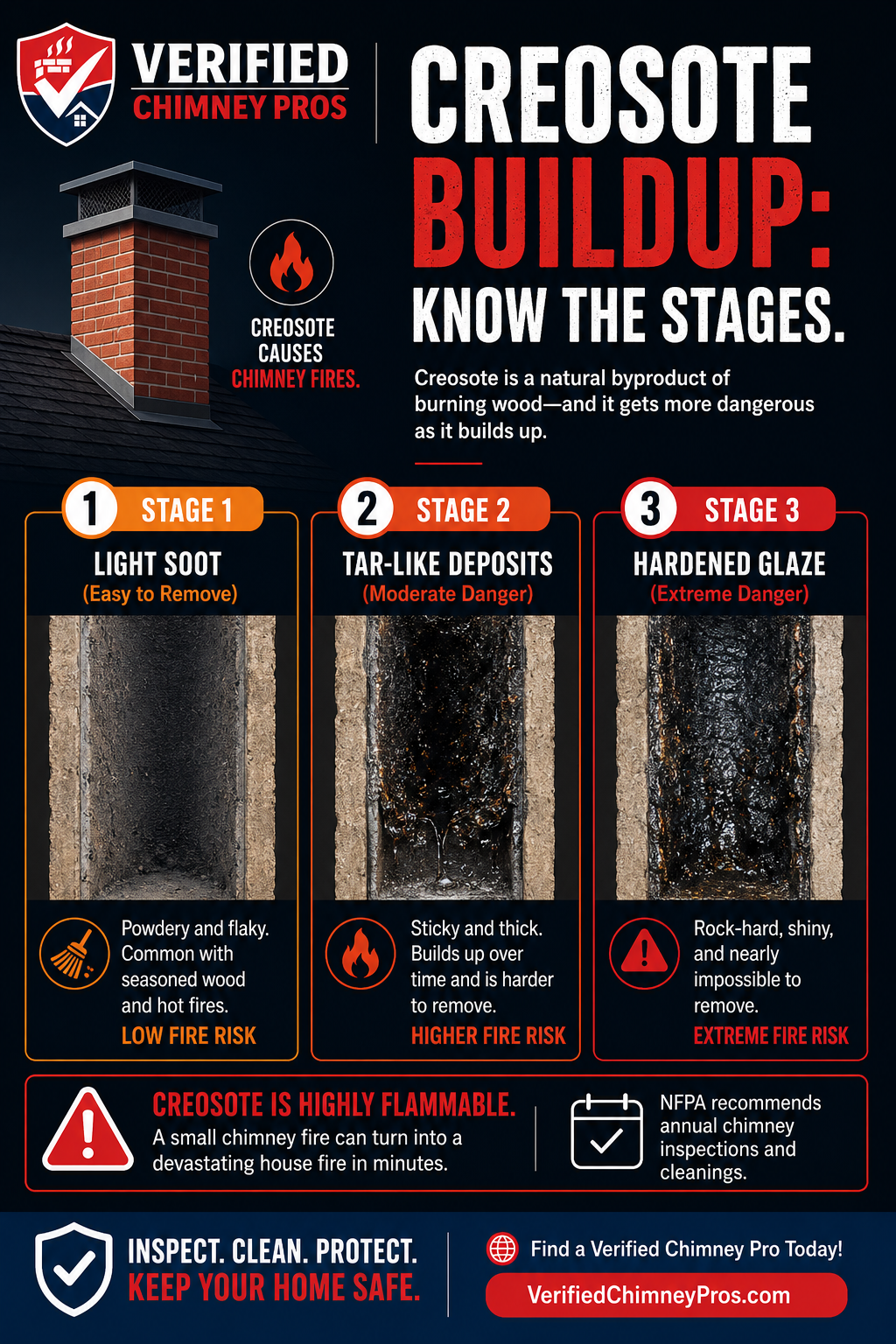
Not all chimney creosote is the same. The CSIA categorizes creosote accumulation into three distinct stages — each progressively more dangerous and more difficult to remove. Understanding these stages helps you grasp why professional cleaning is essential and why waiting until you notice a problem is waiting too long.
Stage 1 creosote is the least dangerous form — but it’s still a hazard. It appears as a fine, flaky, sooty deposit on the interior flue walls. It’s relatively easy to brush away with professional chimney sweeping equipment. Homeowners who schedule annual chimney cleanings will typically encounter only Stage 1 buildup — which is exactly why annual sweeping is so effective at keeping creosote from progressing to more dangerous forms.
The mistake many homeowners make is assuming that Stage 1 chimney creosote isn’t serious enough to warrant a professional cleaning. It absolutely is. Stage 1 deposits are the foundation that becomes Stage 2 if ignored. One season of missed cleaning can allow Stage 1 creosote to progress — especially in a frequently used fireplace.
Stage 2 creosote is significantly more problematic. It appears as a harder, tar-like substance — often shiny and black — that adheres stubbornly to flue liner walls. Standard chimney brushes cannot remove Stage 2 deposits effectively. Professional removal requires specialized rotary tools and chemical treatments that only certified chimney sweep technicians are equipped to use.
Stage 2 chimney creosote is substantially more flammable than Stage 1 deposits. If ignited, it burns hotter and longer — dramatically increasing the risk of structural damage to your chimney and home. Homeowners who have skipped one or two annual cleanings are at high risk of Stage 2 accumulation, particularly if they burn green or wet wood.
Stage 3 creosote is the most alarming and the most difficult — and most expensive — to address. It appears as a thick, concentrated layer of highly concentrated tar that coats the entire interior of the flue. In some cases, it hardens into a glazed, almost impenetrable coating. Stage 3 chimney creosote is extremely flammable, burns at extraordinary temperatures, and is incredibly difficult to remove without potentially damaging the flue liner itself.
In severe Stage 3 cases, the CSIA and certified chimney professionals may recommend replacing the flue liner entirely rather than attempting to clean the existing one. This is an expensive, time-consuming repair that starts in the thousands of dollars — a cost that annual sweeping would have prevented entirely. Stage 3 creosote is the direct result of years of neglected chimney maintenance. It is completely preventable.
5 Alarming Dangers of Chimney Creosote That Put Your Home and Family at Risk
Beyond the three stages, chimney creosote creates a cascade of specific, compounding risks for your home and your family. Here are the five most alarming — and most important to understand.
This is the most direct and well-documented danger. When chimney creosote ignites, a chimney fire erupts inside your flue. These fires burn at extreme temperatures and can spread to the structural components of your home within minutes. According to the CSIA, chimney fires are responsible for thousands of home fires and hundreds of millions of dollars in property damage each year in the United States.
A chimney fire doesn’t always look like what you’d expect. Some are explosive and obvious — producing a roaring sound, dense smoke, and visible flames from the chimney top. Others are slow and silent, burning undetected for hours. Both types cause serious damage. Regular chimney creosote removal is the only reliable way to prevent them.
The extreme heat generated by a creosote fire can crack and destroy your chimney’s flue liner. The liner is the critical barrier between combustion gases and the structural wood framing of your home. A cracked liner creates gaps that allow heat, sparks, and toxic gases to reach combustible materials surrounding your chimney — creating a secondary fire risk that may not become apparent until days or weeks after the initial chimney fire.
Even without a full chimney fire, the gradual thermal stress caused by chimney creosote accumulation degrades liner integrity over time. Annual inspections by a certified professional catch liner cracks early — before they become catastrophic and before replacement costs spiral.
Heavy chimney creosote deposits narrow the effective interior diameter of your flue. This restriction impairs proper draft — the airflow that carries combustion gases safely out of your home. When draft is compromised, smoke and combustion gases back up into your living space rather than venting outside. This includes carbon monoxide — a colorless, odorless gas that can be fatal in enclosed spaces.
Homeowners who notice excessive smoke entering the room when the fireplace is in use should treat it as an urgent warning sign. A professional chimney inspection and creosote cleaning should be scheduled immediately — before the fireplace is used again.
Chimney creosote is not only flammable — it’s also chemically corrosive. The acids present in creosote deposits attack mortar joints, brick, and flue liner materials over time. This accelerates the natural deterioration of your chimney structure, causing spalling bricks, crumbling mortar, and liner degradation that would otherwise take decades to develop naturally.
The financial consequences are significant. A routine annual chimney sweep costs $150 to $350. Repairing creosote-accelerated chimney damage — including liner replacement, masonry restoration, and crown repair — can cost $2,000 to $10,000 or more. Preventing chimney creosote accumulation through annual professional cleaning is one of the highest-ROI home maintenance investments a homeowner can make.
Many homeowners first become aware of a chimney creosote problem not through a fire — but through a persistent, unpleasant odor. Creosote has a distinctive, acrid smell that intensifies during humid weather and when air conditioning draws air down the chimney from outside. This odor is not simply an annoyance — it’s a signal that creosote deposits are present and that airflow through your chimney is not functioning as it should.
If you smell a strong, tarry, or campfire-like odor coming from your fireplace even when it’s not in use, schedule a professional inspection immediately. A verified chimney professional can assess the level of chimney creosote accumulation and recommend the appropriate cleaning or remediation approach.
6 Common Habits That Make Chimney Creosote Buildup Significantly Worse
Understanding what accelerates chimney creosote formation helps you take preventative action between professional cleanings. Avoid these six habits to reduce your creosote risk:
| ❌ Habit That Worsens Creosote | ✅ Better Practice |
|---|---|
| Burning wet or green (unseasoned) wood | Use only properly seasoned hardwood with moisture content below 20% |
| Building small, slow-smoldering fires | Build hot, efficient fires that maintain proper flue temperature |
| Restricted air supply to the firebox | Keep the damper fully open during fires for maximum draft |
| Burning softwoods like pine or cedar regularly | Choose dense hardwoods like oak, hickory, or maple |
| Using an oversized fireplace insert or stove | Match your appliance size to your flue dimensions |
| Skipping annual professional chimney sweeping | Schedule an annual sweep before every fireplace season |
Even when you follow all of these best practices, chimney creosote will still accumulate. The chemistry of wood combustion guarantees it. The only way to keep your chimney safe is to have a certified professional remove the buildup annually — before it reaches Stage 2 or Stage 3 levels.
How Verified Chimney Pros Eliminates Chimney Creosote Danger Before It Strikes
Verified Chimney Pros connects homeowners with licensed, insured, and certified chimney professionals who have the tools, training, and credentials to safely and completely remove chimney creosote at all three stages. Every professional in the Verified Chimney Pros network has been reviewed for licensing status, insurance coverage, industry certifications — including CSIA and NFI credentials — and professional reputation before being approved to appear in the directory.
When you hire a verified chimney professional through the platform, you’re not gambling on an unknown contractor. You’re working with a vetted professional who knows how to assess creosote accumulation accurately, recommend the correct level of intervention, and perform the cleaning or remediation work to the highest professional standard. That means your chimney is genuinely clean — not just visually cleaner — when the job is done.
This matters because chimney creosote removal is not a job for the uninitiated. Improper cleaning — especially of Stage 2 or Stage 3 deposits — can spread creosote through your home, damage the flue liner, and leave dangerous residue behind. A certified professional from the Verified Chimney Pros network uses the right equipment and the right technique for your specific creosote situation — safely and completely.
6 Powerful Benefits of Annual Creosote Removal by a Verified Chimney Professional
Scheduling annual chimney creosote removal with a verified professional delivers six compounding benefits that protect your home, your family, and your finances:
Annual creosote removal keeps buildup at Stage 1 levels — far below the threshold required to sustain a chimney fire. This single action is the single most effective thing a homeowner can do to prevent a chimney fire.
Removing corrosive creosote deposits annually slows the chemical deterioration of your flue liner and mortar joints — adding years to your chimney’s functional life and reducing long-term repair costs.
A clean flue drafts better. Better draft means more complete combustion, less smoke in your living space, lower carbon monoxide risk, and more heat output from your fireplace.
Annual sweeping appointments give a certified professional the opportunity to inspect your liner, crown, cap, flashing, and damper — catching developing problems before they become expensive emergencies.
A $200 annual sweep prevents the $5,000 to $15,000 repair bills that follow a creosote fire or advanced liner deterioration. The math is unambiguous — annual maintenance is an investment with exceptional return.
There is no substitute for knowing your chimney has been professionally inspected and cleaned by a verified, credentialed professional. That peace of mind is worth more than the cost of the service — every single year.
FAQ
1: What exactly is chimney creosote made of?
Chimney creosote is a complex mixture of combustion byproducts, including tar compounds, carbon particles, unburned wood resins, volatile organic compounds, and water vapor that has condensed and solidified on flue liner walls. Its exact chemical composition varies depending on the type of wood burned, combustion temperature, and draft conditions — but all forms are flammable and all forms require professional removal.
Chimney creosote begins accumulating from the very first fire. The rate of buildup depends on burning habits, wood type, fire temperature, and chimney draft efficiency. In a fireplace used regularly during winter months, measurable creosote deposits can accumulate within a single season. Chimneys used frequently with wet wood or slow fires can develop Stage 2 deposits within one to two seasons of missed cleaning.
Stage 1 chimney creosote can be partially addressed with consumer chimney cleaning products, but these products do not eliminate the need for professional sweeping. Stage 2 and Stage 3 deposits require specialized professional equipment and cannot be safely or effectively removed by homeowners. DIY attempts to remove advanced creosote can spread toxic deposits through your home and may damage your flue liner. Always hire a certified professional.
Common signs of chimney creosote buildup include: a strong, acrid, tar-like odor from the fireplace (especially in warm or humid weather), visible black or brown deposits inside the firebox or on the damper, smoke entering the room when the fireplace is in use, and reduced draft efficiency. The most reliable way to assess creosote levels is through a professional chimney inspection — a certified sweep can evaluate all three stages accurately.
The NFPA Standard 211 recommends annual inspections and cleaning for all chimneys — regardless of how frequently the fireplace is used. Chimneys used daily during winter months, or those burning unseasoned wood, may benefit from cleaning more than once per year. Consult with a CSIA-certified professional to determine the appropriate frequency for your specific fireplace usage patterns.
Wet, green, or unseasoned wood produces significantly more chimney creosote than properly dried hardwood. Softwoods — including pine, cedar, and fir — also produce more creosote than dense hardwoods like oak, hickory, ash, and maple. The best practice is to burn only properly seasoned hardwood with a moisture content below 20%, verified with an inexpensive wood moisture meter.
Yes — indirectly. Heavy chimney creosote deposits restrict airflow through the flue, which impairs proper draft. When draft fails, combustion gases — including carbon monoxide — can back up into your living space rather than venting safely outside. A properly cleaned chimney with unobstructed draft is one of your best defenses against carbon monoxide exposure from your fireplace. Install carbon monoxide detectors on every level of your home as an additional safety layer.
A major chimney creosote fire often produces a loud rumbling or roaring sound — similar to a freight train — coming from the chimney. You may see dense, black smoke from the chimney top, feel unusual heat radiating from the fireplace surround or chimney wall, and observe sparks or flame shooting from the chimney cap. If you suspect a chimney fire, exit your home immediately and call 911. Do not attempt to extinguish it yourself.
Yes. Chimney creosote deposits are chemically corrosive and continue damaging your flue liner and masonry even between fires. During warm, humid weather, creosote odor can penetrate into your living space — especially when air conditioning creates negative pressure that draws air down the chimney. Advanced deposits also create structural weakness in your flue that poses a risk the next time you light a fire.
A routine annual chimney sweep — which removes Stage 1 chimney creosote — typically costs $150 to $350, depending on your region and the size of your system. Stage 2 creosote removal using rotary tools and chemical treatments can range from $300 to $600 or more. Stage 3 removal or flue liner replacement can cost $2,000 to $10,000 or higher. The cost difference makes annual Stage 1 removal an obvious financial priority.
No. If you suspect significant chimney creosote accumulation — especially if you see visible deposits, smell strong odors, or notice poor draft — stop using your fireplace immediately and schedule a professional inspection. Using a fireplace with advanced creosote deposits is a serious fire risk. Do not resume use until a certified chimney professional has inspected and cleaned the system.
Gas fireplaces do not produce chimney creosote in the way that wood-burning fireplaces do, because natural gas burns more completely and at higher temperatures. However, gas venting systems can still accumulate moisture, debris, bird nests, and other blockages that impair safe operation. The NFPA still recommends annual inspections for all venting systems — including gas — to ensure safe operation and proper draft.
Creosote remover products — typically chemical additives or powder treatments — work by drying out and loosening Stage 1 chimney creosote deposits, making them slightly easier to remove during sweeping. They can be a useful supplement to professional maintenance, but they are not a replacement for professional sweeping. They have minimal effectiveness on Stage 2 or Stage 3 deposits and should never be used as a substitute for annual professional cleaning.
The safest and most reliable approach is to find a verified professional through Verified Chimney Pros. Every chimney professional listed on the platform has been reviewed for licensing, insurance, and industry certifications — including CSIA and NFI credentials — before being approved. This eliminates the risk of hiring an unqualified contractor for a task that directly affects your home’s fire safety.
The most effective prevention strategies between professional cleanings include: burning only properly seasoned hardwood with moisture content below 20%, building hot, efficient fires rather than slow-burning smoldering fires, keeping the damper fully open during fires, avoiding burning cardboard or treated wood, and installing a properly fitted chimney cap to prevent moisture and debris from entering the flue. These habits significantly reduce chimney creosote accumulation rates — but do not eliminate the need for annual professional sweeping.
Don’t Wait for a Chimney Fire — Remove Chimney Creosote Before It Removes Everything You Have
Chimney creosote doesn’t give warnings. It doesn’t send alerts. It simply accumulates — silently, season after season — until conditions are right for it to ignite. By the time most homeowners discover they have a creosote problem, they’re already past the easy-removal stage. The only reliable way to stay ahead of this threat is to schedule annual professional cleaning before every fireplace season — without exception.
The good news is that this danger is entirely preventable. A certified chimney professional with the right credentials and equipment can assess your creosote levels, remove deposits completely and safely, and give you the peace of mind that comes from knowing your chimney is clean and safe. That annual investment protects your home, your family, and your finances from a risk that costs far more to fix than to prevent.
Don’t search blindly for a chimney professional and hope for the best. Start with a verified professional you can trust. Verified Chimney Pros has done the vetting for you — every professional in the directory has been reviewed for licensing, insurance, and professional credentials. Find your verified chimney pro today. Schedule your sweep. Protect your home before the next fire season begins.