Carbon Monoxide Chimney Risk: 7 Powerful Facts Every Homeowner Must Know Before Lighting Another Fire
The carbon monoxide chimney risk in your home is not a distant, unlikely scenario reserved for headlines about house fires. It is a real, present, and completely invisible danger that can develop silently inside your chimney system while your fireplace appears to function normally from every direction you can see. The carbon monoxide chimney risk becomes active the moment a chimney liner cracks, a flue becomes blocked, or a venting component fails — and it intensifies every time you light a fire without knowing the damage is there.
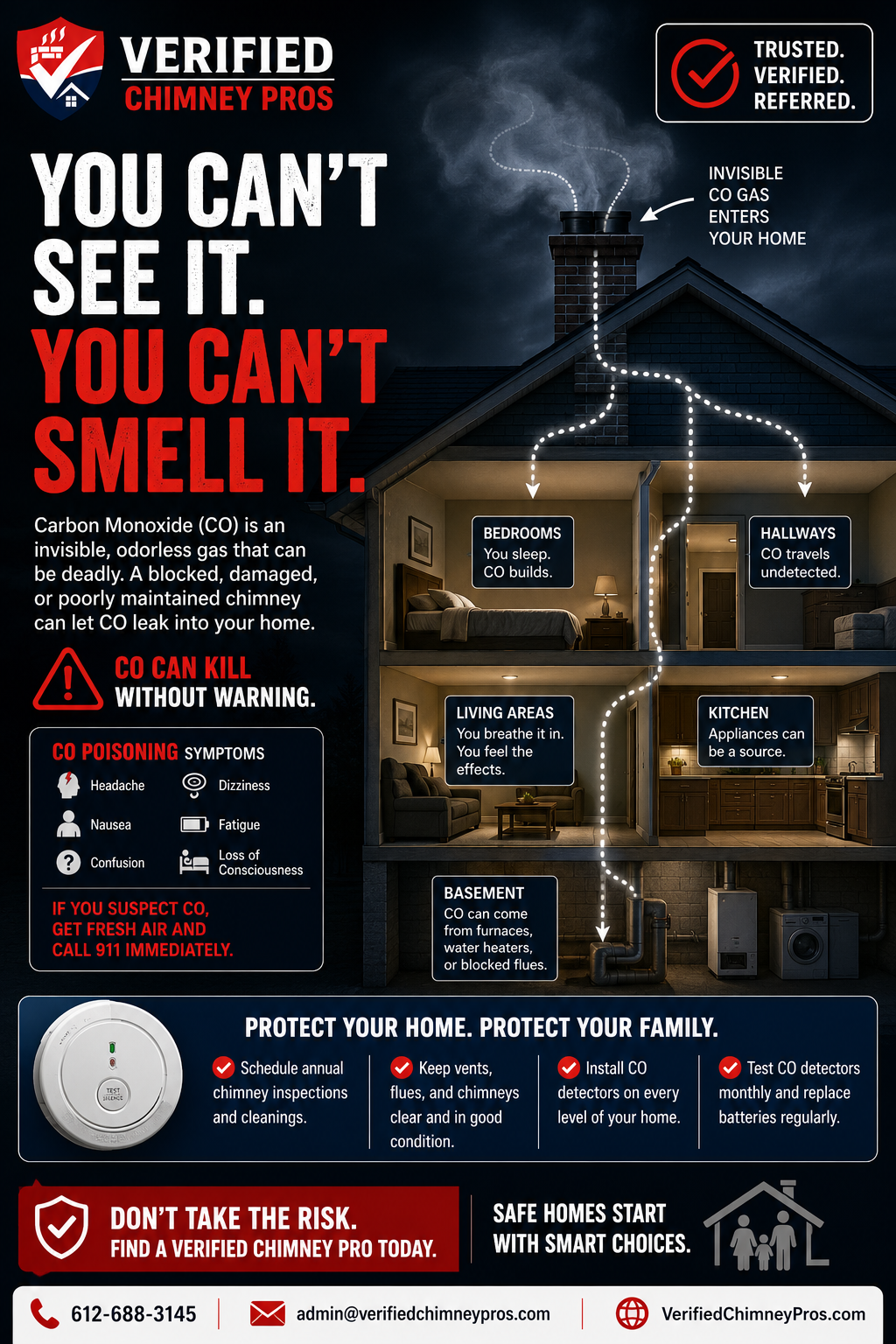
Carbon monoxide is odorless. It is colorless. It produces no taste, no visible smoke trail, and no audible alarm of its own. The Centers for Disease Control and Prevention (CDC) reports that accidental CO poisoning kills more than 400 Americans annually and sends over 100,000 to emergency rooms — a significant proportion from residential heating appliances, including fireplaces and their chimney systems. Every one of those emergencies was preventable. Most of them shared one common factor: no professional had evaluated the chimney system recently enough to catch the failure before it became a crisis.
This guide addresses the carbon monoxide chimney risk directly and completely — explaining exactly how CO enters your living space through chimney system failures, which specific conditions create the greatest danger, and what every homeowner must do before lighting another fire this season. The answers are not complicated. But acting on them requires a verified professional who can find what no homeowner can see on their own. Let’s make sure you know exactly what you are dealing with — and exactly where to go from here.
Why the Carbon Monoxide Chimney Risk Is Far More Common in American Homes Than Anyone Is Telling You
The carbon monoxide chimney risk is chronically underestimated by homeowners — largely because the symptoms of CO exposure are easily confused with common illnesses, because CO itself leaves no visible evidence of its presence, and because most chimney failures that create CO pathways develop gradually rather than catastrophically. A hairline crack in a clay tile liner. A mortar joint that has deteriorated through a decade of freeze-thaw cycling. A chimney cap missing from last winter’s storm that allowed a bird to build a nest in the flue. Each of these conditions is individually unremarkable in appearance from inside the firebox — and each one can create a direct carbon monoxide chimney risk pathway into your living space.
The Consumer Product Safety Commission (CPSC) estimates that approximately 170 people die from CO produced by non-automotive consumer products annually — with portable generators, gas appliances, and heating equipment including fireplaces and their venting systems accounting for the majority of those incidents. What these statistics do not capture is the far larger number of homeowners who experience repeated low-level CO exposure through compromised chimney systems — suffering chronic headaches, fatigue, and cognitive impairment — without ever connecting their symptoms to the fireplace they use every evening through the heating season.
Understanding the specific conditions that create a carbon monoxide chimney risk in your home is the first step toward eliminating it. The seven facts in this guide explain exactly how CO gets from your combustion appliance into your breathing space — and exactly what a qualified, verified professional looks for when they evaluate your chimney system specifically to prevent it.
Why the Carbon Monoxide Chimney Risk Is a Life-Safety Emergency — Not a Maintenance Inconvenience
The carbon monoxide chimney risk is not a category of home maintenance concern in the same sense as a leaking faucet or a squeaky door. It is a life-safety emergency in waiting — one that can activate at any moment a compromised chimney system is used, and one that can progress from mild exposure to incapacitation to death faster than many homeowners understand is possible. The Occupational Safety and Health Administration (OSHA) classifies CO as immediately dangerous to life and health at concentrations above 1,200 parts per million — concentrations achievable in an enclosed residential space with a malfunctioning chimney system within minutes.
The National Fire Protection Association (NFPA) mandates annual chimney inspections through NFPA 211 precisely because the carbon monoxide chimney risk requires professional detection tools and professional training to assess accurately. A homeowner looking into their firebox cannot evaluate the integrity of their liner at 20 feet above the damper. They cannot assess mortar joint deterioration through a camera-free visual glance. They cannot identify a partially blocked flue cap from inside the living room. These are professional evaluation tasks — and skipping them does not make the risk disappear. It makes the risk invisible until it causes harm.
The good news is straightforward: the carbon monoxide chimney risk is among the most completely preventable home safety hazards that exists. Annual professional inspection, proper CO detector placement, and awareness of the specific warning signs that precede CO exposure give homeowners an exceptionally reliable protection framework. Every element of that framework is within your control — starting right now, before the next fire you light.
Powerful Facts Every Homeowner Must Understand About Carbon Monoxide Chimney Risk
These seven facts address the carbon monoxide chimney risk from every critical angle — the specific failure modes that create CO pathways, the symptoms that identify exposure, the tools that detect it, and the professional intervention that eliminates it entirely.
⚠️ Fact 1: The Carbon Monoxide Chimney Risk Begins With Liner Cracks You Cannot See From Inside Your Home
A cracked chimney liner is the single most common structural source of carbon monoxide chimney risk in residential fireplace systems — and it is also one of the least detectable conditions available to homeowner inspection without professional equipment. The liner is the clay tile, stainless steel, or cast-in-place system that runs the length of your flue — channeling combustion gases from your firebox up and out of your home. When it is intact, it contains every byproduct of combustion safely within the flue pathway. When it cracks — through freeze-thaw cycling, creosote fires, age, or seismic activity — it creates direct openings through which carbon monoxide can migrate into surrounding masonry and from there into your living spaces.
Clay tile liners — the most common liner type in homes built before 1980 — are particularly vulnerable to this failure mode. They expand during high-heat combustion and contract during cooling cycles. Over years of seasonal use, that repeated thermal cycling generates stress fractures that begin as hairline cracks invisible to any homeowner without a camera and progress to significant structural failures that create serious carbon monoxide chimney risk pathways without any visible symptom inside the firebox or living room.
The only reliable method for identifying liner cracks before they generate a carbon monoxide chimney risk is a Level 2 chimney inspection using interior video scanning technology — where a specialized camera is lowered through the entire length of the liner, generating footage of every joint, crack, and deteriorated section from top to bottom. The Chimney Safety Institute of America (CSIA) classifies liner integrity assessment as one of the highest-priority components of annual professional chimney inspection specifically because of the CO pathway risk that undetected liner damage creates.
⚠️ Fact 2: A Blocked Flue Creates Lethal CO Backdraft — Even When Your Fireplace Appears to Work Normally
A partially or fully blocked chimney flue is one of the most immediately dangerous sources of carbon monoxide chimney risk available to homeowners — and the blockage itself may be completely invisible from the fireplace opening. Animal nests — particularly from chimney swifts, starlings, and squirrels — are a primary cause of seasonal flue blockages. Debris accumulation from storm damage, collapsed crown material, and creosote deposits severe enough to restrict airflow are additional common blockage sources. In every case, the blockage prevents combustion gases — including carbon monoxide — from venting up and out of the chimney system and forces them to reverse direction into the living space instead.
This reverse airflow condition — called backdraft — can occur even when a fire appears to be burning normally and the damper is fully open. The fire consumes available oxygen, creates combustion gases that have nowhere to vent, and those gases — including CO — reverse direction into the firebox and from there into the room. Backdraft can develop gradually enough that homeowners do not notice the initial CO exposure symptoms — attributing mild headache and fatigue to the warmth of the fire rather than recognizing them as warning signs of a developing carbon monoxide chimney risk emergency.
A professional chimney inspection identifies flue blockages before any fire is lit — using a combination of visual assessment, draft testing, and interior camera evaluation. A CSIA-certified professional checks for animal activity, debris accumulation, collapsed tile material, and any restriction that could create a carbon monoxide chimney risk during normal fireplace operation. This evaluation is particularly critical after any period of seasonal non-use — during which birds and small animals routinely establish nesting sites inside unprotected flue openings.
⚠️ Fact 3: Gas Fireplaces Carry Every Bit as Much Carbon Monoxide Chimney Risk as Wood-Burning Systems
A widely held and genuinely dangerous misconception among homeowners is that gas fireplaces are immune to the carbon monoxide chimney risk that affects wood-burning systems. They are not. Gas combustion produces carbon monoxide as a byproduct under all operating conditions — and gas fireplace venting systems are subject to the same liner deterioration, blockage, and draft failure modes that create CO pathways in wood-burning systems. The NFPA 211 annual inspection requirement applies equally to gas fireplaces and their associated venting systems — specifically because the carbon monoxide chimney risk from gas appliances is real, documented, and capable of creating the same life-threatening exposure conditions.
Gas fireplaces introduce one additional CO risk factor that wood-burning systems do not share: the potential for incomplete combustion at the appliance level. When a gas burner malfunctions — through a dirty pilot assembly, an improperly adjusted air-to-fuel ratio, or a failing ignition component — combustion becomes incomplete and CO production increases dramatically. That elevated CO production enters the venting system and, in a system with any liner or draft compromise, creates a carbon monoxide chimney risk that exceeds what a properly functioning wood-burning fireplace typically generates.
Schedule annual professional inspections for your gas fireplace and its venting system without exception — and do not assume that a fireplace that lights reliably and burns visibly is functioning safely. CO production from gas combustion appliances does not require visible malfunction to create exposure risk. Only professional evaluation can confirm that your gas fireplace and its venting system are operating safely within all relevant carbon monoxide chimney risk parameters.
⚠️ Fact 4: Carbon Monoxide Symptoms Mimic the Flu So Closely That Thousands of Exposures Are Never Identified
One of the most dangerous dimensions of the carbon monoxide chimney risk is that its primary physical symptoms — headache, nausea, fatigue, dizziness, and confusion — are clinically indistinguishable from the influenza symptoms that affect millions of Americans every winter. The CDC explicitly warns that many CO poisoning incidents are initially misidentified as flu — delaying recognition, delaying evacuation, and in some cases allowing continued exposure until the situation becomes fatal.
The key diagnostic indicator that distinguishes CO exposure from the flu is a pattern-based observation: symptoms that improve significantly when you leave the home and return when you come back inside strongly suggest a CO source within the residence rather than a viral illness. Multiple household members — including pets — experiencing the same symptoms simultaneously is another critical warning sign. If your family is experiencing winter flu-like symptoms that seem concentrated in the hours spent at home near the fireplace, do not wait for a medical diagnosis. Exit the home immediately, leave the door open, and call 911.
Understanding this symptom pattern is essential to addressing the carbon monoxide chimney risk effectively — because the window between recognizing early CO exposure symptoms and facing life-threatening concentrations can be narrow. The National Capital Poison Center recommends that any homeowner who suspects CO exposure call Poison Control at 1-800-222-1222 immediately from outside the building. Do not re-enter until emergency services have confirmed the environment is safe.
⚠️ Carbon Monoxide Chimney Risk — Symptom Warning Signs That Demand Immediate Action:
✔️ Headache, dizziness, or nausea that improves when you leave the home
✔️ Multiple household members experiencing identical symptoms simultaneously
✔️ Pets appearing lethargic, disoriented, or unwell without other explanation
✔️ Symptoms that correlate with fireplace use and diminish when not in use
✔️ Flu-like illness during a season when flu vaccination was current
⚠️ Fact 5: A CO Detector Is Your Most Critical Emergency Tool — But It Cannot Replace a Professional Inspection
Every home with a fireplace, gas appliance, or attached garage must have at least one working carbon monoxide detector — and this is non-negotiable regardless of how recently your chimney was professionally inspected. The CPSC recommends CO detectors on every level of the home and outside every sleeping area. The carbon monoxide chimney risk that a detector alerts you to may develop at any point during the heating season — between annual inspections, after a storm that shifts a chimney cap, or following a minor chimney fire that damages liner integrity.
However — and this distinction is critical — a CO detector is a reactive safety device, not a preventive one. It alarms when CO concentration in the ambient air reaches a threshold that the Underwriters Laboratories (UL) standard requires the detector to register. By the time an alarm sounds, occupants have already been exposed to elevated CO concentrations. The detector saves lives by prompting evacuation before concentrations reach immediately dangerous levels — but it does not eliminate the carbon monoxide chimney risk that caused the alarm. Only professional identification and repair of the underlying chimney failure eliminates the risk at its source.
Test your CO detector monthly. Replace batteries at the start of every heating season. Replace the entire unit every five to seven years — sensor sensitivity degrades with age, and an older detector may not alarm at concentrations that a current-generation unit would identify reliably. Treat your CO detector as the essential emergency backup it is — and treat your annual professional chimney inspection as the primary carbon monoxide chimney risk elimination strategy it is designed to be.
⚠️ Fact 6: Only a Professional Annual Inspection Can Locate the Specific Failure Creating Your Carbon Monoxide Chimney Risk
The generate: Graphic: Bold reminder card — large clock or calendar icon centered, with text:
‘When Was Your Last Chimney Inspection?’ Subtext: ‘NFPA recommends annual
inspections.’ Red urgency accent, clean white background, VCP footer CTA. is by definition invisible to homeowner assessment — because the failure modes that create CO pathways are located inside liner systems, behind masonry joints, and at structural junction points that no homeowner can access, illuminate, or evaluate without specialized professional tools. A visual check of the firebox opening tells you nothing about the liner condition at 15 feet above the damper. A look at the exterior chimney cap tells you nothing about the mortar joint integrity inside the flue system. A damper that opens and closes smoothly tells you nothing about draft performance under active combustion load.
A professional inspection — performed by a CSIA-certified or NFI-credentialed chimney professional — uses interior video cameras, draft testing equipment, specialized lighting systems, and professional training to assess every component of your chimney system that creates or mitigates carbon monoxide chimney risk. The inspection generates a written findings report that documents every condition of concern with photographic or video evidence — giving you specific, verifiable information rather than a verbal assurance that “everything looks fine.”
This is precisely why the NFPA 211 mandates annual professional inspection for all chimneys and venting systems — not because chimney professionals need the business, but because the carbon monoxide chimney risk is genuinely inaccessible to any other form of assessment. An unverified contractor who glances in your firebox and declares it safe has not addressed the carbon monoxide chimney risk — they have simply confirmed that you have a firebox. Only a credentialed professional performing a complete inspection protocol protects you from CO exposure at the source.
⚠️ Fact 7: The Carbon Monoxide Chimney Risk Is Completely and Reliably Preventable — With the Right Professional
The most important fact about the carbon monoxide chimney risk is this: it is not inevitable, it is not random, and it is not outside your control as a homeowner. Every CO pathway that a chimney system creates — whether through liner cracks, flue blockages, failed mortar joints, or improper venting configurations — can be identified by a qualified professional before it causes exposure, and addressed through documented professional repairs that eliminate the carbon monoxide chimney risk at its source.
The homeowners who never experience a CO emergency from their chimney system are not lucky. They are consistent. They schedule their annual inspection before every heating season. They hire a verified, credentialed professional who performs a complete documented assessment rather than a superficial visual check. They install CO detectors on every level of their home and replace them on schedule. And they respond immediately when any warning sign appears — rather than waiting to see if it resolves on its own. These are not expensive behaviors. They are disciplined ones — and they eliminate the carbon monoxide chimney risk as reliably as any home safety strategy available.
How Verified Chimney Pros Gives You the Strongest Possible Defense Against Carbon Monoxide Chimney Risk
Eliminating the carbon monoxide chimney risk in your home begins with one decision: choosing the right professional to perform your annual inspection. And that decision is exactly where Verified Chimney Pros makes its most critical contribution to homeowner safety. Every chimney professional listed on the platform has been reviewed for active state licensing, current general liability insurance, and professional certifications from the CSIA or National Fireplace Institute (NFI) before being approved to appear in the directory. Those credentials are not self-reported claims — they are verified qualifications confirmed through the platform’s screening process.
This matters enormously in the context of carbon monoxide chimney risk — because the inspection that protects you from CO exposure is only as reliable as the professional performing it. An unlicensed contractor who performs a superficial firebox inspection and misses a cracked liner at elevation has not reduced your carbon monoxide chimney risk. They have simply collected a fee while leaving you with a false sense of security that may be more dangerous than having no inspection at all. A CSIA-certified professional who performs a complete documented assessment with interior camera evaluation, draft testing, and written findings has genuinely addressed your carbon monoxide chimney risk at the professional standard required to protect your family.
When you search for a chimney inspector through Verified Chimney Pros, you are accessing a directory of professionals who have been evaluated before you ever call them. Their licensing is current. Their insurance is active. Their certifications are verified. And their accountability to the platform’s ongoing standards creates a professional incentive for thorough, honest, documented inspections — exactly the kind that genuinely eliminate the carbon monoxide chimney risk rather than simply appearing to address it.
Powerful Reasons to Find Your Carbon Monoxide Chimney Risk Inspector Through Verified Chimney Pros
Here is exactly what changes when you address your carbon monoxide chimney risk through the Verified Chimney Pros directory:
✅ Every Listed Professional Is Pre-Screened for the Credentials That Make CO Risk Elimination Possible
Licensing, insurance, and CSIA or NFI certification have been confirmed before any professional appears in your search results. You never have to take an unknown contractor’s word for qualifications they may or may not actually hold.
✅ Transparent Profiles Let You Verify Credentials Before You Schedule — Eliminating Fraud Risk Entirely
See certifications, service areas, completed inspection photos, and real homeowner reviews in one place — before your first call — so your decision to address the carbon monoxide chimney risk in your home starts from a position of complete information.
✅ Written Inspection Reports Are a Platform Standard — Not an Optional Extra You Must Negotiate For
Every verified professional provides documented findings with photographic or video evidence of any CO-risk conditions identified — giving you a complete, verifiable record of your chimney system’s current safety status.
✅ Ongoing Accountability Means Your Verified Pro Maintains Professional Standards Beyond the First Visit
Professionals who fail to maintain the platform’s standards risk removal from the directory — creating a sustained incentive for thorough, honest, professional inspection performance on every job, every season.
✅ National Coverage Means a Verified Professional Who Can Eliminate Your Carbon Monoxide Chimney Risk Is Near You Right Now
Verified Chimney Pros is actively building a national network of verified chimney professionals across the United States. Search your area today and find the credentialed professional your family’s safety requires.
Your Quick-Reference Carbon Monoxide Chimney Risk Prevention Checklist
Use this checklist before every heating season. Every item directly addresses a specific dimension of the carbon monoxide chimney risk in your home.
| ✅ Prevention Action | Why It Addresses Carbon Monoxide Chimney Risk |
|---|---|
| Annual Professional Inspection | Only method to identify liner cracks, blockages, and draft failures creating CO pathways |
| Hire a CSIA or NFI Certified Pro | Credentials confirm professional training in CO-risk detection and chimney safety assessment |
| CO Detector on Every Level | Reactive emergency protection — alarms before concentrations reach immediately dangerous levels |
| CO Detector Tested Monthly | Confirms sensor function throughout the heating season when CO risk is highest |
| CO Detector Replaced Every 5–7 Years | Prevents sensor degradation from reducing alarm sensitivity below protective thresholds |
| Damper Confirmed Open Before Every Fire | Eliminates backdraft CO exposure from combustion gases with nowhere to vent |
| Chimney Cap Confirmed Intact | Prevents animal nesting and debris blockages that create CO backdraft conditions |
| Know CO Symptom Patterns | Enables immediate evacuation rather than misidentification as flu illness |
| Emergency Action Plan in Place | Family knows to exit, call 911, and not re-enter until professionals confirm safety |
FAQ
1: What is the carbon monoxide chimney risk and how does it develop?
The carbon monoxide chimney risk develops when any failure in a chimney system creates a pathway through which CO — produced by combustion appliances — bypasses the flue and enters the living space instead of venting safely out of the home. Specific failure modes include cracked or deteriorated liner tiles, partially or fully blocked flue openings, failed mortar joints, damaged chimney caps, and improperly configured venting systems. Each of these conditions is detectable through professional annual inspection and addressable through documented professional repairs before any CO exposure occurs.
2: Can I identify the carbon monoxide chimney risk in my home without hiring a professional?
No reliable self-assessment of the carbon monoxide chimney risk is possible for homeowners without professional tools. Liner cracks, mortar joint failures, and draft performance issues — the primary structural sources of CO chimney pathways — are located inside the flue system at points inaccessible to homeowner visual inspection without specialized cameras, lighting equipment, and draft testing tools. A homeowner who looks into their firebox and sees no obvious damage has not assessed their carbon monoxide chimney risk — they have assessed the interior of their firebox only. Annual professional inspection is the only reliable risk assessment available.
3: How quickly can carbon monoxide reach dangerous levels from a chimney system failure?
The speed at which the carbon monoxide chimney risk creates dangerous concentrations depends on the severity of the venting failure, the size of the affected space, and the ventilation rate of the home. The OSHA notes that CO concentrations can reach immediately life-threatening levels within minutes in small, tightly sealed spaces with a significant CO source. In larger residential spaces with a moderate venting failure, exposure may build gradually over hours — producing chronic low-level exposure symptoms before any acute emergency develops. Neither scenario is acceptable. Both are preventable through annual inspection.
4: Where should I place carbon monoxide detectors to address the chimney risk in my home?
The CPSC recommends carbon monoxide detectors on every level of the home and outside every sleeping area. For homeowners specifically addressing carbon monoxide chimney risk, place an additional detector within 15 feet of the primary fireplace on the same floor at breathing height. Interconnected detectors — which sound all alarms simultaneously when any single detector triggers — provide the most comprehensive protection in multi-level homes where a chimney-originated CO source may not be on the same floor as sleeping areas.
5: Does a gas fireplace create a carbon monoxide chimney risk the same way a wood-burning fireplace does?
Yes. Gas combustion produces carbon monoxide as a byproduct under all operating conditions — and gas fireplace venting systems are subject to the same liner deterioration, blockage, and draft failure modes that create carbon monoxide chimney risk in wood-burning systems. Gas fireplaces carry an additional CO risk from incomplete combustion at the appliance level when burner components malfunction. The NFPA 211 annual inspection requirement applies to all gas fireplace and venting systems equally — specifically because the carbon monoxide chimney risk from gas appliances is real and equally serious.
6: What should I do immediately if my CO detector alarms?
Exit the home immediately with all household members and pets — do not stop to investigate, gather belongings, or open windows. Call 911 from outside the home. Do not re-enter until emergency services have confirmed the environment is safe. After the emergency, call a verified chimney professional to perform a Level 2 inspection before the fireplace or any combustion appliance is used again. The CO alarm confirmed an active carbon monoxide chimney risk — identifying and repairing the specific failure that triggered it is mandatory before any further fireplace use.
7: How often should I have my chimney inspected to prevent CO risk?
The NFPA 211 standard mandates annual professional chimney inspection for all chimneys and venting systems — regardless of fireplace usage frequency. Chimneys that are used infrequently can develop blockages, liner deterioration, and mortar failures that create a carbon monoxide chimney risk with no relation to combustion frequency. Schedule your annual inspection in late August or September — before peak demand arrives — to ensure your chimney system receives a thorough professional evaluation before your first fire of the season.
8: What certifications should the professional inspecting my chimney for CO risk hold?
Look for active CSIA Certified Chimney Sweep (CCS) credentials or NFI (National Fireplace Institute) specialty certifications. Both require passing rigorous professional examinations and maintaining ongoing continuing education specific to chimney system safety — including CO risk assessment. Verify certification status directly on each organization’s official website before scheduling any inspection. Alternatively, search through Verified Chimney Pros — where every listed professional has already been verified for active credentials, current insurance, and professional standing before appearing in the directory.
9: Can chimney repairs eliminate the carbon monoxide chimney risk completely?
Yes — when performed by a qualified professional using appropriate materials and documented to professional standards. Liner relining with stainless steel or cast-in-place systems eliminates the CO pathway that cracked clay tile liners create. Flue cleaning and blockage removal eliminates the backdraft conditions that blocked flues generate. Crown repair and cap installation eliminate the moisture and animal intrusion that leads to progressive structural deterioration. Each of these repairs, performed by a CSIA-certified professional and confirmed through post-repair inspection, directly addresses the specific carbon monoxide chimney risk the original failure created.
10: What is the difference between a Level 1 and Level 2 inspection for CO risk assessment?
A Level 1 inspection covers all accessible portions of the chimney system — firebox, damper, accessible flue areas, exterior crown, and cap. It is the standard annual inspection appropriate for chimneys in continuous use without appliance changes or suspected damage. A Level 2 inspection adds interior video scanning of the full liner — providing the most reliable assessment of the carbon monoxide chimney risk from liner cracks and mortar joint failures at elevation. A Level 2 inspection is required following any chimney fire, appliance change, real estate transaction, or any incident that may have affected liner integrity.
11: How do I know if my chimney professional actually checked for CO risk during my inspection?
A professional who genuinely addressed your carbon monoxide chimney risk during an inspection delivers a written findings report that specifically documents liner condition, draft performance assessment, blockage status, and any conditions of concern — with photographic or video evidence. They explain each finding in plain language and answer your questions directly. If your chimney professional completed an inspection and left without providing written documentation, they did not perform the professional assessment standard required to reliably evaluate and address the carbon monoxide chimney risk in your specific chimney system.
12: Is the carbon monoxide chimney risk higher in older homes?
Older homes — particularly those with pre-1980 clay tile liner systems — carry a statistically elevated carbon monoxide chimney risk because clay tile liner deterioration accelerates with age and thermal cycling history. Homes with masonry chimneys constructed before modern liner standards were established may also lack properly sized liner systems for the appliances currently connected to them — creating chronic draft performance issues that elevate CO exposure risk during normal operation. Annual inspection is especially critical for owners of older homes with fireplace systems — and a CSIA-certified professional who specializes in older masonry system assessment is the appropriate choice for addressing the elevated carbon monoxide chimney risk these systems present.
13: Can I use my fireplace safely if a CO detector is installed but my chimney has not been inspected recently?
No. A CO detector provides reactive emergency protection — it alarms when CO concentration in the ambient air reaches a specified threshold. It does not prevent the carbon monoxide chimney risk from activating. It does not identify the chimney failure creating the CO pathway. And it does not protect you from chronic low-level CO exposure that builds gradually below alarm threshold while still causing measurable physiological harm over time. A CO detector is a critical emergency safety device — but it is not a substitute for the annual professional inspection that addresses the carbon monoxide chimney risk at its structural source.
14: How do I find a verified chimney professional qualified to assess carbon monoxide chimney risk?
Search directly at Verified Chimney Pros — where every listed professional has been reviewed for active state licensing, current general liability insurance, and professional certifications from the CSIA or NFI before appearing in the directory. Compare profiles, review credentials, and read verified homeowner reviews before scheduling. Starting your search at Verified Chimney Pros is the most direct, most reliable path to finding a professional whose qualifications genuinely match the technical demands of carbon monoxide chimney risk assessment and prevention.
The Carbon Monoxide Chimney Risk Is Real — But It Belongs to Homeowners Who Don’t Act, Not to Those Who Do
The carbon monoxide chimney risk in your home is real. It is invisible. It is completely preventable. And the difference between a homeowner who never experiences a CO emergency from their chimney system and one who does is almost never equipment quality or fireplace brand. It is the consistent choice to schedule an annual professional inspection with a verified, credentialed chimney professional before every heating season begins.
Verified Chimney Pros exists to make that choice as simple, trustworthy, and risk-free as possible. Every professional in the directory has been reviewed for the credentials, insurance, and professional standing that genuine carbon monoxide chimney risk assessment requires. You do not have to verify credentials independently. You do not have to hope you chose someone qualified. You search, compare, and hire with complete confidence — knowing the most critical due diligence has already been completed on your behalf.
Install your CO detectors today. Test them. Replace them on schedule. And then schedule your annual inspection through Verified Chimney Pros — because the most important defense against the carbon monoxide chimney risk is a verified professional who finds the danger before you ever experience it.