Animals in Chimney: 7 Powerful Facts Every Homeowner Must Know Before This Season to Protect Their Home and Family
Animals in your chimney are not simply a seasonal nuisance that resolves itself when temperatures drop. They are a documented home safety hazard that creates chimney fire risk, carbon monoxide exposure pathways, and structural damage that worsens silently with every week the problem goes unaddressed. The animals in chimney problem affects hundreds of thousands of American homeowners every year — most of whom have no idea the issue exists until they light their first fire of the season and discover, in the worst possible way, that their flue was not clear.
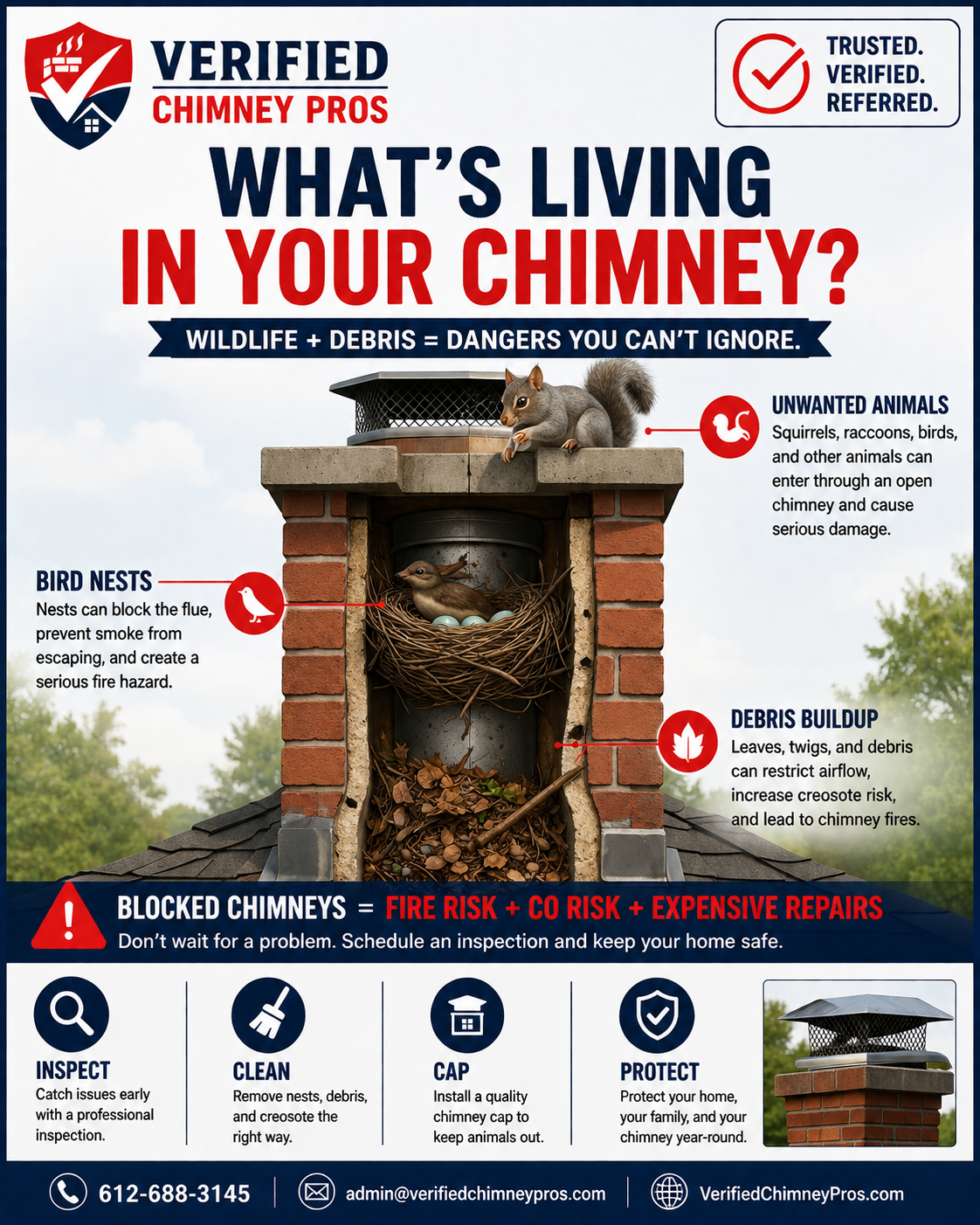
Birds, squirrels, and raccoons are the three most common wildlife species that establish themselves inside uncapped residential chimneys. Each species creates a distinct set of hazards. Each requires a different professional removal and prevention approach. And in every case, the damage they cause — nesting material blocking the flue, parasites left behind in the chimney system, structural deterioration from animal activity, and carbon monoxide pathways created by blocked venting — is both serious and completely preventable with one chimney cap and one annual inspection by a verified professional.
This guide addresses animals in chimney systems directly and completely — the seven most important facts every homeowner must understand about how wildlife enters, what damage it causes, and exactly what a qualified chimney professional must do to resolve the problem safely and permanently. Read this before your next fireplace season starts. What you learn here will change what you check before you light another fire.
Why Animals Target Uncapped Chimneys — and Why Your Home Is More Vulnerable to This Problem Than You Realize
An uncapped chimney is one of the most attractive nesting sites available to urban and suburban wildlife — and the reasons are straightforward from the animal’s perspective. Chimneys are warm during cold seasons, dark and sheltered from weather, located above ground away from ground-level predators, and structurally stable. For a bird seeking a nesting cavity, a squirrel looking for a winter den, or a raccoon searching for a protected birthing site, an uncapped residential chimney offers ideal conditions that are extraordinarily difficult for urban wildlife to find elsewhere in a suburban environment.
The animals in chimney problem is not a rare occurrence limited to homes in heavily wooded areas. The Humane Society of the United States documents that wildlife intrusion into residential structures — including chimney systems — occurs across virtually all suburban and urban environments throughout the country. Homes without chimney caps, homes with damaged or missing spark arrestor mesh, and homes with deteriorated chimney crown sections that leave gaps between the liner and the surrounding masonry all represent entry vulnerabilities that wildlife identifies and exploits rapidly — often within a single nesting season.
The most dangerous aspect of the animals in chimney problem for homeowners is its invisibility from inside the living room. A bird building a nest three feet above your damper creates no visible change in your firebox. A squirrel storing acorns in the smoke shelf leaves no trace you can see from the hearth opening. A raccoon settling in above the flue produces no symptom you can observe indoors — until you open the damper, light a fire, and discover that your flue is completely blocked and combustion gases have nowhere to go but backward into your home.
Why Animals in Your Chimney Are a Genuine Home Safety Emergency — Not a Problem You Can Wait to Address
The animals in chimney problem carries a safety significance that most homeowners dramatically underestimate on first discovery. The instinct is to treat it as a pest problem — an inconvenience to be resolved at a convenient time. The reality is that animals in chimney systems create conditions that are directly analogous to the most serious documented chimney safety hazards: flue blockages that generate carbon monoxide backdraft, combustible material accumulation that ignites during fireplace use, and structural damage that compromises liner integrity over time.
The Chimney Safety Institute of America (CSIA) identifies flue blockages — including those caused by animal nesting material — as a primary contributing factor in chimney fires and carbon monoxide exposure incidents. The National Fire Protection Association’s NFPA 211 standard mandates annual chimney inspections specifically to identify and address blockage conditions before they create safety emergencies — and animals in chimney systems are one of the most common blockage sources discovered during professional annual inspections nationwide.
Do not use your fireplace if you suspect animals in chimney activity. The temptation to “just try it and see” is understandable — but lighting a fire with any degree of flue obstruction from animal nesting material, debris, or a deceased animal creates an immediate fire hazard and carbon monoxide exposure risk that no homeowner should willingly accept. Contact a verified chimney professional for a complete inspection before any further fireplace use — and let them assess and clear the situation with the professional tools and safety protocols the job requires.
Powerful Facts Every Homeowner Must Know About Animals in Chimney Systems
These seven facts address the most critical dimensions of the animals in chimney problem — from the specific hazards each animal species creates to the legal considerations homeowners must understand before attempting any removal.
🐦 Fact 1: Animal Nesting Material Is Highly Combustible — and One of the Most Direct Chimney Fire Triggers Available
The most immediately dangerous consequence of animals in chimney systems is the nesting material those animals carry in and build with. Birds and squirrels construct nests from dried leaves, grass, twigs, feathers, bark shreds, and other combustible organic materials that accumulate inside the flue and smoke shelf in quantities that create significant fire fuel concentrated directly in the combustion gas pathway. When a fire is lit below this material — even a small, carefully controlled fire — the radiant heat from combustion gases can ignite accumulated nesting debris within seconds, creating a chimney fire that burns at temperatures capable of cracking clay tile liners and transferring heat to surrounding structural components.
The U.S. Fire Administration (USFA) consistently identifies debris accumulation inside chimney flues — including animal nesting material — as a contributing factor in residential chimney fire incidents. Unlike creosote fires — which develop gradually through repeated fireplace use — a animals in chimney nesting fire can occur on the very first use of the season, with no prior warning and no detectable symptom from inside the living room before the fire event begins.
A professional chimney inspection — performed by a CSIA-certified technician using interior video scanning equipment — is the only reliable method for identifying nesting material accumulation at elevation inside the flue, where no homeowner visual check can reach. Annual inspection before the first fire of every season is the only protection strategy that reliably catches animals in chimney nesting hazards before they become fire events.
⚠️ Fact 2: Animals Block Your Flue and Force Carbon Monoxide Directly Into Your Living Space
Every animals in chimney intrusion that creates a partial or complete flue blockage creates a direct carbon monoxide chimney risk — identical in mechanism and danger to a blocked flue from any other cause. When a nest, a deceased animal, or accumulated debris restricts airflow through the flue, combustion gases produced by your fireplace or any connected heating appliance cannot vent properly. Those gases — including odorless, colorless carbon monoxide — reverse direction and enter your living space instead of exiting through the chimney top.
The Centers for Disease Control and Prevention (CDC) reports that carbon monoxide poisoning kills more than 400 Americans annually from non-automotive sources — with heating appliance blockages, including those caused by animals in chimney systems, representing a significant proportion of those incidents. Symptoms of CO exposure — headache, nausea, dizziness, confusion — are virtually indistinguishable from flu symptoms, which means many animals in chimney-related CO exposure incidents are initially misidentified and addressed too slowly.
Install a working carbon monoxide detector on every level of your home and outside every sleeping area. Test it monthly. But never treat a working CO detector as a substitute for professional chimney inspection — because the animals in chimney blockage that generates dangerous CO concentrations must be identified and physically removed by a professional, not simply alarmed against. The detector is your emergency warning system. The annual inspection is your prevention system.
✅ Immediate Actions Required When You Suspect Animals in Your Chimney:
- ✔️ Stop using the fireplace immediately — do not attempt a test fire
- ✔️ Do not open the damper — this can allow nesting debris and CO to enter the living space
- ✔️ Contact a CSIA-certified chimney professional for immediate inspection
- ✔️ Confirm your CO detector is functioning and positioned on the same floor as the fireplace
- ✔️ Do not attempt wildlife removal yourself — legal and safety considerations apply
🦅 Fact 3: Chimney Swifts Are Federally Protected — Removing Them Without a Permit Violates Federal Law
One of the most critical legal facts about animals in chimney situations is that chimney swifts — a migratory bird species that frequently nests inside uncapped masonry chimneys — are protected under the Migratory Bird Treaty Act (MBTA), a federal law administered by the U.S. Fish and Wildlife Service. It is illegal to disturb, remove, or destroy chimney swift nests, eggs, or birds without a federal permit — and violations carry significant civil and criminal penalties regardless of whether the homeowner was aware of the law.
The practical implication for homeowners dealing with animals in chimney situations involving chimney swifts is that removal during active nesting season — typically May through October in most regions — is not legally available as an option. The appropriate professional response is to seal all alternative entry points, allow the active nest to complete its cycle, and install a properly fitted chimney cap with spark arrestor mesh immediately after the birds have departed for their winter migration — preventing re-entry the following season.
A CSIA-certified chimney professional familiar with the legal framework around animals in chimney situations involving protected species will know how to assess, document, and respond to chimney swift activity appropriately — without exposing the homeowner to federal liability. This is a specific reason why professional chimney inspection and wildlife management matters: an unlicensed contractor who removes a chimney swift nest without legal authorization creates legal exposure for the homeowner who hired them.
🦝 Fact 4: Raccoons Cause More Structural Chimney Damage Than Any Other Animal — and They Return Every Year
Among the animals most commonly found in residential chimneys, raccoons create the most significant and most costly structural damage. A female raccoon seeking a protected denning site for her litter will enter an uncapped chimney, break apart deteriorated chimney crown sections to widen the opening if necessary, shred liner components to create nesting material, and establish a den above the damper that she will return to in subsequent years if the entry point is not professionally sealed. The animals in chimney damage that a raccoon family creates over a single nesting season can require thousands of dollars in professional chimney repair to address correctly.
Raccoon feces left inside the chimney system also present a direct human health risk. Baylisascaris procyonis — the raccoon roundworm — is a documented parasitic pathogen present in raccoon feces that can cause serious illness in humans who are exposed through contact with contaminated surfaces. Professional chimney cleaning after raccoon removal must include specific decontamination protocols appropriate to biological hazard material — a level of service that requires professional training and appropriate protective equipment that no homeowner should attempt to replicate independently.
Raccoons are also extraordinarily persistent re-entry animals — they remember and return to previous denning sites with a reliability that makes incomplete exclusion measures almost entirely ineffective. The professional response to raccoon animals in chimney situations must include not just animal removal but a complete structural assessment of the entry point, professional sealing of the chimney cap with heavy-gauge mesh, and documentation of any structural damage created by the animal activity.
🐿️ Fact 5: Squirrels in Your Chimney Create Secondary Entry Points That Compound Structural Damage Each Season
Squirrels represent the third major animals in chimney intrusion category — and they create a specific structural damage pattern distinct from birds and raccoons. Squirrels gnaw. They gnaw on every material they encounter inside the chimney system — including mortar joints, clay tile liner edges, damper components, and any wood elements at the firebox surround. That gnawing activity not only accelerates structural deterioration of components that are already subject to thermal stress and moisture cycling, it frequently creates secondary entry points that expand the animals in chimney problem from a single-entry situation to a multi-access structural vulnerability.
Squirrels also cache food — nuts, seeds, and other organic material — inside chimney flues and on smoke shelves. This organic material accumulation adds to the combustible debris load that makes the flue a fire hazard, and the stored food attracts secondary pest activity from insects and rodents that further complicates the removal and remediation process. A chimney system that has hosted a squirrel for even a single season typically requires a more comprehensive professional cleaning and inspection than one that hosted a bird, because the gnawing damage, food caching, and secondary pest attraction must all be assessed and addressed as part of a complete remediation.
Professional squirrel exclusion for animals in chimney situations requires a heavy-gauge stainless steel chimney cap with a spark arrestor mesh sized small enough to prevent squirrel entry — typically with openings no larger than half an inch. Standard birdcage caps with wider mesh openings are insufficient for squirrel exclusion and will be bypassed by a determined squirrel within a single season. A professional chimney cap installation matched to the specific animal species involved is a critical component of any complete animals in chimney prevention strategy.
💀 Fact 6: Animal Remains Left in the Flue Create Ongoing Hazards That Do Not Resolve Without Professional Removal
One of the most frequently overlooked animals in chimney scenarios is the deceased animal — a bird, squirrel, or small mammal that entered the chimney system and could not exit. Deceased animals inside the flue create a category of hazard that homeowners rarely anticipate: a partial blockage that restricts but does not fully obstruct draft, an odor source that enters the living space through the damper opening, and a biological hazard that attracts insects and secondary pest activity throughout the decay cycle.
The partial blockage created by a deceased animal is particularly dangerous for carbon monoxide risk — because it is subtle enough that a homeowner might light a fire and notice reduced draft performance without recognizing the CO exposure risk that a restricted flue creates. The CSIA notes that any chimney odor emanating from the fireplace opening when the damper is closed or opened should be treated as a professional inspection trigger — because unusual odors are among the most reliable early indicators of animals in chimney conditions that are not visible from the firebox opening.
Professional removal of deceased animals from chimney flues requires specialized retrieval tools, interior camera assessment to locate the carcass precisely, appropriate biological hazard protocols for safe removal and disposal, and complete inspection of the flue for any secondary damage or additional animal presence that accompanied the initial intrusion. This is not a DIY project — and it is not a service that every general pest control provider is equipped to perform safely inside a chimney system. A CSIA-certified chimney professional with wildlife intrusion experience is the appropriate professional resource for this specific situation.
🏠 Fact 7: A Chimney Cap Is the Single Most Cost-Effective Animals in Chimney Prevention Tool Available — Install One Before This Season
Every animals in chimney scenario documented in this guide — birds building nests, raccoons denning, squirrels gnawing, deceased animals blocking the flue — is preventable with one properly installed chimney cap fitted with a spark arrestor mesh sized appropriately for the animal species present in your area. A professionally installed chimney cap typically costs between $150 and $400 depending on flue size, cap style, and installation complexity — making it one of the most cost-effective preventive maintenance investments available in the entire home maintenance category.
A properly fitted chimney cap serves multiple simultaneous protective functions beyond animals in chimney prevention. It prevents rain and snow from entering the flue directly — reducing moisture-driven liner deterioration, masonry freeze-thaw damage, and rust formation on damper components. It prevents downdraft conditions that reverse flue airflow during high-wind events. And it provides the spark arrestor function that prevents burning embers from exiting the flue top and landing on combustible roof surfaces during fireplace use.
A chimney cap alone is necessary but not sufficient for complete animals in chimney prevention. Annual inspection by a CSIA-certified professional confirms that the cap remains properly fitted, that the mesh is intact and appropriately sized, and that no entry points have developed through crown deterioration, mortar joint gaps, or cap displacement from storm or animal activity. The combination of a professionally installed cap and annual professional inspection eliminates virtually all animals in chimney risk — at a total annual cost that is a fraction of the damage repair cost that a single unaddressed wildlife intrusion typically generates.
How Verified Chimney Pros Connects You With Professionals Qualified to Resolve the Animals in Chimney Problem the Right Way
The animals in chimney problem requires a chimney professional with specific capabilities that not every contractor advertising chimney services actually possesses: interior video assessment equipment to locate wildlife and nesting material at elevation, knowledge of federal and state wildlife protection laws that govern removal procedures, appropriate biological hazard protocols for deceased animal removal and decontamination, and professional chimney cap installation expertise matched to the specific animal species and chimney configuration involved.
Verified Chimney Pros connects homeowners with chimney professionals who have been reviewed for active state licensing, current general liability insurance, and professional certifications from the CSIA or National Fireplace Institute (NFI) before being approved to appear in the directory. These credentials matter specifically in animals in chimney situations — because a CSIA-certified professional has the training to assess wildlife intrusion damage correctly, perform the appropriate level of inspection, recommend the legally compliant removal approach for the specific animal species involved, and install a chimney cap solution that prevents recurrence.
When you search for a chimney professional through Verified Chimney Pros, you access a curated directory of verified professionals whose qualifications have already been confirmed — so you never have to take an unknown contractor’s word for credentials they may or may not hold. In the context of animals in chimney situations — where improper handling creates legal liability, ongoing blockage hazards, and expensive repeat intrusion — that pre-verified professional quality is not a luxury. It is the minimum standard any homeowner should accept.
Powerful Reasons to Find Your Animals in Chimney Specialist Through Verified Chimney Pros
Here is exactly what changes when you address your animals in chimney situation through the Verified Chimney Pros directory:
✅ Pre-Screened Professionals With the Credentials to Handle Wildlife Intrusion Correctly and Legally
Every listed professional has been reviewed for active licensing, current insurance, and CSIA or NFI certification — ensuring the credentials required for proper animals in chimney assessment and removal are in place before you schedule a single appointment.
✅ Transparent Profiles Let You Evaluate Experience and Expertise Before You Call
See credentials, service descriptions, completed project photos, and real homeowner reviews — all in one place — so you can confirm that the professional you contact has specific experience with animals in chimney situations before any appointment is made.
✅ Written Inspection Reports Document Every Animals in Chimney Finding With Photographic Evidence
Every verified professional provides documented findings — including interior video assessment images of wildlife, nesting material, and associated damage — giving you a complete, verifiable record of the animals in chimney condition in your specific chimney system.
✅ Legally Aware Professionals Who Know the Wildlife Protection Laws That Apply in Your State
Verified chimney professionals understand the Migratory Bird Treaty Act and applicable state wildlife protection regulations — ensuring that your animals in chimney situation is handled in full legal compliance, without creating federal or state liability exposure for you as the homeowner.
✅ Ongoing Platform Accountability That Ensures Professional Standards Are Maintained After Approval
Verified Chimney Pros holds every listed professional to ongoing standards — creating a sustained incentive for thorough, honest, legally compliant professional service on every animals in chimney removal and prevention job.
Your Quick-Reference Animals in Chimney Prevention and Response Checklist
Use this checklist to assess your current animals in chimney risk status and determine the appropriate immediate actions for your specific situation.
| ✅ Action Item | Why It Addresses Animals in Chimney Risk |
|---|---|
| Schedule Annual Professional Inspection | Only method to detect nesting material and wildlife at elevation before fireplace season |
| Install a Properly Fitted Chimney Cap | Primary physical barrier preventing all categories of animals in chimney entry |
| Confirm Cap Mesh Size Is Species-Appropriate | Standard mesh openings allow squirrel entry — verify with your professional |
| Do Not Use Fireplace If Wildlife Is Suspected | Prevents ignition of nesting material and CO backdraft from blocked flue |
| Install CO Detector on Every Level | Reactive emergency protection against CO from animals in chimney blockage events |
| Have Chimney Crown Inspected Annually | Crown gaps allow animal entry independent of cap condition |
| Know Your State Wildlife Laws | Chimney swift and other protected species require specific legal handling |
| Request Written Inspection Report | Documents all animals in chimney findings with photographic evidence |
| Confirm Biological Hazard Protocols | Required for raccoon feces removal — verify professional capability before booking |
FAQ
1: How do I know if I have animals in my chimney?
The most common indicators of animals in chimney activity include: scratching, chirping, or rustling sounds from inside the firebox or smoke shelf, unusual odors coming from the fireplace opening when the damper is closed, visible debris falling into the firebox from above, and reduced draft performance when the fireplace is in use. However — the most dangerous animals in chimney situations produce no detectable symptom at all until a fire is lit. Annual professional inspection is the only reliable detection method for animals in chimney conditions that have not yet produced observable symptoms.
2: Can animals in my chimney start a house fire?
Yes. Animals in chimney systems who carry nesting material — including birds and squirrels — create accumulated combustible debris inside the flue that can ignite when radiant heat from a fire below reaches the nesting material. The USFA documents chimney fires caused by debris and nesting material ignition annually. A chimney fire originating from animals in chimney nesting material burns at temperatures capable of cracking clay tile liners, damaging surrounding masonry, and in severe cases transferring heat to structural building components surrounding the chimney chase.
3: Is it illegal to remove animals from my chimney myself?
Certain species found as animals in chimney situations are federally or state-protected and cannot legally be removed without appropriate permits. Chimney swifts are protected under the Migratory Bird Treaty Act — making disturbance, removal, or nest destruction illegal during active nesting season. Various songbird species may carry similar protections depending on your state’s wildlife regulations. Even for unprotected species, DIY removal from inside a chimney system presents significant personal safety risks and biological hazard exposure concerns. Always contact a CSIA-certified chimney professional who understands applicable wildlife law before attempting any animals in chimney removal.
4: What is the best chimney cap for preventing animals in my chimney?
The most effective chimney cap for animals in chimney prevention is a stainless steel top-mount cap with a spark arrestor mesh sized appropriately for the specific animal species in your area. Standard mesh openings of approximately one inch prevent bird entry effectively but allow squirrel access — a one-half inch mesh is required for complete squirrel exclusion. Raccoon exclusion typically requires heavy-gauge mesh and additional mechanical fastening to prevent cap displacement by a determined animal. A CSIA-certified professional can assess your specific chimney configuration and animal activity history to recommend the most appropriate cap specification for your situation.
5: How much does it cost to remove animals from a chimney professionally?
Professional animals in chimney removal costs vary based on animal species, infestation severity, flue configuration, and geographic region. Wildlife removal fees typically range from $200 to $600 for a standard situation. If the animals in chimney activity has caused structural damage — cracked liner tiles, deteriorated crown, gnawed damper components — repair costs are additional and can range from several hundred to several thousand dollars depending on severity. Chimney cap installation following removal typically adds $150 to $400. These costs are substantially lower than the repair and remediation costs generated by an unaddressed animals in chimney situation that is discovered only after a chimney fire or CO exposure event.
6: Can I use my fireplace if birds are nesting in my chimney?
No. Using your fireplace while animals in chimney nesting is active creates a direct fire hazard from nesting material ignition and a carbon monoxide risk from the partial flue blockage the nest creates. If chimney swifts are nesting — the most commonly protected animals in chimney species — you are also legally prohibited from disturbing the nest during the active nesting period under the Migratory Bird Treaty Act. Do not use the fireplace. Contact a chimney professional for assessment and await the legal clearance window before cap installation.
7: How do professionals remove a deceased animal from a chimney?
Professional removal of a deceased animal from an animals in chimney situation requires interior video camera assessment to locate the carcass precisely within the flue system, specialized retrieval tools to access the animal at elevation, appropriate personal protective equipment for biological hazard handling, and a complete post-removal inspection to confirm flue clearance and assess any associated damage. Removal procedures also include disinfection of the affected flue area using protocols appropriate to the specific biological hazard the animal’s decomposition presents. This service requires professional training and equipment — it is not appropriate for homeowner DIY removal.
8: Will a chimney cap damage my chimney draft performance?
A properly fitted, professionally installed chimney cap does not negatively affect draft performance and in many cases improves it by eliminating downdraft conditions created by wind-driven air entering the uncapped flue from above. A cap that is incorrectly sized — either too small to allow adequate combustion gas flow or too large to fit securely — can affect draft performance negatively. This is why professional cap selection and installation by a CSIA-certified chimney professional is preferable to homeowner-installed caps purchased at hardware stores — ensuring the cap specification matches your specific chimney dimensions and performance requirements while providing complete animals in chimney exclusion.
9: How do raccoons cause so much damage inside a chimney?
Raccoons are among the most physically destructive animals in chimney species because of their combination of size, strength, and manual dexterity. A raccoon establishing a denning site inside a chimney system will physically enlarge entry openings by breaking deteriorated mortar joints and crown sections, shred liner components and gasket materials to create nesting material, displace damper hardware through physical force, and deposit feces containing Baylisascaris procyonis — a parasitic roundworm — throughout the affected chimney area. The combined structural and biological hazard remediation required after a raccoon animals in chimney situation typically represents the most expensive single wildlife intrusion scenario a homeowner can face.
10: Can animals in my chimney cause carbon monoxide poisoning?
Yes. Animals in chimney systems that create partial or complete flue blockages prevent combustion gases — including carbon monoxide — from venting safely out of the home, causing those gases to reverse direction and enter living spaces. The CDC classifies carbon monoxide as immediately dangerous to life and health at concentrations above certain thresholds — concentrations that can develop rapidly in enclosed residential spaces when a flue blockage from animals in chimney nesting prevents proper venting. Install CO detectors on every level of your home and schedule immediate professional inspection if any animals in chimney activity is suspected.
11: What should I do if I see a bird flying around inside my fireplace?
A bird visible inside your firebox has typically fallen from a nest or entered the chimney from the top and become disoriented. Do not light a fire. Keep the damper closed to prevent the bird from entering the living space. Open a nearby window and darken the room to give the bird an exit point if it does access the living space. Contact a CSIA-certified chimney professional to assess the animals in chimney situation — determine whether a nest is present above the damper, identify any protected species considerations, and recommend appropriate removal and prevention measures before the fireplace is used again.
12: How often should my chimney cap be inspected to ensure animals cannot enter?
Your chimney cap should be visually inspected during every annual professional chimney inspection — and immediately following any significant weather event, storm damage, or suspected animal activity that may have displaced or damaged the cap. Chimney caps are durable components, but heavy snow loads, ice accumulation, storm debris impact, and persistent animal pressure can displace, deform, or damage mesh openings in ways that restore animals in chimney entry vulnerability. A CSIA-certified professional can assess cap integrity as part of your annual inspection and recommend replacement or reinforcement if the current cap no longer provides complete wildlife exclusion.
13: Are there any animals in a chimney situations that I can address myself?
Homeowner DIY intervention in animals in chimney situations is generally not recommended for any species — because of the legal considerations around protected wildlife, the biological hazard risks from animal feces and deceased animal remains, the safety risk of accessing elevation inside a chimney system without professional equipment, and the risk of incomplete exclusion that creates recurring intrusion in subsequent seasons. Basic observation — noting sounds, odors, and visible indicators of wildlife activity — is appropriate for homeowners. Physical removal, decontamination, and prevention installation are professional services requiring the credentials, tools, and legal knowledge that a CSIA-certified chimney professional provides.
14: What is the best time of year to have my chimney inspected for animal intrusion?
Late summer — August or September — is the optimal inspection window for animals in chimney assessment because it precedes peak fireplace season demand, allows sufficient time for cap installation and any necessary repairs before cold weather arrives, and typically follows the primary spring and summer nesting season when the most active animals in chimney situations develop. Schedule your annual inspection in this window every year — and contact a professional immediately if any animals in chimney symptoms appear outside the annual inspection cycle.
15: How do I find a verified professional to handle animals in my chimney correctly?
Search directly at Verified Chimney Pros — the national directory of pre-screened, verified chimney professionals where every listed contractor has been reviewed for active state licensing, current insurance, and professional certifications from the CSIA or NFI before approval. Browse profiles, confirm wildlife intrusion experience, and read verified homeowner reviews before scheduling. For questions before booking, contact the platform directly at 📞 612-688-3145 or 📧 admin@verifiedchimneypros.com. Addressing animals in chimney situations with a verified professional is the only approach that guarantees legally compliant removal, complete structural assessment, and permanent prevention — rather than a temporary fix that fails before the next nesting season.
Animals in Your Chimney Are Preventable — Act Before the Season Starts and Never Deal With This Twice
Animals in chimney systems are not an unpredictable, unavoidable home safety hazard — they are one of the most completely preventable problems available to any homeowner who installs a properly fitted chimney cap and schedules an annual professional inspection before every fireplace season. The fire risks, the carbon monoxide exposure pathways, the legal complications of protected species situations, the biological hazards of raccoon feces — every one of these consequences is avoided entirely by two simple, consistent actions taken before the first fire of the season.
Verified Chimney Pros exists to ensure that the professional you trust with your chimney — and your family’s safety — has the credentials, the training, and the legal knowledge to handle animals in chimney situations correctly from assessment through prevention. Every professional in the directory has been reviewed for the qualifications the job requires. You do not have to hope you found someone competent. You search, compare, and book with complete confidence.
Install a chimney cap. Schedule your annual inspection. And find your verified professional at Verified Chimney Pros — because the animals in chimney problem you prevent this summer is the chimney fire and CO emergency you never have to survive next winter.