How Do I Know If My Chimney Is Safe? 7 Critical Warning Signs Every Homeowner Must Know
How do I know if my chimney is safe? It is one of the most frequently asked—and most important—questions homeowners pose before lighting their first fire of the season. The honest, professional answer is this: only a thorough inspection by a certified chimney professional can definitively determine whether your chimney system is structurally sound, properly ventilating, and safe to operate.
However, there are 7 critical warning signs you can identify yourself right now that indicate your chimney may be unsafe, damaged, or in urgent need of professional evaluation. Recognizing these red flags early can prevent devastating house fires, deadly carbon monoxide leaks, and costly emergency repairs down the road.
According to the National Fire Protection Association (NFPA), failure to clean chimneys is the leading factor contributing to home heating fires in the United States. Creosote buildup, structural cracks, damaged flue liners, and improper ventilation create life-threatening hazards that most homeowners cannot detect without professional training and specialized equipment.
This comprehensive guide answers the question “How do I know if my chimney is safe?” by walking you through 7 visual, functional, and structural warning signs that demand immediate attention. You will learn what to look for, why these issues are dangerous, and when to contact a Verified Chimney Pro for a complete safety inspection.
How Do I Know If My Chimney Is Safe? Why This Question Matters
If you are asking yourself, “How do I know if my chimney is safe?” you are already ahead of most homeowners who assume their chimney is fine simply because it “worked last year.” Chimneys are complex systems exposed to extreme temperature fluctuations, moisture infiltration, corrosive combustion byproducts, and structural settling over time.
Unlike visible home systems—like plumbing leaks or electrical sparks—chimney damage often develops hidden inside flue liners, smoke chambers, and damper assemblies where homeowners cannot see it. By the time visible exterior damage appears, the internal deterioration may already be severe enough to pose immediate fire or carbon monoxide risks.
That is why asking “How do I know if my chimney is safe?” is not just a smart question—it is a potentially life-saving question. Professional chimney inspections use video scanning equipment, smoke draft testing, and structural assessments to detect hazards invisible to the untrained eye.
However, between annual inspections, you can monitor your chimney for 7 critical warning signs that indicate urgent safety concerns. Recognizing these red flags early allows you to schedule professional evaluations before minor issues escalate into catastrophic failures.
How Unsafe Chimneys Cause Fires, Carbon Monoxide Poisoning, and Structural Damage
When homeowners ask, “How do I know if my chimney is safe?” they are really asking, “How do I protect my family from invisible dangers?” Unsafe chimneys cause three primary categories of life-threatening hazards:
1. Chimney Fires from Creosote Buildup
Creosote—a black, tar-like byproduct of wood combustion—accumulates on flue liner walls every time you burn a fire. When creosote deposits reach critical thickness (typically 1/8 inch or more), they become highly flammable. A single spark can ignite a chimney fire that burns at temperatures exceeding 2,000°F, cracking masonry, destroying flue liners, and spreading flames into wooden roof structures.
According to the Chimney Safety Institute of America (CSIA), creosote-fueled chimney fires cause millions of dollars in property damage annually and frequently result in total home loss.
2. Carbon Monoxide Poisoning from Structural Defects
Carbon monoxide (CO) is an odorless, colorless gas produced during incomplete combustion. When chimney liners crack, dampers fail, or flue obstructions prevent proper ventilation, deadly CO gas can back-draft into your home instead of venting safely outdoors.
The Centers for Disease Control and Prevention (CDC) reports that hundreds of Americans die from unintentional carbon monoxide poisoning every year—many caused by malfunctioning heating appliances and chimney systems.
3. Structural Damage from Water Infiltration
Masonry chimneys are porous. When chimney crowns crack, caps go missing, or mortar joints deteriorate, rainwater penetrates deep into brick and stone. Repeated freeze-thaw cycles cause spalling (surface flaking), crumbling mortar, and even complete chimney collapse in severe cases.
Water damage also accelerates flue liner deterioration, rusts damper assemblies, and rots wooden framing members adjacent to the chimney structure. These repairs are exponentially more expensive than preventative maintenance inspections.
Understanding these dangers is why asking “How do I know if my chimney is safe?” is not paranoia—it is responsible homeownership.
7 Critical Warning Signs: How Do I Know If My Chimney Is Safe?
Use these 7 visual and functional warning signs to monitor your chimney between professional inspections. If you observe any of these red flags, contact a Verified Chimney Pro immediately for a complete safety evaluation.
Warning Sign 1: White Staining or Efflorescence on Chimney Exterior
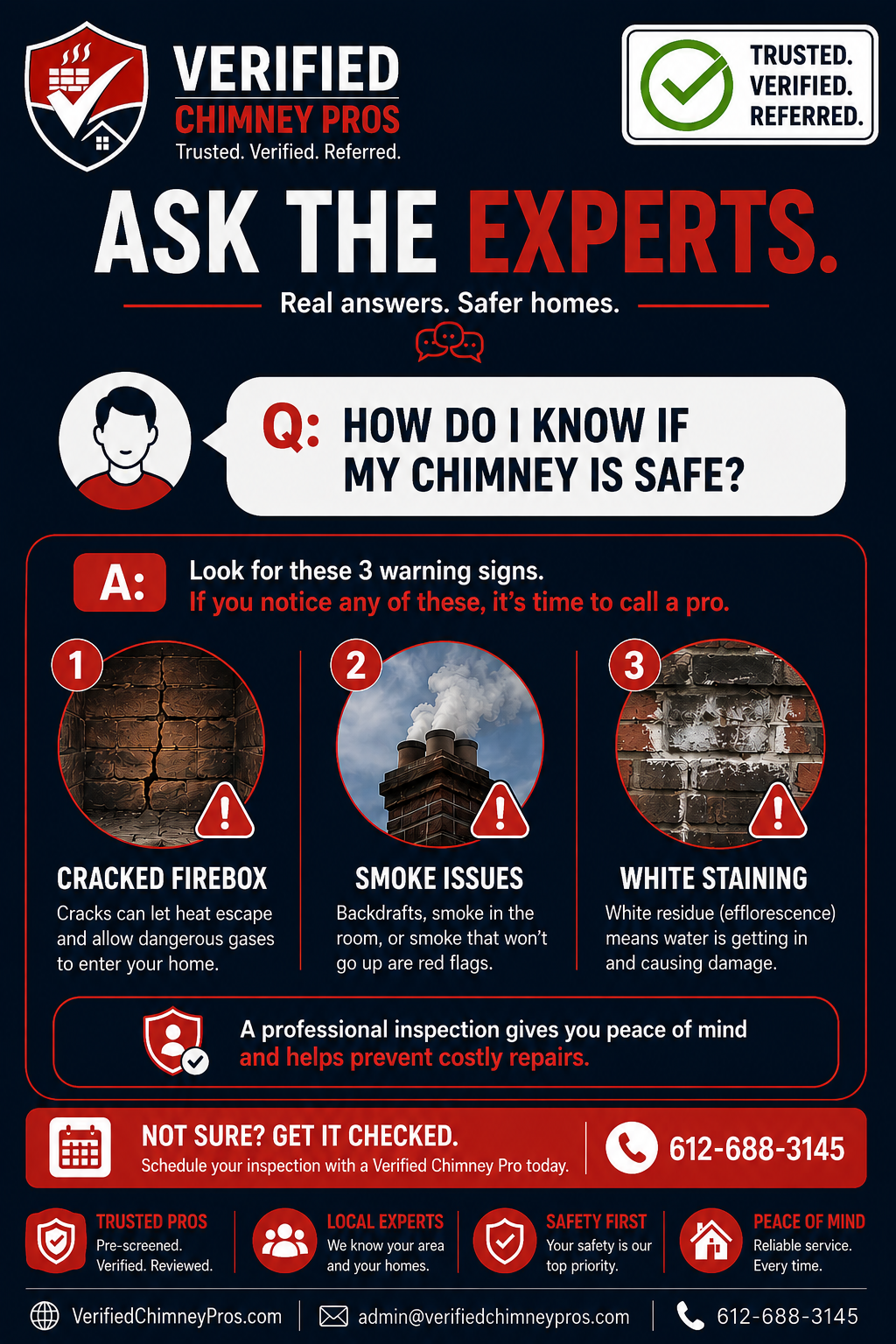
If you notice white, powdery staining on the exterior bricks of your chimney, you are observing efflorescence—a clear indicator of moisture infiltration. Efflorescence occurs when water dissolves soluble salts inside masonry and carries them to the surface, where they crystallize into white deposits.
While efflorescence itself is not dangerous, it proves water is penetrating your chimney structure. That moisture accelerates freeze-thaw damage, corrodes metal components, and can deteriorate flue liners from the inside out.
How do I know if my chimney is safe when I see efflorescence? You don’t—not without a professional inspection. A certified chimney sweep will identify the water entry point (damaged crown, missing cap, cracked mortar joints) and recommend waterproofing solutions before structural damage worsens.
Warning Sign 2: Crumbling or Spalling Bricks and Mortar Joints
Spalling refers to the flaking, crumbling, or peeling of brick and stone surfaces caused by moisture freeze-thaw cycles. When you observe bricks losing their outer face, mortar joints turning to powder, or chunks of masonry falling onto your roof, your chimney has sustained serious structural damage.
Spalling compromises the chimney’s ability to contain heat and combustion gases safely. It also signals that water infiltration has progressed to dangerous levels. Left unaddressed, spalling can lead to partial or complete chimney collapse.
How do I know if my chimney is safe when spalling is visible? You don’t. Schedule an immediate inspection to assess whether tuckpointing (mortar repair), brick replacement, or complete chimney rebuilding is required.
Warning Sign 3: Cracks in the Firebox, Smoke Chamber, or Flue Liner
Cracks inside your firebox (the area where you burn fires), smoke chamber (the transition zone above the firebox), or flue liner (the protective inner lining of the chimney) are critical safety hazards. These cracks allow extreme heat and combustion gases to reach combustible building materials, dramatically increasing fire risk.
Flue liner cracks also permit carbon monoxide to seep into wall cavities and living spaces. Even hairline cracks can widen rapidly under thermal stress during active fires.
How do I know if my chimney is safe if I cannot see inside the flue? You can’t. Professional chimney sweeps use video inspection cameras to scan the entire length of the flue liner for cracks, gaps, and deterioration invisible from the firebox or rooftop.
Warning Sign 4: Smoke Entering Your Home Instead of Drafting Up the Chimney
If smoke billows into your living room when you light a fire—or if you experience chronic backdrafting whenever the fireplace is in use—your chimney has a serious ventilation problem. Common causes include:
- Flue obstructions (bird nests, leaves, debris, or creosote buildup)
- Damaged or stuck damper assemblies
- Improperly sized flue for your fireplace or stove
- Negative air pressure inside your home
- Structural defects preventing proper draft
How do I know if my chimney is safe when smoke backs into my home? You know it is not safe. Stop using the fireplace immediately and contact a verified chimney professional to diagnose and repair the ventilation failure before operating the system again.
Warning Sign 5: Strong Smoky or Musty Odors During Summer Months
A properly functioning chimney should not produce strong odors when not in use. If you detect persistent smoky, musty, or campfire-like smells during warm, humid weather, you likely have significant creosote buildup inside your flue liner.
Creosote is hygroscopic—it absorbs moisture from humid air, intensifying its odor. These smells indicate dangerous creosote accumulation that could ignite during your next fire.
How do I know if my chimney is safe when I smell smoke in summer? You don’t. The odor proves creosote is present, but only a professional inspection and cleaning can determine whether the buildup has reached hazardous levels requiring specialized removal techniques.
Warning Sign 6: Visible Creosote Buildup or Black Flaky Deposits
If you shine a flashlight up your chimney from the firebox and observe thick, black, tar-like coatings or shiny, hardened glazed deposits on flue liner walls, you are looking at dangerous Stage 2 or Stage 3 creosote accumulation.
Stage 3 glazed creosote is extremely difficult to remove and highly flammable. It often requires specialized chemical treatments or mechanical removal tools beyond standard chimney sweeping brushes.
How do I know if my chimney is safe when I see creosote? You don’t—not without quantifying the thickness and determining the creosote stage. Professional chimney sweeps measure buildup and recommend appropriate cleaning methods to restore safe operation.
Warning Sign 7: Damaged or Missing Chimney Cap and Crown {#sign-7}
Your chimney cap (the metal cover on top of the flue) and chimney crown (the concrete or masonry seal at the top of the chimney structure) serve as your chimney’s first line of defense against water, debris, and wildlife intrusion.
If your chimney cap is missing, rusted through, or damaged, rain pours directly into your flue. Animals nest inside the chimney. Leaves and debris create dangerous obstructions. If your chimney crown is cracked or crumbling, water infiltrates the masonry, accelerating freeze-thaw damage and interior deterioration.
How do I know if my chimney is safe without a cap or with a damaged crown? You don’t. Even if the chimney appears functional, unprotected flues deteriorate rapidly. Professional inspection and cap/crown replacement are mandatory to prevent exponential damage.
Related reading: 7 Warning Signs You’re About to Hire a Chimney Scam
7 Critical Signs Your Chimney Liner Is Damaged and Needs Immediate Replacement
How can you tell if your chimney liner is failing before a disaster happens? Watch for these 7 critical warning signs inside your home and around your fireplace.
Sign 1: Crumbling Clay Tile Pieces Falling Into Your Firebox
If you find thin, orange, or reddish clay shards lying on your hearth or firebox floor, your clay tile chimney liner is actively disintegrating. This flaking process, known as spalling, occurs when moisture gets trapped inside the porous clay and freezes during cold winter weather.
Spalled tile pieces mean your chimney liner has lost its structural thickness. The protective barrier is peeling away, leaving thin, fragile walls that cannot withstand the 1,000-degree heat of a wood-burning fire. Continued use under these conditions risks immediate flue tile collapse.
Never ignore clay debris in your fireplace. Sweep up the fragments and call a Verified Chimney Pro immediately. They will assess how much of your chimney liner has spalled and recommend a seamless stainless steel liner upgrade.
Sign 2: White Salt Stains and Moisture Leaks Inside Your Fireplace
White, chalky staining on your interior fireplace bricks is called efflorescence. While many homeowners treat this as a cosmetic cleaning issue, it actually proves that moisture is penetrating your chimney liner and migrating through the masonry walls.
An intact chimney liner keeps moisture, rain condensation, and acidic vapor contained inside the flue until it exhausts out the chimney cap. When a liner cracks or mortar joints fail, water leaks out of the flue and saturates the brickwork, dragging mineral salts to the surface.
Where water leaks through a chimney liner, carbon monoxide and creosote can follow. Addressing efflorescence requires more than a scrub brush—it demands a professional inspection to determine where the chimney liner has breached.
Sign 3: Unexplained Carbon Monoxide Detector Alarms
Your home’s carbon monoxide detectors are your last line of defense against venting failure. If your alarms chirp or trigger when your fireplace, furnace, or boiler runs, your chimney liner is likely leaking toxic combustion gases into your home.
The Environmental Protection Agency (EPA) warns that carbon monoxide poisoning often mimics flu symptoms, causing headaches, dizziness, and nausea. A cracked chimney liner allows these lethal gases to bypass the roof vent and pool inside living areas.
If your CO alarm sounds, evacuate your home, call emergency services, and do not use your heating appliance again. Schedule an emergency venting inspection with a Verified Chimney Pro to test your chimney liner for dangerous gas leaks.
Sign 4: Excessive Smoke Backdrafting When You Build a Fire
A healthy chimney liner creates a strong, upward thermal draft that pulls smoke rapidly out of the firebox. If smoke billows out of your fireplace and into your living room every time you burn wood, your chimney liner is failing to draft properly.
Backdrafting occurs when a chimney liner is cracked, obstructed by debris, or incorrectly sized for your heating appliance. When clay tiles collapse inside the flue, they create physical blockages that choke airflow and force smoke back into your home.
Breathing wood smoke introduces toxic particulate matter into your lungs. A certified technician can determine whether your draft failure stems from creosote buildup, structural collapse, or an uninsulated chimney liner that is cooling flue gases too quickly.
Sign 5: Overheating Interior Walls Adjacent to Your Fireplace
Next time you have a hot fire burning, place your hand against the drywall or plaster walls surrounding your chimney upstairs or in adjacent rooms. If those interior walls feel unusually hot to the touch, your chimney liner is failing to insulate your home’s framing.
A functional chimney liner keeps high temperatures inside the flue. When tiles crack or shift out of alignment, heat blasts directly against the surrounding chimney chase. That heat transfer is the primary trigger for hidden residential framing fires.
Hot walls indicate an immediate emergency. Extinguish your fire safely and do not light another one until a professional evaluates your chimney liner. Installing an insulated stainless steel liner eliminates this heat transfer hazard permanently.
Sign 6: Foul, Rotten Smells Emitting From the Flue
A musty, damp, or asphalt-like odor coming from your fireplace during humid weather or after rain points to chimney liner decay. This smell is caused by acidic creosote mixing with trapped water inside a porous, damaged flue.
In a sealed chimney liner, creosote residue remains dry and relatively odorless until sweeping occurs. When a liner cracks, rain condensation combines with soot to create a toxic, smelly sludge that soaks deep into the surrounding masonry walls.
Masking the smell with room deodorizers does nothing to fix the structural decay. Replacing the damaged chimney liner and sealing the flue system removes the moisture source and eliminates the foul chimney odors for good.
Sign 7: Failed Level 2 Video Flue Inspection Report
The most definitive sign of a damaged chimney liner comes from a Level 2 video inspection. During this test, a certified technician lowers a specialized 360-degree camera down the entire length of your flue to record the internal walls.
A Level 2 camera inspection reveals hairline cracks, missing mortar joints, spalled clay, and improper offsets that no flashlight inspection can ever detect from the fireplace opening. If the video report shows fractured tiles, your chimney liner has officially failed code standards.
Always demand video proof before authorizing expensive masonry work. A Verified Chimney Pro will show you the exact live camera footage of your chimney liner, protecting you from high-pressure sales tactics and unverified scare stories.
Related reading: 7 Warning Signs You’re About to Hire a Chimney Scam
The Verified Chimney Pros Solution: Professional Inspections Answer "How Do I Know If My Chimney Is Safe?"
While the 7 warning signs above help you identify urgent red flags, the definitive answer to “How do I know if my chimney is safe?” always requires a professional chimney inspection by a certified, verified chimney professional.
At Verified Chimney Pros, every contractor in our directory passes rigorous third-party verification for:
✅ Active Liability Insurance Coverage
Verified pros carry current general liability and workers’ compensation insurance, protecting you from financial liability if accidents occur during service.
✅ Professional Certifications and Credentials
Our verified professionals hold certifications from recognized industry organizations like the Chimney Safety Institute of America (CSIA) or the National Chimney Sweep Guild (NCSG), proving technical competency and ongoing education.
✅ Background Screening and Reputation Reviews
We validate criminal background checks and verify positive customer reputation through independent review platforms, ensuring you hire trustworthy, ethical professionals.
✅ Specialized Inspection Equipment
Verified chimney pros use video scanning cameras, smoke draft testing, moisture meters, and structural assessment tools to detect hazards invisible to homeowners.
When you hire a Verified Chimney Pro, you receive a detailed written inspection report documenting:
- Current condition of flue liners, dampers, and smoke chambers
- Creosote buildup measurements and recommended cleaning schedules
- Structural defects requiring repair (cracks, spalling, water damage)
- Safety hazards demanding immediate attention
- Maintenance recommendations to extend chimney lifespan
Professional inspections answer “How do I know if my chimney is safe?” with factual, documented evidence—not guesswork or assumptions.
Related reading: How to Find a Trusted and Verified Chimney Professional Near You
7 Life-Saving Benefits of Professional Chimney Safety Inspections
Investing in professional chimney inspections delivers critical, life-saving benefits that far outweigh the modest cost:
1. Prevent Catastrophic House Fires
Professional cleaning removes dangerous creosote before it ignites. Inspections identify structural defects that could spread flames into wooden framing.
2. Eliminate Carbon Monoxide Poisoning Risks
Certified sweeps detect and repair ventilation failures, cracked liners, and damper malfunctions that cause deadly CO backdrafting.
3. Protect Your Family’s Health and Safety
Early detection of chimney hazards prevents emergency evacuations, smoke inhalation injuries, and tragic fatalities.
4. Avoid Exponentially Expensive Emergency Repairs
Catching minor cracks, water damage, or mortar deterioration early costs hundreds. Ignoring these issues until catastrophic failure costs tens of thousands.
5. Extend Chimney Lifespan Through Preventative Maintenance
Regular inspections, cleaning, and minor repairs keep chimneys functioning safely for decades instead of requiring premature rebuilding.
6. Maintain Homeowner’s Insurance Coverage Compliance
Many insurance policies require annual chimney inspections. Professional documentation protects your coverage in the event of a claim.
7. Enjoy Peace of Mind Every Time You Light a Fire
Knowing your chimney has been professionally certified safe allows you to enjoy cozy fires without worry or fear.
When homeowners ask, “How do I know if my chimney is safe?” the answer is simple: hire a verified professional to tell you definitively.
FAQ
1. How do I know if my chimney is safe without hiring a professional?
You cannot know for certain. While the 7 warning signs in this guide help you identify urgent red flags, only professional inspections using specialized equipment can definitively assess internal flue liner condition, creosote levels, and structural integrity.
2. How often should I ask, “How do I know if my chimney is safe?” and schedule inspections?
The National Fire Protection Association (NFPA) recommends annual chimney inspections—even if you rarely use your fireplace. Inspections should occur before each heating season to detect damage from summer weather and wildlife activity.
3. What does a professional chimney safety inspection include?
Professional Level 1 inspections include visual examination of accessible chimney components, creosote measurement, draft testing, and structural assessment. Level 2 inspections add video scanning of flue interiors. Level 3 inspections involve destructive examination of concealed areas.
4. How do I know if my chimney is safe if I only burn fires occasionally?
Infrequent use does not eliminate safety risks. Chimneys deteriorate from weather, moisture, and wildlife intrusion even when not actively used. Annual inspections remain mandatory regardless of burn frequency.
5. Can I inspect my chimney myself to answer “How do I know if my chimney is safe?”
You can perform basic visual checks for the 7 warning signs listed in this article, but you cannot replace professional inspection. Homeowners lack the training, equipment, and experience to detect internal flue damage, measure creosote thickness, or assess structural integrity accurately.
6. How do I know if my chimney is safe after a chimney fire?
You don’t—not without a professional Level 2 inspection. Chimney fires often cause hidden damage to flue liners, masonry, and structural components. Never operate a fireplace after a chimney fire until a certified sweep certifies it safe.
7. What should I do immediately if I notice warning signs that make me ask, “How do I know if my chimney is safe?”
Stop using your fireplace or wood stove immediately. Contact a verified chimney professional to schedule an urgent safety inspection. Do not resume burning until the chimney has been professionally evaluated and any necessary repairs completed.
8. How do I know if my chimney is safe if I smell smoke during summer?
Smoky odors during warm weather indicate dangerous creosote buildup. Schedule professional cleaning immediately. Do not light fires until the chimney has been swept and inspected.
9. How much does a professional chimney safety inspection cost?
Basic Level 1 inspections typically cost $100–$250. Level 2 video inspections range from $200–$500. This investment prevents catastrophic fires and carbon monoxide poisoning that could cost you everything.
10. How do I know if my chimney is safe if the previous homeowner never had it inspected?
You don’t. When purchasing a home, always hire a certified chimney professional for a pre-purchase inspection. Sellers rarely disclose hidden chimney defects, and home inspectors often lack specialized chimney training.
11. Can a home inspector answer “How do I know if my chimney is safe?” during a general home inspection?
General home inspectors provide basic visual assessments but lack the specialized training, certifications, and equipment chimney professionals use. Always hire a dedicated certified chimney sweep for thorough safety evaluation.
12. How do I know if my chimney is safe if I have a gas fireplace instead of wood-burning?
Gas fireplaces still require annual inspections. Gas appliances produce carbon monoxide, and flue liners can crack or deteriorate. Ventilation failures in gas systems are just as dangerous as wood-burning chimney defects.
13. What happens if I ignore the question “How do I know if my chimney is safe?” and never get inspections?
You risk catastrophic house fires, deadly carbon monoxide poisoning, structural collapse, and insurance claim denials. Neglected chimneys deteriorate exponentially faster than maintained systems, turning minor issues into catastrophic failures.
14. How do I know if my chimney is safe if it was recently cleaned?
Cleaning removes creosote but does not assess structural integrity. You need both cleaning and inspection. Many chimney sweeps perform both services simultaneously during annual maintenance visits.
15. Where can I find a verified chimney professional to answer “How do I know if my chimney is safe?”
Visit Verified Chimney Pros to search our directory of insurance-verified, background-checked, certified chimney professionals in your area. Every contractor is independently vetted for credentials, reputation, and professionalism.
Get Your Chimney Inspected Today
If you are still asking yourself, “How do I know if my chimney is safe?” the answer is clear: you need a professional chimney inspection by a certified, verified chimney professional.
The 7 warning signs covered in this guide—white staining, spalling masonry, cracks, smoke backdrafting, summer odors, creosote buildup, and damaged caps or crowns—are critical red flags that demand immediate professional evaluation. However, even chimneys without visible symptoms can harbor hidden hazards detectable only through specialized inspection equipment and expert training.
Do not gamble with your family’s safety. Do not assume your chimney is fine because it “worked last year.” Do not wait until smoke fills your living room or a chimney fire destroys your home.
Schedule your annual chimney safety inspection today with a Verified Chimney Pro near you. Protect your family. Preserve your home. Enjoy peace of mind every time you light a fire.
Ready to Find Out If Your Chimney Is Safe?
Connect with a certified, background-checked chimney professional in your area today.
📞 612-688-3145 | 📧 admin@verifiedchimneypros.com