Fireplace Safety Checklist: 10 Powerful Habits Every Homeowner Must Follow to Protect Their Family This Season
This fireplace safety checklist exists because most homeowners light their fireplace without ever thinking about the invisible dangers building silently inside their chimney system. Creosote accumulates with every fire. Liner cracks widen through every freeze-thaw cycle. Carbon monoxide pathways open without a single visible symptom. And year after year, thousands of American families experience chimney fires, carbon monoxide emergencies, and costly structural damage — not because they were reckless, but because nobody gave them a clear, practical fireplace safety checklist before the season started.
This guide changes that. The 10 habits in this fireplace safety checklist are drawn from standards published by the National Fire Protection Association (NFPA), the Chimney Safety Institute of America (CSIA), and the U.S. Fire Administration (USFA). They are not complicated. They do not require special equipment or chimney expertise. They require consistency — and one annual appointment with a verified professional who can confirm your chimney system is functioning exactly the way it should.
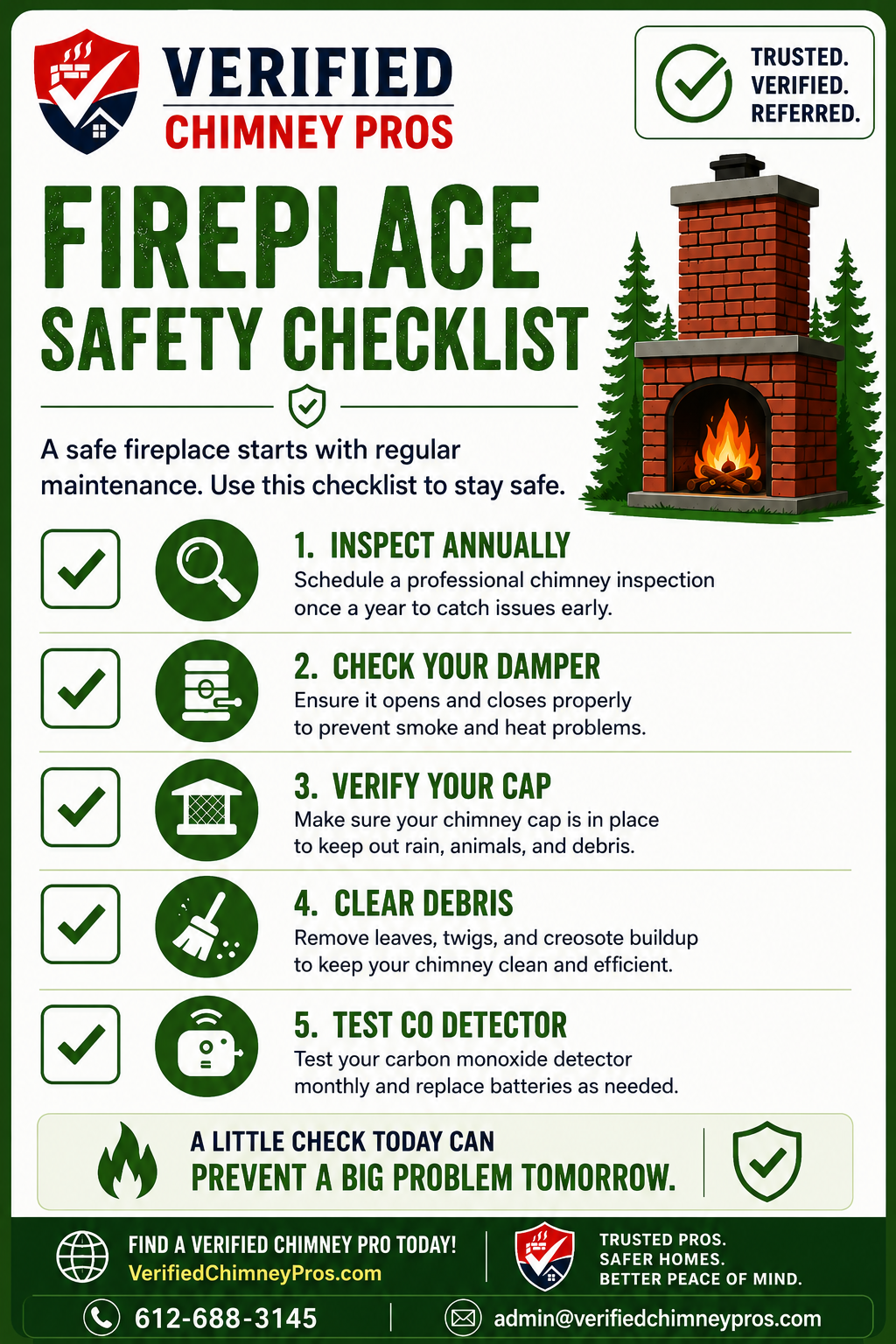
Follow every item on this fireplace safety checklist before your first fire of the season. Share it with neighbors who have fireplaces. And when you reach item one — the annual chimney inspection — find the right professional to perform it through Verified Chimney Pros. Because the most important item on any fireplace safety checklist is the one most homeowners still skip.
Why Most Homeowners Are One Skipped Inspection Away From a Dangerous Fireplace Season
The single most alarming fact about residential chimney fires is this: the majority of them are completely preventable. The NFPA reports that heating equipment — including fireplaces and chimneys — is consistently among the leading causes of home fires in the United States. And the primary contributing factor in most chimney-related fires is not equipment failure or freak accident. It is deferred maintenance — specifically, the skipped annual inspection that allowed creosote to accumulate, a liner crack to widen, or a blockage to develop undetected until the first fire of the season turned a manageable risk into an emergency.
Homeowners who use their fireplace regularly often believe that regular use itself is evidence of safety. It is not. Creosote — the combustible byproduct of wood burning — accumulates progressively with every fire, regardless of how carefully you burn or how high-quality your wood is. A chimney that functioned safely last season may harbor Stage 2 or Stage 3 creosote buildup by the time the next season begins. Only a professional inspection can identify and address that accumulation before it becomes a fire hazard. The CSIA classifies Stage 3 creosote as one of the most serious and most difficult-to-address hazards in residential chimney maintenance.
The good news is that prevention is genuinely straightforward — when you follow a complete fireplace safety checklist consistently and start every season with a professional inspection by a verified chimney professional. The 10 habits in this guide give you everything you need to make this the safest fireplace season your home has ever had.
Why Your Fireplace Safety Checklist Is the Most Critical Home Maintenance Document You'll Ever Use
Your fireplace is not a decorative amenity. It is an active combustion system connected directly to your home’s structure — one that introduces real fire, real combustion gases, and real structural heat stress into your living environment every time you use it. Unlike a leaking faucet or a squeaky door, a compromised fireplace system can fail catastrophically and silently — producing a chimney fire while you sleep or allowing carbon monoxide to fill your living space while your family relaxes in the next room.
This is exactly why the NFPA 211 standard mandates annual inspections for all chimneys and fireplaces — regardless of usage frequency. Annual inspections and consistent safe-use habits are not optional upgrades for particularly cautious homeowners. They are the baseline standard for any homeowner who wants their fireplace to function safely. A fireplace safety checklist is not excessive caution. It is the minimum responsible approach to maintaining a combustion system in your home.
The 10 habits that follow are organized in order of safety impact — from the most critical professional action (your annual inspection) to the daily behavioral habits that determine how safely your fireplace operates every time you light it. Follow all 10. Share this checklist with every homeowner you know who has a fireplace. And use Verified Chimney Pros to find the verified professional who makes item one a reality before this season begins.
The Complete Fireplace Safety Checklist: 10 Powerful Habits Every Homeowner Must Follow
Each item on this fireplace safety checklist addresses a specific, documented risk in residential fireplace and chimney operation. None of them are optional. All of them are actionable. Start at the top — and do not light your first fire of the season until every item has been confirmed.
🔥 Checklist Item 1: Schedule Your Annual Chimney Inspection — Before You Light a Single Fire This Season
The first and most important item on every fireplace safety checklist is an annual professional chimney inspection — and it must happen before the first fire of the season, not after. The NFPA 211 is unambiguous: all chimneys, fireplaces, and venting systems require professional inspection at least once every year. That recommendation applies whether you used your fireplace daily last season or not at all. Chimneys develop hazardous conditions — creosote accumulation, liner cracks, crown damage, animal nests — independently of use frequency.
A professional Level 1 inspection covers all accessible portions of your chimney system — firebox, damper, flue, exterior crown, and cap. A Level 2 inspection adds interior video scanning of the liner, required any time you’ve experienced a chimney fire, changed your heating appliance, or are buying or selling your home. Both levels result in a written findings report that documents the current condition of your chimney system and provides specific, prioritized recommendations for any required action.
Schedule your inspection in late August or September — before seasonal demand peaks in October and scheduling becomes difficult. Find a CSIA-certified or NFI-credentialed professional through Verified Chimney Pros to ensure the person performing your inspection has the training, credentials, and accountability to do it right.
✅ Annual Inspection Confirmation Checklist:
✔️ Inspection scheduled before first fire of the season
✔️ Correct inspection level confirmed (Level 1 or Level 2)
✔️ Professional carries active CSIA or NFI certification
✔️ Written findings report received and reviewed
✔️ All recommended repairs completed before fireplace use
🔥 Checklist Item 2: Verify Your Chimney Professional’s Credentials Before the Appointment — Every Single Time
Scheduling an inspection is not enough. The inspection is only as safe and reliable as the professional performing it — and the chimney services industry has one of the highest rates of consumer fraud of any home services trade. Unlicensed contractors, fabricated findings, and unnecessary repair pressure cost American homeowners billions of dollars annually. Your fireplace safety checklist must include credential verification as a non-negotiable step before any appointment is confirmed.
Before your inspection, ask for your contractor’s state contractor’s license number and verify it through your state’s official online licensing portal. Request a current certificate of general liability insurance and workers’ compensation coverage. Confirm active CSIA certification, NFI credentials, or NCSG membership directly on each organization’s official website. These verifications take minutes — and they are the most powerful fraud-prevention actions available to a homeowner before any chimney work begins.
Alternatively, start your search at Verified Chimney Pros — where every listed professional has already been reviewed for active licensing, current insurance, and professional credentials before appearing in the directory. That pre-screening eliminates the most dangerous sources of chimney contractor fraud before the first phone call is ever made.
🔥 Checklist Item 3: Burn Only Properly Seasoned, Dry Hardwood — and Confirm It Before You Buy
The fuel you burn is one of the most direct controllable variables in your fireplace safety checklist — and most homeowners significantly underestimate its impact on creosote accumulation and overall chimney safety. Properly seasoned firewood has been dried for a minimum of six to twelve months after cutting, reducing its moisture content to 20 percent or below. Wood burned at that moisture level combusts more completely, produces significantly less creosote, generates more usable heat, and creates far less smoke than wet or “green” wood burned before it is ready.
Wet wood — wood with moisture content above 25 percent — burns cooler and less completely. That incomplete combustion produces dramatically more creosote per fire than seasoned wood. It also produces more smoke, more particulate emissions, and a less satisfying fire experience. The EPA’s Burn Wise program provides detailed consumer guidance on identifying properly seasoned wood, testing moisture content, and choosing the right fuel for your specific fireplace type and local air quality regulations.
Always burn hardwoods — oak, ash, maple, hickory, or cherry — rather than softwoods like pine, cedar, or spruce. Softwoods contain significantly higher resin content, which accelerates creosote accumulation and increases chimney fire risk. Split your wood rather than burning large whole rounds, and store it off the ground in a covered, well-ventilated location to maintain proper dryness through the season. Use an inexpensive wood moisture meter — available at any hardware store — to confirm moisture content below 20 percent before burning.
🔥 Checklist Item 4: Never Burn Prohibited Materials — They Create Dangers No Inspection Can Fully Reverse
This item on your fireplace safety checklist is simple, absolute, and non-negotiable: never burn cardboard, household trash, gift wrap, treated wood, painted wood, manufactured composite boards, or any material not specifically designed for combustion in a wood-burning fireplace. These materials burn at irregular temperatures, release toxic chemical compounds, produce excessive particulate emissions, and generate highly concentrated creosote deposits that accelerate chimney fire risk in ways that dramatically exceed what seasoned wood combustion creates.
Cardboard and paper products seem harmless but burn at unpredictably high temperatures and can send burning embers or flaming debris up the flue — igniting accumulated creosote before it can be professionally removed. Treated and painted woods release toxic fumes including formaldehyde, arsenic compounds, and volatile organic chemicals that pose direct inhalation health risks to everyone in the home. Manufactured fire logs made from compressed sawdust and wax are designed for single-log burns only — never stack multiple manufactured logs or mix them with natural wood.
The U.S. Fire Administration and the EPA Burn Wise program both publish clear consumer guidance on prohibited burning materials and the specific health and fire risks each category creates. Review these resources with every member of your household before fireplace season begins — particularly children and teenagers who may not understand the difference between firewood and convenient fuel alternatives.
🔥 Checklist Item 5: Keep Your Damper Fully Open While Burning — and Confirm It Every Single Time
A closed or partially closed damper during active fireplace use is one of the most immediately dangerous situations a homeowner can create — and it is also one of the most easily preventable. The damper controls airflow between your firebox and the flue, and when it is fully open during combustion, it allows smoke, combustion gases, and carbon monoxide to vent safely up and out of your chimney. When it is closed or restricted, those same gases reverse direction and fill your living space — creating a carbon monoxide emergency that can render occupants unconscious within minutes.
Make damper confirmation the first action in your fire-starting ritual — every single time, without exception. Open the damper before lighting any fire. Confirm full open position by feeling for upward airflow with your hand before igniting kindling. Keep the damper fully open throughout the entire burn — including the smoldering phase after the active flame has died down, when carbon monoxide production from cooling embers remains significant. Only close the damper after the fire is completely extinguished and the firebox has returned to room temperature.
Have your damper’s operational condition confirmed during your annual inspection. A damper that does not open fully, does not seal completely when closed, or shows signs of corrosion or physical damage needs professional service before the season begins. A properly functioning damper is not just a fireplace safety checklist item — it is a life-safety component of your chimney system.
🔥 Checklist Item 6: Install and Test a Carbon Monoxide Detector Within 15 Feet of Your Fireplace
Carbon monoxide is invisible, odorless, and — at sufficient concentrations — lethal within minutes. It is produced by every combustion appliance in your home, including your fireplace — and it can enter your living space through a cracked liner, a blocked flue, a closed damper, or downdraft conditions that reverse normal chimney airflow. The Centers for Disease Control and Prevention (CDC) reports that accidental carbon monoxide poisoning kills more than 400 Americans annually and sends more than 100,000 to emergency rooms. A significant proportion of those incidents originate from residential heating appliances — including fireplaces.
Every home with a fireplace, wood stove, or gas heating appliance must have at least one carbon monoxide detector installed and functioning. Place it within 15 feet of your fireplace on the same floor — at breathing height, not ceiling height, where carbon monoxide concentrations typically differ. Test the detector’s battery and alarm function monthly throughout the burning season. Replace the detector every five to seven years in accordance with manufacturer recommendations, as detection sensor sensitivity degrades with age.
The Consumer Product Safety Commission (CPSC) recommends carbon monoxide detectors on every level of the home and outside every sleeping area — not just near the fireplace. A multi-alarm system with interconnected detectors ensures that an alarm triggered in one area of the home sounds on every level simultaneously. Do not rely on smoke detectors to alert you to carbon monoxide — they are not designed to detect it. Your fireplace safety checklist is incomplete without a functioning, current-generation CO detector confirmed before every burning season.
🔥 Checklist Item 7: Remove Fireplace Ash Correctly — Safely, Infrequently, and With the Right Tools
Ash management is a frequently overlooked item on homeowner fireplace safety checklists — and improper ash disposal is a documented cause of residential house fires every season. Live embers can remain buried and active within an ash bed for up to 72 hours after a fire appears to be completely extinguished. Disposing of ash in a paper bag, a plastic bin, or directly into household trash — without confirming it is completely cooled — creates a genuine fire risk that has destroyed homes and taken lives.
Always use a dedicated metal ash bucket with a tight-fitting metal lid for ash collection. Wait a minimum of 72 hours after the last fire before attempting removal. Use a metal shovel or fireplace poker — never a vacuum cleaner, which can ignite fine ash particles and create a fire inside the appliance. Transfer the cooled ash to your metal container, seal it, and store it outside on a non-combustible surface — away from your home’s exterior walls and away from any vegetation — for an additional 24 hours before final disposal.
Maintain a thin layer of ash — approximately one inch — on the floor of your firebox between uses. This ash layer actually improves combustion by insulating the firebox floor and helping new fires establish more quickly. You do not need to remove all ash after every fire. Clean the firebox completely only at the end of the burning season, after a minimum 72-hour cooling period from the final fire of the year.
🔥 Checklist Item 8: Establish and Enforce a 3-Foot Safety Zone Around Your Fireplace Hearth
The area immediately surrounding your fireplace is one of the most common locations for residential fire ignition from hearth-related causes. The NFPA recommends maintaining a minimum three-foot clear zone around all sides of your fireplace hearth — completely free of rugs, furniture, curtains, holiday decorations, children’s toys, pet bedding, and any other combustible material. Flying sparks, rolling embers, and radiant heat all extend well beyond the firebox opening and can ignite materials placed closer than three feet with no direct contact required.
Use a properly fitted fireplace screen or spark guard at all times when a fire is active — even if your fireplace has glass doors. A screen catches sparks and embers that clear the firebox opening before they can reach floor coverings, furniture, or other flammable materials. Ensure your screen fits your specific firebox opening correctly — a screen that is too small or improperly seated creates the same gap risk it is designed to prevent.
Review your hearth safety zone at the start of every burning season and before every individual fire during the season. Seasonal decorations — particularly holiday items that accumulate near fireplaces during the winter months — are among the most common combustible materials found inside the three-foot safety zone. Establish a family rule: nothing within three feet of the fireplace opening while any fire is burning or while embers remain active in the firebox.
🔥 Checklist Item 9: Never Leave an Active Fire or Live Embers Unsupervised — Not Even Briefly
An unsupervised fireplace with an active fire or live embers is the single most preventable cause of residential chimney-related fires and home fire injuries. The USFA consistently identifies unattended fires as a primary contributing factor in heating-related home fire incidents. No fire — regardless of how small, how contained, or how recently lit — should ever be left without adult supervision. Not to answer the door. Not to put children to bed. Not to grab something from another room. Not briefly, ever.
Establish a clear household protocol: the last adult to leave any room where a fire is burning must first fully extinguish the fire and confirm that no live embers remain active. Use a fireplace poker to spread and expose the ash bed before leaving the firebox for an extended period. Never use water to extinguish a fireplace fire — the rapid temperature change can crack your firebox walls and cause masonry damage that compromises the structural integrity of your entire chimney system.
If you are hosting guests, assign explicit fire supervision responsibility to a designated adult for the duration of any gathering where the fireplace is active. Social situations — where attention is naturally divided and alcohol may be present — are among the highest-risk contexts for unsupervised fireplace incidents. A clearly assigned supervisor eliminates that ambiguity entirely and keeps supervision consistent throughout the event.
🔥 Checklist Item 10: Recognize the Warning Signs That Demand Immediate Professional Attention — Before Your Next Fire
The final item on your fireplace safety checklist is the ability to recognize the specific symptoms that indicate your chimney system needs immediate professional evaluation — before you light another fire. These warning signs do not resolve on their own. They escalate. And a homeowner who recognizes them and acts immediately prevents the kind of catastrophic failure that a homeowner who ignores them eventually experiences.
Stop using your fireplace immediately and contact a verified chimney professional if you notice any of the following: smoke entering your living space during or after a fire, an unusual roaring or rumbling sound inside the flue during burning (a potential sign of an active chimney fire), a strong persistent odor of tar or smoke when the fireplace is not in use, visible cracks or spalling in the firebox walls or exterior masonry, white staining on the exterior chimney (efflorescence — a sign of water intrusion), or any evidence of animal entry through the chimney cap or crown.
If you suspect you have experienced a chimney fire — even a small one — do not use your fireplace again until a Level 2 inspection with full video scanning has been completed. The CSIA notes that chimney fires can occur at temperatures that cause structural liner damage without producing any dramatic visible flame or audible explosion. Small chimney fires are often discovered only during subsequent inspections — after they have already created the liner damage that makes the next fire a far more serious hazard.
How Verified Chimney Pros Ensures Your Fireplace Safety Checklist Starts With the Right Professional
Your fireplace safety checklist is only as effective as the professional you hire to perform item one — the annual inspection. And finding a genuinely qualified, trustworthy chimney inspector is harder than most homeowners realize. The chimney services industry is one of the most frequently cited trades for consumer fraud complaints, according to the Better Business Bureau (BBB). Unlicensed contractors, fabricated findings, and pressure campaigns for unnecessary repairs are all documented and common — particularly in the weeks immediately preceding and following fireplace season, when homeowner urgency is highest.
Verified Chimney Pros was built specifically to eliminate that risk. Every chimney professional listed on the platform has been reviewed for active state licensing, current general liability insurance, professional certifications from the CSIA or NFI, and a verified professional reputation before being approved to appear in the directory. Homeowners who start their fireplace season at Verified Chimney Pros do not have to verify credentials independently, compare unverifiable claims, or hope they hired someone legitimate. That due diligence has already been completed on their behalf.
When you use your fireplace safety checklist this season and reach item one — the annual inspection — do not leave that appointment to chance. Search for a verified professional in your area at Verified Chimney Pros. Compare profiles. Review credentials. Read verified reviews from real homeowners. And book with the confidence that every professional in that directory has earned the right to be there through a documented verification process — not simply by claiming credentials they may or may not hold.
Powerful Reasons to Find Your Seasonal Chimney Inspector Through Verified Chimney Pros
Knowing what the chimney inspection process should look like is powerful — but it only protects you if the professional you hire actually follows through. That is where Verified Chimney Pros changes everything. Every chimney professional listed on the platform has been reviewed for active state licensing, current general liability insurance, industry certifications — including CSIA and NFI credentials — and a verified track record of professional conduct before being approved.
When you find a chimney inspector through Verified Chimney Pros, you are not searching blindly through an open directory where anyone can claim credentials they don’t hold. You are accessing a curated network of contractors who have been evaluated against meaningful professional standards and who remain accountable to the platform on an ongoing basis. The verification badge is not decorative. It is a documented signal that the professional behind the listing has been reviewed and approved.
This matters especially in the inspection context — because the inspection is the moment of maximum vulnerability for homeowners. It is the moment when a dishonest contractor presents fabricated findings and launches a pressure campaign. Verified Chimney Pros removes the most dangerous variable in that equation — the unvetted, unaccountable contractor — and replaces it with a professional whose credentials, insurance, and reputation have already been confirmed.
Powerful Reasons to Find Your Next Chimney Inspector Through Verified Chimney Pros
Here is exactly what changes when your fireplace safety checklist inspection appointment starts at Verified Chimney Pros:
✅ Every Listed Professional Has Been Pre-Screened — Not Just Self-Reported
Licensing, insurance, and professional certifications have been reviewed and confirmed before any contractor appears in your search results. You never have to take an unverified contractor’s word for credentials they claim to hold.
✅ Transparent Profiles Give You Full Information Before the First Phone Call
See credentials, service area, completed project photos, and real homeowner reviews — organized clearly so you can make a fully informed hiring decision before scheduling anything.
✅ Written Inspection Reports Are a Platform Standard — Not a Negotiated Extra
Every verified professional understands that written documentation of inspection findings is non-negotiable. You receive a complete, detailed report you can review, keep, and use to make fully informed decisions about any recommended repairs.
✅ No Surprise Pressure Tactics After the Inspection Is Complete
Verified Chimney Pros professionals are held to ongoing accountability standards that include transparent communication and honest reporting. You get documented findings and clear recommendations — not a manufactured emergency designed to rush you into an expensive repair commitment.
✅ Growing National Coverage Means a Verified Pro Is Near You Right Now
Verified Chimney Pros is actively expanding its national network of verified professionals across the United States. Whether you are in a major metro area or a smaller regional market, search your area today to find the verified chimney professional your fireplace safety checklist demands.
Your Complete Quick-Reference Chimney Inspection Process Checklist
Use this checklist to follow along during your next inspection. A legitimate professional performing a complete chimney inspection process will complete every item without prompting.
| ✅ Inspection Step | What a Qualified Pro Does |
|---|---|
| Pre-Inspection Interview | Asks about usage history, prior repairs, and appliance changes |
| Exterior Assessment | Evaluates masonry, flashing, crown, and cap from outside |
| Firebox Inspection | Checks firebox walls, smoke chamber, and smoke shelf |
| Damper Check | Tests full range of movement and proper sealing |
| Flue and Liner Evaluation | Visual inspection (Level 1) or camera scan (Level 2) |
| Crown and Cap Assessment | Inspects for cracks, improper slope, and physical damage |
| Creosote Evaluation | Documents stage level, thickness, and cleaning recommendation |
| Written Findings Report | Delivers full written documentation with photos before repair discussion |
FAQ
1: How often should I run through my fireplace safety checklist?
Complete your full fireplace safety checklist at least once per year — at the start of every burning season, before the first fire is lit. Many of the individual items on the checklist — damper confirmation, hearth clear zone, fire supervision — should be reviewed before every individual fire throughout the season. Schedule your annual professional inspection in August or September, before peak seasonal demand, to ensure your chimney system receives a thorough evaluation while scheduling is still flexible and inspector availability is highest.
2: What is the most dangerous item to skip on a fireplace safety checklist?
The annual professional chimney inspection is the most dangerous item to skip — because it is the only action that can identify hidden hazards that no homeowner can detect through visual observation alone. Cracked liners, Stage 3 creosote accumulation, collapsed flue tiles, and deteriorated mortar joints all create serious fire and carbon monoxide risks that are completely invisible from inside the firebox. The NFPA 211 mandates annual inspection for this exact reason — it is the only reliable way to confirm that a chimney system that appears normal is actually functioning safely.
3: What type of wood is safest to burn in a fireplace?
The safest wood for fireplace burning is properly seasoned dry hardwood with a moisture content below 20 percent. Oak, ash, maple, hickory, and cherry are all excellent choices — they burn cleanly, produce less creosote than softwoods, and generate more usable heat per cord. Confirm moisture content using an inexpensive wood moisture meter before purchasing or burning any firewood. The EPA Burn Wise program provides detailed consumer guidance on choosing and testing firewood for safe, efficient combustion.
4: How do I know if my carbon monoxide detector is still working correctly?
Test your carbon monoxide detector monthly by pressing the test button — if the alarm sounds, the alarm function is operational. Replace batteries at the start of every burning season, regardless of the last replacement date. Replace the entire detector unit every five to seven years — most units have a manufacturing date printed on the back panel. Sensor sensitivity degrades with age, and an old detector may not alarm at dangerous CO concentrations even if its test button still functions. The CPSC provides detailed consumer guidance on carbon monoxide detector placement, testing, and replacement schedules.
5: Is it safe to burn manufactured fire logs in my wood-burning fireplace?
Manufactured fire logs — compressed sawdust and wax products — are generally safe for use in wood-burning fireplaces when used exactly according to manufacturer instructions, which typically means burning one log at a time without adding natural wood to the same fire. Never stack multiple manufactured logs, never add natural wood to a fire that contains a manufactured log, and never use manufactured logs in a fireplace insert, wood stove, or pellet stove unless specifically rated for that appliance by the manufacturer. Review your specific product’s instructions and your fireplace manufacturer’s guidelines before use.
6: What does a chimney fire sound like — and what should I do if I suspect one?
An active chimney fire often produces a loud roaring, rumbling, or crackling sound from inside the flue — sometimes described as a freight train sound from within the chimney. You may also see dense smoke pouring from the chimney top, notice an intense heat radiating from the chimney chase wall, or observe sparks and debris exiting the flue. If you suspect an active chimney fire: get everyone out of the home immediately, call 911, and do not attempt to fight the fire yourself. After any chimney fire — even a small one — schedule a Level 2 inspection with interior video scanning before using the fireplace again.
7: How long do I need to wait after a fire before closing the damper?
Wait until the fire is completely extinguished and the firebox has cooled completely to room temperature before closing the damper — typically a minimum of 12 to 24 hours after the last visible flame and glowing ember activity. Closing the damper prematurely while embers are still active traps carbon monoxide and combustion gases inside the firebox, from which they can migrate into your living space. When in doubt, leave the damper open — the energy cost of a draft is infinitely less consequential than carbon monoxide exposure.
8: What is the difference between a chimney fire and a house fire caused by a chimney?
A chimney fire is a fire that occurs inside the flue liner — fueled by ignited creosote deposits — and is contained (at least initially) within the chimney structure itself. A house fire caused by a chimney occurs when a chimney fire burns hot enough to transfer heat through a compromised liner or masonry joints to surrounding combustible building materials — framing, sheathing, insulation — and ignites a structural fire that spreads through the home. The key distinction is that chimney fires can rapidly escalate into house fires when liner integrity is compromised — which is exactly why annual inspection and professional creosote removal are non-negotiable items on every fireplace safety checklist.
9: Do gas fireplaces need to be included in a fireplace safety checklist?
Yes — absolutely. Gas fireplaces present a distinct but equally serious set of safety risks compared to wood-burning fireplaces. They produce carbon monoxide, require proper venting through intact liner systems, and can develop gas connection issues, pilot light malfunctions, and vent blockages that create dangerous conditions with no visible symptoms. The NFPA 211 annual inspection requirement applies equally to gas fireplaces and their venting systems. A complete fireplace safety checklist applies to every combustion appliance in your home — wood-burning, gas, or pellet.
10: What should I do if my chimney professional recommends expensive repairs during my inspection?
Request the written inspection report with photographic or video documentation of every finding before authorizing any repair work. Ask the professional to explain each finding in specific, plain-language detail. Then get a second independent opinion from a separate CSIA-certified professional before committing to any significant repair expenditure — particularly if the finding was “discovered” during a low-cost or free initial inspection. Use HomeAdvisor and Angi to benchmark regional repair costs. A legitimate professional welcomes second opinions and provides documentation that makes them possible.
11: How do I choose the right firewood moisture content for safe burning?
The EPA Burn Wise program recommends firewood with a moisture content of 20 percent or below for clean, efficient, low-creosote combustion. Purchase an inexpensive digital wood moisture meter — available at any hardware store for under $30 — and test multiple pieces of each firewood batch before purchasing or burning. Split the wood and test the interior exposed face rather than the outer surface, which may be drier than the wood’s core. Wood that tests above 25 percent moisture should be stored in a well-ventilated, covered location for additional seasoning before use.
12: What is creosote and why is it the biggest fireplace safety concern?
Creosote is the combustible byproduct of wood burning that deposits on the interior walls of your flue liner with every fire. It accumulates in three progressively dangerous stages: Stage 1 (light, flaky, brushable), Stage 2 (harder, tar-like coating), and Stage 3 (dense, glazed, extremely difficult to remove). Stage 3 creosote has an extremely high ignition temperature and — once ignited — burns with an intensity that can crack or destroy a liner, transfer heat through compromised masonry, and ignite structural building components surrounding the chimney chase. The CSIA classifies Stage 3 creosote as the most serious hazard in residential chimney maintenance and recommends immediate professional treatment before any further fireplace use.
13: How do I find a truly trustworthy chimney professional for my annual inspection?
Start at Verified Chimney Pros — the national directory of pre-screened, verified chimney professionals where every listed contractor has been reviewed for active licensing, current general liability insurance, and professional certifications before being approved. Every profile includes credentials, service area, completed project photos, and real homeowner reviews — giving you everything you need to make a fully informed hiring decision before the first phone call. Find a verified professional in your area today and complete the most important item on your fireplace safety checklist with total confidence.
14: What is the best time of year to complete my fireplace safety checklist?
Late August or early September is the ideal time to complete your full fireplace safety checklist — particularly the annual professional inspection. Scheduling before the peak October-November demand surge gives you maximum flexibility in choosing your preferred verified professional, the best availability for timely scheduling, and sufficient time to complete any needed repairs before cold weather arrives and your fireplace becomes a daily necessity. Do not wait until the first cold night of the season to schedule — by then, every qualified chimney professional in your area may already be booked weeks out.
15: Can I complete my own chimney inspection as part of my fireplace safety checklist?
Basic homeowner visual checks — examining the firebox for obvious cracks, testing damper operation, looking for visible blockages at the flue opening — are valuable supplements to professional inspection between annual appointments. However, they cannot substitute for annual professional assessment. Proper evaluation of liner integrity, creosote stage classification, crown condition, flashing performance, and draft characteristics requires specialized tools, technical training, and professional knowledge that no homeowner visual inspection can replicate. Complete your homeowner visual checks — and then schedule your annual professional inspection through Verified Chimney Pros to confirm what your eyes cannot see.
This Fireplace Safety Checklist Is Your Family’s Best Protection — Use It Every Single Season
Your fireplace safety checklist is not a one-time document — it is a seasonal commitment to the safety of every person who lives in and visits your home. The 10 habits in this guide are not complicated, not expensive, and not time-consuming. But they require consistency. They require follow-through. And they require starting every season with a professional inspection by a verified chimney professional who has the credentials, tools, and accountability to confirm your chimney system is safe before you light your first fire.
Verified Chimney Pros exists to make that first and most critical item on your fireplace safety checklist as simple and risk-free as possible. Every professional in the directory has been reviewed for the credentials that matter, the insurance that protects you, and the professional reputation that earns genuine homeowner trust. You do not have to guess. You do not have to verify credentials independently. You simply search, compare, and hire with complete confidence.
Share this checklist with every homeowner you know who has a fireplace. Post it in your neighborhood Facebook group. Pin it to your home maintenance board. And use it yourself — every season, without exception — because the homeowners who follow a complete fireplace safety checklist consistently are the ones whose fireplaces remain a source of warmth and comfort rather than an emergency.