Chimney Water Damage: 8 Critical Warning Signs Every Homeowner Must Catch Before It Costs a Fortune
The chimney inspection process is one of the most misunderstood — and most frequently exploited — services in the entire home improvement industry. Most homeowners have never watched a professional inspection happen from start to finish. They don’t know what gets checked, what a legitimate finding looks like, or what a fair repair recommendation sounds like. That knowledge gap is exactly what dishonest contractors count on to inflate repair bills and fabricate damage that simply doesn’t exist.
Here’s the truth: a properly conducted chimney inspection process is straightforward, transparent, and documented. A qualified professional follows a defined sequence of steps — established by the National Fire Protection Association (NFPA) Standard 211 — that covers everything from your firebox to your exterior chimney crown. When it’s done right, you get a clear, honest report. When it’s done wrong, you get a pressure campaign for repairs you may not need.
This guide walks you through every step of the chimney inspection process in plain language — what gets inspected, what each level means, what honest findings look like, and how Verified Chimney Pros ensures the professional arriving at your home is qualified, verified, and accountable from the first step to the last. Read this before your next inspection. It will change the way you hire.
Why Most Homeowners Walk Into a Chimney Inspection Completely Unprepared — And Pay the Price
Here is the uncomfortable reality: the average homeowner schedules a chimney inspection knowing almost nothing about what should actually happen during one. They let a contractor arrive, watch them disappear onto the roof, and then accept whatever findings come back — because they have no baseline to compare them against. That information vacuum is not accidental. Dishonest contractors depend on it.
According to the Chimney Safety Institute of America (CSIA), consumer fraud in the chimney services industry most commonly occurs immediately following an inspection — when a contractor presents fabricated or dramatically exaggerated findings to a homeowner who has no way to verify or dispute them. The “catastrophic damage” appears right on cue, the pressure campaign starts immediately, and a homeowner who arrived without context ends up signing off on thousands of dollars in unnecessary repairs.
The single most effective protection against this pattern is knowledge. When you understand the chimney inspection process — what gets checked, in what order, and what honest findings actually sound like — you become extraordinarily difficult to deceive. That knowledge shift is exactly what this guide delivers. Let’s start with the official framework that governs every legitimate inspection.
Why Understanding the Chimney Inspection Process Is a Non-Negotiable Home Safety Move
Your chimney is a life-safety system — not a decorative feature. It vents combustion gases, reduces fire risk, and protects your family from carbon monoxide exposure every time you use your fireplace or heating appliance. When that system fails silently — because an unqualified inspector missed a cracked liner or dismissed dangerous creosote buildup — the consequences can be catastrophic and irreversible.
The NFPA 211 standard exists precisely because chimney inspection is a technical discipline — not a casual visual glance from a ladder. NFPA 211 defines specific inspection levels, required access points, and documentation standards that every legitimate chimney professional is expected to follow. When you understand this framework, you immediately know whether the person standing in your living room is performing a real inspection or running a script.
Understanding the chimney inspection process also helps you ask better questions, interpret findings more accurately, and recognize when a repair recommendation is legitimate versus manufactured. That combination — knowledge plus a verified professional — is the most powerful homeowner protection combination available. And it starts right here.
The 3 Official Chimney Inspection Levels — And the Exact Situation Each One Covers
Before breaking down the step-by-step chimney inspection process, every homeowner needs to understand the three official inspection levels defined by NFPA 211. These levels are not arbitrary — they exist to match the depth of inspection to the specific situation and risk profile of your chimney system.
🔍 Level 1 — Your Annual Routine Inspection
A Level 1 inspection covers all readily accessible portions of your chimney system — the firebox, damper, accessible flue areas, exterior crown, and cap. No special equipment is required. This is the standard annual inspection recommended for chimneys in continuous use without any changes to the appliance or venting system. Most homeowners need a Level 1 inspection every year.
🔍 Level 2 — When Something Has Changed or Needs Closer Evaluation
A Level 2 inspection includes everything in a Level 1 plus interior video scanning of the flue and liner. It is required when you change your heating appliance, experience a chimney fire, purchase or sell a home, or when any external event — like a nearby lightning strike or seismic activity — may have affected the chimney’s structural integrity. A Level 2 inspection is the minimum standard required for real estate transactions.
🔍 Level 3 — When Serious Hidden Damage Is Suspected
A Level 3 inspection involves invasive assessment — including the removal of components like chimney crowns, walls, or other concealing structures — to access areas that cannot be evaluated by any less invasive means. This level is reserved for situations where Level 1 and Level 2 inspections have identified damage that cannot be fully assessed without physical access to hidden areas. It is the least common inspection type and should only be recommended with clear, documented justification from prior inspection findings.
The Chimney Inspection Process: 7 Powerful Steps Every Qualified Professional Always Follows
A legitimate chimney inspection process follows a clear, documented sequence. Every one of these steps should be performed by a qualified, insured professional — and every finding should be explained to you clearly before any repair is discussed. Here is exactly what should happen.
🏠 Step 1: The Pre-Inspection Homeowner Interview — Where Honest Pros Always Start
A qualified chimney professional begins every inspection with a brief but purposeful conversation — not a ladder and a clipboard. Before touching anything, they ask about your recent fireplace usage, any unusual odors or sounds, any prior repairs, and whether you’ve made any changes to your heating appliance or venting system. This information directly determines what inspection level applies and where to focus the assessment most carefully.
This step matters more than most homeowners realize. A contractor who skips the interview and goes straight to the roof is not following a professional protocol. They’re either cutting corners or running toward a predetermined finding. A verified, credentialed chimney professional treats the pre-inspection conversation as essential context — because it is. It tells them exactly what they’re walking into before they start evaluating anything.
✅ What a Legitimate Pro Asks Before Starting:
- When did you last use your fireplace and for how long?
- Have you noticed any unusual odors, smoke, or sounds?
- Has any prior chimney work been performed — and when?
- Have you changed your heating appliance or venting setup recently?
- Are you aware of any existing damage from a previous inspection?
🏠 Step 2: The Exterior Chimney Assessment — Reading the Outside Before Opening Anything Up
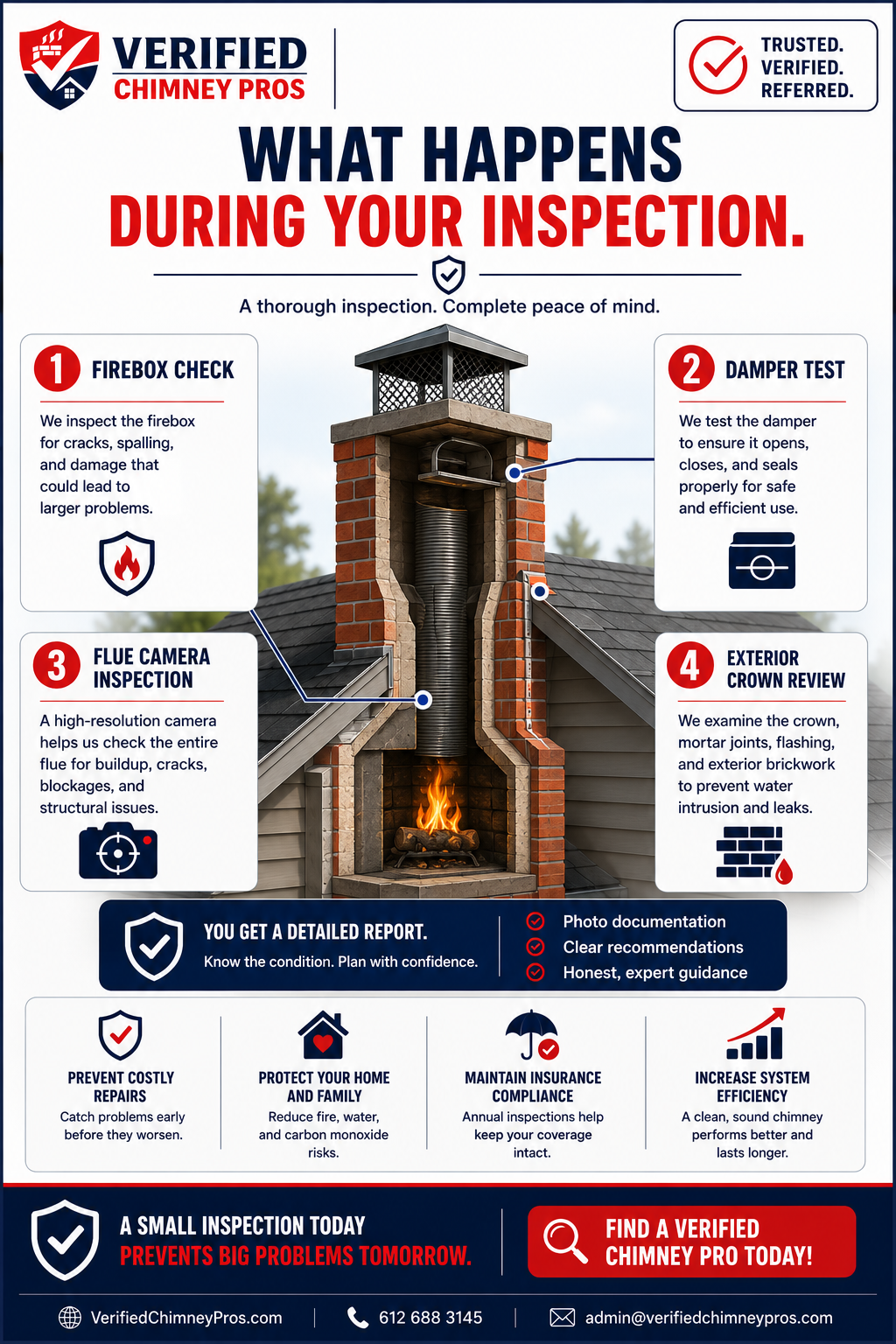
The exterior inspection is the first physical component of the chimney inspection process — and it tells an experienced professional an enormous amount before they ever look inside. A qualified inspector evaluates the chimney’s exterior masonry or siding for cracks, spalling, mortar deterioration, efflorescence (white mineral staining from water intrusion), and any signs of structural shifting or lean. They check flashing conditions, inspect the chimney cap and crown visually, and document any exterior damage with notes and, ideally, photographs.
Water is the chimney’s most persistent and destructive enemy. Damaged flashing allows water to penetrate the roofline junction. A cracked crown allows freeze-thaw water damage to propagate through the masonry year after year. A missing or damaged cap allows water, debris, and animals directly into the flue. A thorough exterior assessment catches all of these issues before they’re visible as interior damage — which is exactly why it comes first in every legitimate inspection protocol.
🏠 Step 3: The Firebox and Damper Inspection — The Heart of Your Indoor Fire Safety System
The firebox is the combustion chamber where your fires actually burn — and it requires careful visual examination during every chimney inspection process. A qualified professional inspects the firebox walls and floor for cracks, spalling firebrick, deteriorated refractory mortar, and any signs of unusual heat stress or chemical damage. They check the smoke chamber and smoke shelf above the damper for creosote accumulation, structural integrity, and proper construction geometry.
The damper — the movable plate that controls airflow between your firebox and flue — gets tested for full operational range, proper seating, and absence of physical damage or corrosion. A damper that doesn’t seal correctly when closed allows conditioned air to escape your home year-round, increasing heating and cooling costs significantly. A damper that doesn’t open fully restricts draft and creates dangerous smoke backdraft conditions. Both failure modes matter and both get checked here.
🏠 Step 4: The Flue and Liner Evaluation — The Most Critical Safety Check in the Entire Process
The flue liner is the most safety-critical component of your entire chimney system — and evaluating it is the most technically demanding step in the chimney inspection process. The liner channels combustion gases up and out of your home while protecting the surrounding masonry from heat and chemical corrosion. When the liner is cracked, missing segments, or improperly fitted, combustion gases — including deadly carbon monoxide — can migrate through those gaps directly into your living spaces.
In a Level 1 inspection, the professional examines accessible flue areas using a high-powered flashlight and mirror. In a Level 2 inspection, a specialized interior camera is deployed to capture video of the entire liner from bottom to top, documenting every crack, joint gap, or deteriorated section with visual evidence. A legitimate professional always shows you the camera footage and explains what they found in plain language — with the video documentation available to you as part of the written report.
Be immediately skeptical of any contractor who claims liner damage without camera documentation during a Level 2 inspection, or who quotes liner replacement without showing you specific documented evidence of the failure. CSIA-certified professionals are trained to distinguish cosmetic liner aging from genuine structural failure — a distinction that can mean the difference between a $200 cleaning and a $5,000 liner relining job.
🏠 Step 5: The Chimney Crown and Cap Assessment — Your First Line of Defense Against Water Damage
The chimney crown is the concrete or mortar slab that seals the top of your chimney structure around the flue opening. The chimney cap is the metal cover that sits directly over the flue. Together, they form the primary weather barrier protecting your entire chimney system from water, debris, birds, and small animals. Both components get carefully assessed during every complete chimney inspection process.
A qualified professional inspects the crown for hairline cracks, significant fractures, improper slope (water should shed away from the flue, never toward it), and evidence of previous patching that may be failing. The cap gets checked for physical damage, rust, missing or bent spark arrestor mesh, and proper fit over the flue opening. Both components are inexpensive to maintain proactively and extremely costly to ignore until failure becomes structural water damage throughout the chimney system.
🏠 Step 6: The Creosote and Debris Evaluation — The Step That Directly Prevents Chimney Fires
Creosote is the combustible byproduct of wood burning that accumulates on the interior walls of your flue with every fire you build. At Stage 1, it presents as a light, brushable flaky deposit. At Stage 2, it hardens into a tar-like coating. At Stage 3 — the most dangerous and most difficult to remove — it becomes a dense, glazed layer with an extremely high ignition temperature and an extraordinary potential for a sustained chimney fire. The CSIA identifies Stage 3 creosote as one of the most serious chimney hazards a homeowner can face.
During the chimney inspection process, a qualified professional evaluates creosote accumulation at multiple points in the flue — documenting the stage level and thickness, noting any areas of concentrated buildup, and recommending the appropriate cleaning method based on what they find. A Level 1 inspection that finds Stage 1 or early Stage 2 creosote typically leads to a standard chimney sweep recommendation. Stage 3 creosote requires specialized chemical treatment and may require multiple service visits to address safely. Any recommendation beyond a standard sweep should come with specific, documented justification.
🏠 Step 7: The Written Findings Report — The Non-Negotiable Deliverable Every Homeowner Deserves
The final and arguably most important step of any legitimate chimney inspection process is the delivery of a clear, written findings report. This document should identify every area inspected, describe every finding in plain language, include photographic or video documentation of any conditions of concern, assign a severity level to each finding, and provide specific, itemized recommendations for any required action.
A qualified professional walks you through this report in person — explaining each finding, answering your questions directly, and giving you time to review the documentation before any repair discussion begins. They never pressure you to authorize repairs on the spot. They give you the written report to keep, review, and use to obtain comparison quotes if needed. That final conversation — transparent, unhurried, and fully documented — is the clearest possible signal that you hired the right person.
If a contractor completes your inspection and delivers verbal findings only — with no written report, no photographs, and immediate repair pressure — that is not a professional chimney inspection. That is a setup. A verified chimney professional always provides written documentation. Always. This is one of the non-negotiable standards that every contractor listed on Verified Chimney Pros is held to as a condition of their listing.
How Verified Chimney Pros Guarantees Your Inspector Actually Follows Every Step of the Process
Knowing what the chimney inspection process should look like is powerful — but it only protects you if the professional you hire actually follows through. That is where Verified Chimney Pros changes everything. Every chimney professional listed on the platform has been reviewed for active state licensing, current general liability insurance, industry certifications — including CSIA and NFI credentials — and a verified track record of professional conduct before being approved.
When you find a chimney inspector through Verified Chimney Pros, you are not searching blindly through an open directory where anyone can claim credentials they don’t hold. You are accessing a curated network of contractors who have been evaluated against meaningful professional standards and who remain accountable to the platform on an ongoing basis. The verification badge is not decorative. It is a documented signal that the professional behind the listing has been reviewed and approved.
This matters especially in the inspection context — because the inspection is the moment of maximum vulnerability for homeowners. It is the moment when a dishonest contractor presents fabricated findings and launches a pressure campaign. Verified Chimney Pros removes the most dangerous variable in that equation — the unvetted, unaccountable contractor — and replaces it with a professional whose credentials, insurance, and reputation have already been confirmed.
Powerful Reasons to Find Your Next Chimney Inspector Through Verified Chimney Pros
Here is exactly what changes when you start your chimney inspection search at Verified Chimney Pros:
✅ Every Listed Inspector Has Been Verified — Not Just Self-Reported
Licensing, insurance, and credentials have been reviewed by the platform before the professional appears in your search results. You never have to take a contractor’s word for it.
✅ Transparent Profiles Give You Full Context Before You Call
See credentials, service area coverage, completed inspection photos, and real homeowner reviews — all in one place, before the first conversation begins.
✅ No Surprise Pressure After the Inspection
Verified Chimney Pros professionals are held to accountability standards that include honest reporting and transparent communication. You get findings, not a sales pitch.
✅ Written Documentation Is a Platform Standard — Not an Optional Extra
Every verified professional understands that written inspection reports are non-negotiable. You receive documentation you can review, keep, and use to make fully informed decisions.
✅ Accountability That Extends Beyond the Initial Verification
Professionals who fail to maintain the platform’s standards risk removal from the directory. That ongoing accountability creates a powerful incentive for consistent, honest professional conduct.
Your Complete Quick-Reference Chimney Inspection Process Checklist
Use this checklist to follow along during your next inspection. A legitimate professional performing a complete chimney inspection process will complete every item without prompting.
| ✅ Inspection Step | What a Qualified Pro Does |
|---|---|
| Pre-Inspection Interview | Asks about usage history, prior repairs, and appliance changes |
| Exterior Assessment | Evaluates masonry, flashing, crown, and cap from outside |
| Firebox Inspection | Checks firebox walls, smoke chamber, and smoke shelf |
| Damper Check | Tests full range of movement and proper sealing |
| Flue and Liner Evaluation | Visual inspection (Level 1) or camera scan (Level 2) |
| Crown and Cap Assessment | Inspects for cracks, improper slope, and physical damage |
| Creosote Evaluation | Documents stage level, thickness, and cleaning recommendation |
| Written Findings Report | Delivers full written documentation with photos before repair discussion |
FAQ
1: How long does a standard chimney inspection process take?
A Level 1 inspection typically takes between 45 minutes and one hour for a standard single-flue chimney. A Level 2 inspection with interior video scanning takes between one and two hours depending on the chimney’s configuration and the scope of findings. Any inspection completed in under 30 minutes for a full-size residential chimney should be viewed with serious skepticism — a thorough professional process simply cannot be rushed that dramatically.
2: What is the difference between a chimney inspection and a chimney sweep?
A chimney inspection evaluates the structural, functional, and safety condition of your chimney system and produces a written findings report. A chimney sweep cleans the flue, firebox, and related components by removing creosote, ash, and debris. Many certified professionals perform both services during the same visit, but they are distinct services — and each should be clearly itemized on your written estimate before work begins.
3: How often should a homeowner schedule a chimney inspection?
The National Fire Protection Association NFPA 211 recommends annual chimney inspections for all chimneys, fireplaces, and venting systems — regardless of how frequently you use your fireplace. Annual inspections catch developing problems before they become safety emergencies or expensive structural repairs. Schedule before each fireplace season — ideally late summer or early fall.
4: Do I need a chimney inspection if I rarely use my fireplace?
Yes. Infrequently used chimneys can develop blockages from animal nests, debris accumulation, and moisture damage that occur completely independently of fireplace use. A chimney that appears unused can still harbor conditions — including carbon monoxide leak pathways and structural deterioration — that pose genuine safety risks. Annual inspections apply to all chimneys, regardless of usage frequency.
5: What does a written chimney inspection report include?
A complete, professionally prepared chimney inspection report includes a description of every area inspected, a documented finding for each component, photographic or video evidence of any conditions of concern, a severity assessment for each finding, and specific itemized recommendations for any required action. The report should be delivered to you in writing before any repair discussion takes place — and you should always receive a copy to keep for your records.
6: How do I know if a contractor is fabricating chimney inspection findings?
Key warning signs of fabricated findings include: damage claims with no photographic or video documentation, immediate high-pressure repair recommendations following a low-cost or free inspection, inability to explain findings in plain language when asked, refusal to provide a written report, and quotes for extensive repairs significantly higher than regional averages. Reference Angi and HomeAdvisor for regional repair cost benchmarks. When in doubt, always get a second opinion from a verified professional.
7: What certifications should a chimney inspector hold?
Look for active CSIA (Chimney Safety Institute of America) certification — specifically the Certified Chimney Sweep (CCS) designation — or NFI (National Fireplace Institute) credentials. These certifications require passing rigorous professional examinations and maintaining ongoing continuing education. NCSG (National Chimney Sweep Guild) membership is an additional strong positive indicator of professional commitment. Verify these credentials directly on each organization’s website before scheduling any inspection.
8: What is the most dangerous thing a chimney inspection can find?
Stage 3 creosote — a dense, glazed, highly combustible flue liner coating — and cracked or deteriorated liner segments are the two most dangerous findings a chimney inspection can identify. Both create conditions for catastrophic chimney fires or carbon monoxide intrusion into living spaces. Both require immediate professional attention from a qualified, verified contractor before the fireplace or heating appliance is used again. The CSIA provides detailed consumer resources on creosote hazard classification and appropriate responses.
9: Does the chimney inspection process differ for gas fireplaces versus wood-burning fireplaces?
The fundamental inspection framework defined by NFPA 211 applies to both gas and wood-burning systems, but the specific focus areas differ significantly. Gas fireplace inspections emphasize liner integrity, proper gas venting connections, and carbon monoxide pathways. Wood-burning fireplace inspections give greater attention to creosote accumulation and heat stress damage. Both require annual professional inspection for the same fundamental safety reasons.
10: How much does a professional chimney inspection typically cost?
A Level 1 inspection typically costs between $100 and $250 depending on your region and the specific contractor. A Level 2 inspection with interior video scanning typically ranges from $200 to $500. Always request a written estimate before scheduling and verify the specific inspection level included in the service. Use HomeAdvisor and Angi for regional pricing benchmarks. Be cautious of free inspections — they are frequently used as entry points for high-pressure, manufactured repair campaigns.
11: Can I perform my own chimney inspection?
Basic homeowner visual checks — observing the firebox for obvious cracks, testing damper operation, looking for visible blockages at the flue opening — are useful between professional visits. However, a professional chimney inspection process requires specialized tools, technical training, and knowledge to accurately assess liner condition, creosote stage, draft performance, and structural integrity. DIY inspection cannot substitute for annual professional assessment and should never be used to make repair decisions.
12: What should I do if I disagree with my chimney inspector’s findings?
Request the written documentation and photographs supporting every finding before authorizing any repairs. Ask the inspector to explain each finding in specific technical detail. Then get a second independent opinion from a separate CSIA-certified professional before proceeding with any work. A legitimate inspector will welcome your due diligence. If a contractor resists documentation requests or discourages second opinions, that resistance itself is a significant red flag.
13: When is a Level 2 chimney inspection required?
A Level 2 inspection is required any time you change your heating appliance or install a new insert, experience any chimney fire regardless of size, are buying or selling a home, or when any external event — earthquake, severe storm, nearby structure fire — may have affected your chimney’s structural integrity. Many home sale contracts require a current Level 2 inspection report as a condition of closing. Always confirm which level you need before scheduling.
14: What is the best time of year to schedule a chimney inspection?
Late summer — August through September — is the optimal window for scheduling your annual chimney inspection. Demand for chimney services spikes sharply in October and November as homeowners prepare for fireplace season, which means longer scheduling waits and less flexibility in choosing your preferred professional. Scheduling in August or September also gives you adequate time to complete any needed repairs before cold weather arrives and your fireplace becomes a daily necessity.
15: How do I find a verified chimney inspector I can actually trust?
The fastest and most reliable first step is to search for a verified inspector directly at Verified Chimney Pros. Every professional in the directory has been reviewed for active licensing, current insurance, and professional credentials before being listed. You can compare profiles, verify credentials, and contact your selected professional with complete confidence — knowing that the most critical vetting has already been done. Start there, and you’ll never have to take an unknown contractor’s word for anything.
You Now Know Exactly What to Expect — Hire the Right Person to Deliver It
The chimney inspection process is not mysterious — but it is technical, sequential, and completely dependent on the qualifications and integrity of the professional performing it. Now you know every step that should happen, what honest findings look like, what fabricated pressure sounds like, and exactly what documentation you deserve before any repair conversation begins. That knowledge is your most powerful protection as a homeowner.
Verified Chimney Pros was built specifically for this moment — when a homeowner who now knows what to expect needs to find a professional who will actually deliver it. Every contractor in the verified directory has been reviewed for the credentials, insurance, and professional standards that make a legitimate chimney inspection process possible. You don’t have to guess. You don’t have to hope. You just have to search.
Your chimney protects your family every time it vents combustion gases safely away from your home. It deserves a professional inspection performed by someone who has earned the right to be trusted. Find that professional today — and hire with the complete confidence you deserve.