Chimney Water Damage: 8 Critical Warning Signs Every Homeowner Must Catch Before It Costs a Fortune
Chimney water damage is one of the most expensive, most preventable, and most frequently misdiagnosed problems in American homeownership. It doesn’t arrive with a dramatic flood or a sudden structural collapse. It moves quietly — seeping through a hairline crack in the crown, wicking through deteriorated mortar joints, pooling behind a failed section of flashing — while you go about your daily life completely unaware that your chimney is slowly being destroyed from the inside out.
The Chimney Safety Institute of America (CSIA) identifies water as the single greatest enemy of masonry chimneys — more destructive over time than fire, more costly to remediate than creosote, and far more common than most homeowners realize. Water attacks every component of your chimney system: the mortar, the brick, the flue liner, the damper, the firebox, the flashing, and the surrounding structural framing of your home. Left unaddressed, chimney water damage escalates from a minor maintenance issue into a major structural crisis that costs thousands — sometimes tens of thousands — of dollars to correct.
The good news is that chimney water damage announces itself through specific, identifiable warning signs — if you know what to look for. This guide walks you through the eight most critical indicators that your chimney has a water problem, explains the structural mechanisms behind each warning sign, and shows you exactly how to connect with a verified professional through Verified Chimney Pros to assess and address the damage before it reaches catastrophic levels.
Why Chimney Water Damage Is the Silent Destroyer Most Homeowners Never See Coming
Most homeowners associate chimney problems with visible fire hazards — creosote buildup, cracked liners, or obstructed flues. Chimney water damage operates on an entirely different timeline and through entirely different mechanisms. It bypasses your smoke detectors and your visual inspections. It hides inside your walls, beneath your ceiling drywall, and within the masonry structure itself — doing months or years of progressive structural damage before producing a single symptom visible to the untrained eye.
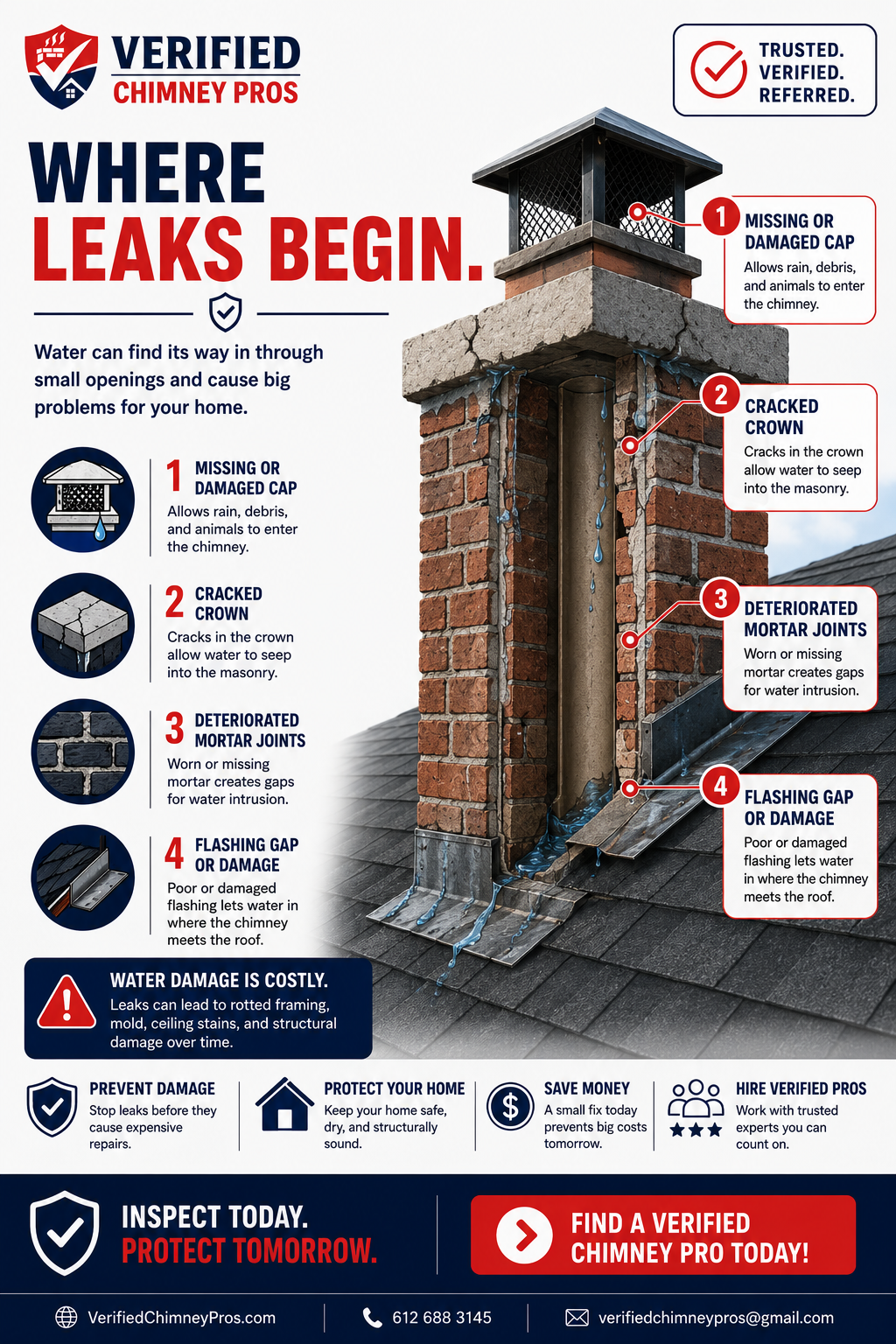
The invisibility of chimney water damage is directly tied to its primary entry points. Water doesn’t typically pour through your firebox opening in an obvious stream. It infiltrates through microscopic cracks in the chimney crown — the concrete slab at the top of the chimney. It seeps through deteriorated mortar joints between aging bricks. It exploits gaps in your chimney flashing where the chimney meets the roofline. Each of these entry points allows small amounts of water to penetrate with every rain event — and small amounts accumulate into devastating structural damage over months and seasons.
The freeze-thaw cycle amplifies every water intrusion event exponentially. When water penetrates your masonry and temperatures drop below freezing, that water expands by approximately 9% as it turns to ice. That expansion forces cracks wider, pops brick faces off their masonry base (a process called “spalling”), and destroys mortar joints that took decades to develop. By spring, what was a hairline crack after summer has become a structural gap — and the chimney water damage that was invisible in September is suddenly a visible deterioration that contractors will price in thousands rather than hundreds.
The Shocking Financial Cost of Letting Chimney Water Damage Go Undetected
The financial argument for early chimney water damage detection is overwhelming. A chimney inspection that identifies water intrusion early — before significant masonry deterioration has occurred — typically results in repairs costing $200 to $500. A chimney crown repair runs $200 to $400. Flashing replacement costs $400 to $900. Tuckpointing deteriorated mortar joints runs $500 to $1,500 depending on scope. These are manageable maintenance expenses that protect your home’s structural integrity and your family’s safety.
Allow chimney water damage to progress undetected for two or three seasons, and the cost structure changes dramatically. Significant masonry deterioration requiring partial chimney rebuilding costs $1,500 to $4,000. Flue liner replacement — which water damage can accelerate significantly — runs $2,500 to $7,000. Water damage that has penetrated into surrounding framing, ceiling materials, and wall cavities can cost $5,000 to $20,000 or more to remediate, depending on the extent of structural and mold-related damage. According to HomeAdvisor’s chimney repair cost data, chimney repairs involving significant water damage consistently rank among the most expensive home repair categories homeowners face.
The insurance dimension adds another layer of financial risk. Many homeowner’s insurance policies exclude gradual water damage — specifically the kind caused by long-term chimney water damage that was knowable and preventable through annual inspection. If your insurer can demonstrate that the damage developed over time rather than occurring suddenly, your claim may be denied entirely. An annual inspection by a verified professional creates a documented maintenance record that protects your insurance position in addition to protecting your home’s structural integrity.
5 Hidden Entry Points Where Water Silently Invades Your Chimney System
Understanding how water enters your chimney helps you monitor the right locations for early evidence of chimney water damage. These five entry points are responsible for the vast majority of chimney moisture problems across all chimney types and climates.
| Entry Point | What Fails | Why Water Gets In |
|---|---|---|
| Chimney Crown | Concrete cracks and deteriorates | Hairline cracks widen through freeze-thaw cycles |
| Chimney Flashing | Metal separates from chimney or roof | Thermal expansion creates gaps at the seal |
| Mortar Joints | Mortar between bricks erodes | Age, weather, and acid rain dissolve mortar |
| Chimney Cap | Cap missing, damaged, or incorrectly sized | Unprotected flue opening admits rain directly |
| Porous Brickwork | Brick surface absorbs moisture | Aging unsealed bricks act as sponges |
Each of these entry points requires a different diagnostic approach and a different remediation technique. A chimney water damage assessment by a certified professional evaluates all five simultaneously — because water intrusion frequently involves multiple compromised entry points contributing to a cumulative moisture problem that no single repair can fully address. This is why professional inspection is essential, and why homeowners who attempt DIY repairs targeting only one visible entry point often find themselves facing the same moisture symptoms the following season.
8 Critical Warning Signs of Chimney Water Damage You Must Never Ignore
These eight warning signs are the most reliable indicators that chimney water damage is actively occurring in your home. Each one represents a specific mechanism of water intrusion or water-related structural deterioration. Never dismiss any of them as cosmetic — they are all structural red flags that require professional evaluation immediately.
Brownish, yellowish, or gray staining on ceiling drywall or wall surfaces adjacent to your chimney is one of the most visible indicators of chimney water damage. These stains appear when water that has penetrated through flashing failures, deteriorated mortar, or a cracked crown saturates the structural framing surrounding the chimney and wicks into the adjacent drywall and plaster.
The critical insight here is that ceiling and wall stains from chimney water damage almost always appear at a distance from the actual entry point. Water migrates through framing, insulation, and structural cavities before finding an exit point at the interior surface — which means a stain six inches from the chimney may indicate a flashing failure on the opposite side of the roofline. Never assume the stain location indicates the damage location. A professional assessment is essential.
🚨 Immediate Action Required If You See This:
- Stop using the fireplace
- Document the stain with photos — note its size and location
- Schedule a professional inspection before the next rain event
Warning Sign 2: A Persistent Musty or Damp Smell Coming From the Fireplace
A musty, damp, or moldy smell emanating from your fireplace — particularly during humid summer weather or after rain events — is a highly reliable indicator of chimney water damage. This odor results from moisture accumulating within the flue, mixing with creosote deposits, and creating a chemical reaction that produces a distinctive acrid, campfire-adjacent smell that penetrates from the firebox into your living space.
The odor mechanism is especially pronounced in summer when air conditioning creates negative pressure within your home, actively drawing air down the chimney and carrying moisture-laden odors with it. A fireplace that smells like damp ash or an old campfire in July — when you haven’t used it in months — is almost certainly experiencing chimney water damage that deserves immediate professional attention.
Warning Sign 3: Visible Efflorescence — White Staining on the Exterior Brick
White, chalky, or powdery staining on the exterior surface of your chimney’s brickwork is called efflorescence — and it is one of the most diagnostically clear indicators of active chimney water damage. Efflorescence occurs when water moves through the masonry, dissolves water-soluble salts within the brick and mortar, and deposits those salts on the exterior surface as the water evaporates.
Efflorescence itself is not structurally dangerous — but what it represents is. The presence of white staining confirms that water is actively moving through your masonry. The more extensive and recurring the efflorescence, the more significant the moisture infiltration. Chimney water damage indicated by efflorescence requires a professional assessment of mortar joint integrity, brick porosity, and crown condition to identify and seal the entry points driving the moisture movement.
Warning Sign 4: Rust on the Damper, Firebox Walls, or Fireplace Components
Rust on your fireplace damper, on the metal components within your firebox, or on any metal accessory inside your chimney system is a direct indicator of moisture intrusion. Metal components corrode when exposed to repeated moisture — and the specific pattern of rust can help identify the entry point. Rust concentrated at the throat of the firebox and damper area typically indicates water entering from above through a compromised crown or missing cap.
Rust is also a structural concern beyond its cosmetic appearance. A rusted damper may not seal properly — allowing heat to escape your home in winter and drawing conditioned air out in summer. A severely rusted damper can fail entirely, creating draft problems and allowing rain to enter the firebox directly. Chimney water damage visible as rust requires immediate professional evaluation and typically indicates a moisture intrusion that has been active for at least one full seasonal cycle.
[Paragraph] Healthy mortar joints between chimney bricks should be firm, flush with the brick surface, and free of visible cracking. Mortar that is crumbling, recessing, cracking, or missing entirely indicates advanced chimney water damage and freeze-thaw deterioration. This condition — called “spalling” in severe cases — dramatically accelerates with every wet and cold season that passes without remediation.
Deteriorated mortar joints create a cascading failure sequence. As mortar erodes, water penetrates more deeply with each rain event, accelerating further mortar deterioration and beginning to compromise the structural stability of the brick coursing itself. A chimney with significant mortar joint deterioration is not just a moisture concern — it is a structural concern. In advanced cases, sections of chimney can become unstable, creating a falling masonry hazard. Tuckpointing by a verified professional stops this cascade and restores the chimney’s waterproof integrity.
Warning Sign 6: Stained, Spalled, or Flaking Bricks on the Chimney Exterior
Brick faces that are flaking, popping off, or visibly pitted indicate that chimney water damage has penetrated the masonry surface itself. This spalling occurs when moisture inside the brick expands during freezing temperatures, forcing the outer face of the brick to separate from its base. Each freeze-thaw cycle that occurs without remediation removes another layer of brick face — progressively weakening the structural integrity of the entire chimney.
Spalled bricks cannot simply be sealed and left in place. The compromised brick must be evaluated by a professional to determine whether repointing the surrounding mortar is sufficient or whether individual bricks require replacement. Applying waterproof sealant over spalled bricks without addressing the underlying moisture source simply traps the moisture inside — accelerating the very damage the sealant was intended to prevent. Always consult a verified chimney professional before applying any waterproofing product to deteriorated masonry.
Warning Sign 7: Water Pooling in the Firebox After Rain Events
Standing water in your firebox after a rain event is the most unmistakable indicator of active chimney water damage — and requires the most urgent professional response. Water pooling in the firebox means either the chimney cap is missing or damaged, the chimney crown has developed significant cracks, or the flue liner has failed in a way that allows water to bypass the normal drainage path and collect at the bottom of the firebox.
Repeated water pooling in the firebox accelerates damage to the firebox floor, the firebox walls, and the smoke chamber above it. It also creates conditions favorable for mold growth within the firebox — which can spread into adjacent wall cavities. If you discover standing water in your firebox, do not use the fireplace under any circumstances. Contact a verified chimney professional for an emergency assessment immediately.
Warning Sign 8: Visible Gaps, Cracks, or Separation in the Chimney Flashing
Chimney flashing — the metal seal where your chimney meets the roofline — is the most common entry point for chimney water damage in most residential chimneys. Flashing that has separated from the chimney, developed gaps at the sealant line, or shows visible rust and corrosion allows water to flow directly into the joint between the chimney and the roof deck with every rain event. This water then moves into the framing, insulation, and ceiling materials below — producing the water stains and structural damage described in Warning Sign 1.
[Paragraph] Chimney flashing failures are frequently mistaken for roof leaks — and homeowners who hire a roofer to address what appears to be a roofing problem may discover that the actual failure is in the chimney flashing rather than the shingles. A verified chimney professional can evaluate both the flashing and the surrounding roofline to identify the true source of chimney water damage and recommend the correct remediation approach. Never allow flashing repairs to be performed without confirming the professional’s credentials — improper flashing installation is one of the leading causes of recurring chimney leak problems.
How Verified Chimney Pros Diagnoses, Addresses, and Prevents Chimney Water Damage
When you find a chimney professional through Verified Chimney Pros, you connect with a contractor who has been reviewed for active licensing, current insurance, recognized industry certifications — including CSIA and NFI credentials — and professional reputation. For chimney water damage assessment specifically, these credentials matter enormously. Diagnosing the full scope of a moisture problem requires a professional who understands how water moves through masonry systems — not just someone who can climb a ladder and apply caulk.
A verified chimney professional performing a chimney water damage assessment evaluates every potential entry point simultaneously — crown condition, flashing integrity, mortar joint soundness, cap presence and fit, brick porosity, and flue liner condition. They use water testing, moisture meters, and in some cases video inspection equipment to trace moisture pathways and identify the full scope of intrusion. This comprehensive approach ensures that every contributing entry point is identified and addressed — not just the most obvious one.
Beyond diagnosis and repair, verified chimney professionals can apply professional-grade chimney waterproofing sealants — penetrating products specifically formulated for masonry that allow moisture vapor to escape while preventing liquid water from entering. These products are fundamentally different from generic hardware store waterproofing compounds and require proper surface preparation and application technique to perform correctly. When applied by a verified professional following a thorough chimney water damage assessment, they provide years of moisture protection that significantly extends the interval between required maintenance events.
6 Powerful Benefits of Catching Chimney Water Damage Before It Escalates
💰 Benefit 1: Early Detection Saves Thousands in Repair Costs
Addressing chimney water damage at the crown crack or flashing gap stage costs hundreds. Addressing it after structural masonry failure, liner deterioration, and framing damage costs thousands to tens of thousands. Early detection is the highest-ROI action a homeowner can take.
🏠 Benefit 2: Structural Integrity Protection for Your Entire Home
Chimney water damage that reaches surrounding framing compromises the structural integrity of your roof system and upper-floor ceiling structure. Early detection prevents moisture intrusion from escalating into a structural engineering problem.
🫁 Benefit 3: Prevention of Toxic Mold Growth in Wall and Ceiling Cavities
Persistent moisture from chimney water damage creates the ideal conditions for mold colonization inside your walls and ceiling cavities. Early detection and repair eliminates the moisture source before mold becomes a health hazard requiring expensive remediation.
📋 Benefit 4: A Professional Maintenance Record That Protects Your Insurance Position
Annual inspections that document the absence of chimney water damage create a maintenance record that demonstrates responsible homeownership — protecting your insurance claim position if a sudden weather event causes damage in the future.
🔥 Benefit 5: Uninterrupted Safe Fireplace Use Throughout the Season
A chimney with unaddressed water damage is unsafe to use. Early detection and repair allows you to use your fireplace safely and confidently throughout the entire heating season without concern for compromised structural components.
✅ Benefit 6: Complete Peace of Mind From a Verified Professional Assessment
Knowing that your chimney has been thoroughly evaluated for chimney water damage by a licensed, insured, and credentialed professional — not just a contractor who showed up in an unmarked van — is a form of home safety assurance that no DIY inspection can provide.
FAQ
1: What causes chimney water damage in the first place?
Chimney water damage is caused by water infiltrating the chimney system through any of five primary entry points: a cracked or deteriorated chimney crown, failed flashing at the roofline junction, eroded mortar joints between bricks, a missing or damaged chimney cap, or porous brick surfaces that have lost their weather resistance over time. Most chimney water damage involves multiple compromised entry points contributing simultaneously to a cumulative moisture problem.
2: How do I know if my chimney is leaking?
The most common indicators of a leaking chimney include water stains on ceilings or walls adjacent to the chimney, a musty or damp smell from the fireplace, efflorescence (white staining) on exterior brickwork, rust on the damper or firebox components, deteriorating mortar joints, spalling bricks, water pooling in the firebox after rain, and visible gaps in the chimney flashing. If you observe any of these signs, schedule a professional inspection for chimney water damage immediately.
3: Can I waterproof my chimney myself?
Consumer-grade waterproofing products can provide limited surface protection on sound, clean masonry. However, DIY waterproofing applied over compromised masonry — cracked crowns, eroded mortar joints, or porous spalled bricks — traps existing moisture within the structure and often accelerates the chimney water damage it was intended to prevent. Professional waterproofing requires proper surface preparation, the correct product for your specific masonry type, and application technique that ensures even penetration. Always consult a verified chimney professional before applying any waterproofing product.
4: Is chimney water damage covered by homeowner’s insurance?
Coverage depends heavily on the nature of the damage and the specific policy language. Chimney water damage caused by a sudden, unexpected event — such as a severe storm that destroys the crown — is more likely to be covered than gradual moisture intrusion that developed over multiple seasons. Many policies specifically exclude “gradual damage” — deterioration that occurred over time and could have been prevented through routine maintenance. An annual chimney inspection creates a documented maintenance record that strengthens your insurance position.
5: How much does chimney water damage repair typically cost?
Repair costs for chimney water damage vary widely based on the scope and severity of the damage. Early-stage repairs — crown coating, flashing resealing, or targeted tuckpointing — typically run $200 to $1,000. Mid-stage repairs involving significant mortar joint restoration or partial flashing replacement run $500 to $2,500. Advanced chimney water damage requiring liner replacement, masonry rebuilding, or structural framing remediation can cost $3,000 to $15,000 or more. Early detection is by far the most cost-effective approach.
6: What is chimney flashing and why does it leak?
Chimney flashing is the metal — typically aluminum, lead, or copper — that seals the junction between your chimney and the roof surface. It consists of base flashing embedded against the chimney and counter-flashing that overlaps it and is sealed into the mortar joints. Chimney water damage from flashing failures occurs when the sealant at these junctions dries out and cracks (typically every 5 to 10 years), when thermal expansion creates gaps between the metal and the masonry, or when the metal itself corrodes. A verified chimney professional can evaluate flashing condition and recommend resealing or full replacement as appropriate.
7: Can a chimney cap prevent water damage?
A properly sized and correctly installed chimney cap prevents chimney water damage from the most direct entry point — the open flue. It deflects rain, sleet, and snow away from the flue opening, significantly reducing the amount of water that enters the chimney system from above. However, a cap alone does not protect against moisture intrusion through flashing failures, crown cracks, or deteriorated mortar joints. A complete moisture protection strategy requires a cap plus a sound crown, intact flashing, sealed mortar joints, and professional waterproofing. Learn more in our guide to chimney cap benefits.
8: How does the freeze-thaw cycle worsen chimney water damage?
When water infiltrates masonry through any of the five entry points and temperatures drop below freezing, that water expands by approximately 9% as it turns to ice. This expansion forces existing cracks wider, pops brick faces off their bases (spalling), and destroys mortar joints through repeated mechanical stress. Each freeze-thaw cycle that occurs while chimney water damage goes unaddressed causes additional structural deterioration — which is why a minor crack identified in fall becomes a significant masonry failure by spring. Annual pre-season inspections catch and seal entry points before winter freeze-thaw cycles can amplify them.
9: What is efflorescence and is it dangerous?
Efflorescence is the white, chalky, or powdery residue that appears on exterior chimney brickwork when water moves through the masonry and deposits dissolved salts on the surface as it evaporates. The efflorescence itself is not structurally dangerous — but the water movement it indicates is. Active chimney water damage evidenced by efflorescence requires a professional assessment to identify entry points, evaluate mortar joint integrity, and develop a remediation plan. Efflorescence that reappears after cleaning confirms ongoing water infiltration that has not been adequately addressed.
10: Should I use my fireplace if I suspect chimney water damage?
No. If you observe any of the eight warning signs described in this guide, stop using your fireplace immediately and schedule a professional inspection before the next use. Chimney water damage can compromise the flue liner — the critical barrier between combustion gases and your home’s structure. A compromised liner may allow heat, sparks, and carbon monoxide to penetrate surrounding framing and living spaces. Never resume fireplace use after observing water damage signs without a professional clearance.
11: How often should I have my chimney inspected for water damage?
The National Fire Protection Association (NFPA) Standard 211 recommends annual inspections for all chimney systems — and this recommendation specifically includes evaluation for chimney water damage indicators. Annual inspections ideally occur in late summer or early fall — before the heating season begins and before winter freeze-thaw cycles can amplify any existing moisture intrusion. Homes in regions with significant rainfall, heavy snowfall, or dramatic temperature swings benefit most from consistent annual inspection schedules.
12: Can chimney water damage cause carbon monoxide problems?
Yes — indirectly. Chimney water damage that deteriorates the flue liner creates gaps and cracks through which combustion gases — including carbon monoxide — can escape into surrounding structural cavities and living spaces rather than venting safely outside. Carbon monoxide is colorless and odorless and cannot be detected without a properly functioning CO detector. If you have observed chimney water damage signs and use a fuel-burning appliance, install carbon monoxide detectors on every level of your home immediately and schedule a professional inspection before using the fireplace again.
13: What is the difference between a chimney crown and a chimney cap?
The chimney crown is the concrete or mortar slab that seals the top of the chimney masonry around the flue tile — it is structural and built into the chimney itself. The chimney cap is the metal cover that fits over the flue tile opening to prevent rain and animals from entering directly. Both protect against chimney water damage through different mechanisms, and both require periodic inspection and maintenance. A cracked crown and a missing cap can each independently create significant moisture intrusion — but together, an intact crown and a properly fitted cap represent the chimney’s primary moisture defense.
14: What should I look for on the interior of my chimney for water damage signs?
From inside your firebox, look for: rust staining on metal components including the damper, throat, and any fireplace inserts; white efflorescence on the firebox walls; deteriorating or crumbling firebrick and refractory mortar; dark staining or moisture sheen on the smoke chamber above the throat; and any visible standing water or water marks on the firebox floor. These interior indicators of chimney water damage are assessable by homeowners but should always be followed by a professional evaluation to determine the entry point and full extent of the damage.
15: How do I find a qualified professional to assess chimney water damage?
The fastest, safest, and most reliable way to find a qualified professional for chimney water damage assessment is through Verified Chimney Pros. Every professional in the directory has been reviewed for active state licensing, current general liability insurance, recognized industry certifications, and professional reputation. You receive the assurance that the professional you hire has the credentials to perform an accurate assessment — not just a visual inspection by someone who arrived in an unmarked van. Contact the VCP team at 📞 612-688-3145 or 📧 admin@verifiedchimneypros.com with any questions.
Act Now — Because Chimney Water Damage Gets Exponentially More Expensive Every Season You Wait
Chimney water damage is not a problem that stays stable. It does not remain a hairline crack, a minor rust stain, or a small patch of efflorescence indefinitely. Water is patient and relentless. It exploits every crack, every gap, and every deteriorated mortar joint — and it works with every freeze-thaw cycle to make those vulnerabilities wider, deeper, and more structurally consequential. What costs $300 to fix today costs $3,000 to fix next year and $15,000 to fix the year after that.
[Paragraph] The eight warning signs in this guide are your early alert system. Water stains. Musty odors. Efflorescence. Rust. Crumbling mortar. Spalling bricks. Pooling water in the firebox. Gaps in the flashing. Each one is a message from your chimney — a message that says: there is water getting in, and the clock is running. The homeowners who act on these signals immediately protect their homes and their finances. The ones who file them away as “something to look at later” face the escalating repair bills that come with deferred chimney water damage remediation.
[Paragraph] Don’t wait for the damage to become undeniable. Find a verified chimney professional through Verified Chimney Pros today, schedule your assessment, and get the documented professional confirmation that your chimney system is sound — or the actionable diagnosis you need to stop the damage before it costs you a fortune. Built in America. Fighting for American Trades. Call 📞 612-688-3145 or email 📧 admin@verifiedchimneypros.com — the team is ready to connect you with the right professional right now.